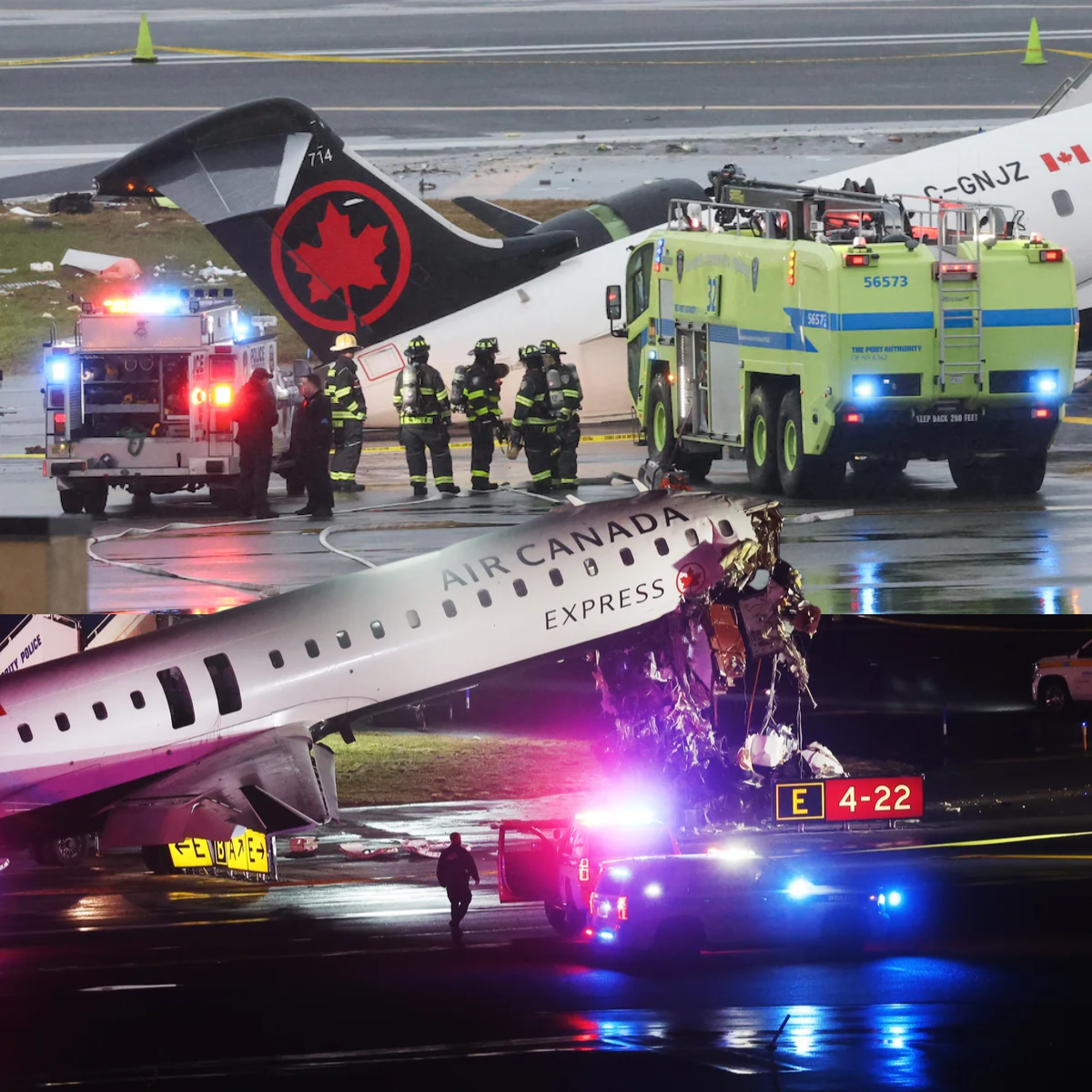
“SCENES OF SHEER PANIC”: Haunting survivor accounts emerge after an Air Canada jet slammed into a fire truck on the LaGuardia runway — leaving both young pilots dead and dozens injured in a catastrophic midnight crash. The initial cause of the collision has now been confirmed as… Read more
In a split-second nightmare that has left the aviation world reeling and passengers counting their blessings, an Air Canada Express regional jet slammed into a Port Authority fire truck on the runway at New York’s notoriously busy LaGuardia Airport late Sunday night, killing both pilots and sparking scenes of pure pandemonium among the 72 terrified passengers and crew.
The dramatic collision – captured on chilling CCTV and air traffic control audio now playing on loop across social media – unfolded around 11:40 p.m. on March 22, 2026, as Flight 8646 (operated by Jazz Aviation) from Montreal touched down on Runway 4 after a routine one-hour hop. What should have been a smooth arrival in the Big Apple turned into a scene of twisted metal, screaming passengers and heroic escapes down the wing as the plane’s nose was brutally sheared off in the high-speed impact.
Passenger Jack Cabot, speaking to reporters in the raw aftermath, summed up the horror in three chilling words that have since gone viral: ‘It was chaos.’
“We went down for a regular landing,” the shaken traveller recalled. “We immediately hit something and it was just chaos from there… Everybody was hunkered down and everybody was screaming. Everybody was flying everywhere. I mean, the plane started veering off left and right. And there was… it was just chaos.”
His words paint a terrifying picture of the moments after impact: seats jolting violently, overhead bins bursting open, bodies flung forward as the jet careered uncontrollably before grinding to a halt in a mangled heap. The cockpit – where 30-year-old Captain Antoine Forest from Coteau-du-Lac, Quebec, and First Officer MacKenzie Gunther were seated – took the full force of the collision, leaving both pilots dead at the scene. They were young, dedicated aviators at the start of promising careers; Forest had been passionate about flying since his teens and learned English to broaden his opportunities in the skies.
Dozens more were hurt. Port Authority officials confirmed around 41 passengers and crew were rushed to hospital with injuries ranging from cuts and bruises to more serious fractures and head trauma. By Monday, many had been released, but at least nine remained under observation. Two firefighters in the truck – identified as Sgt. Michael Orsillo and Officer Adrian Baez – suffered non-life-threatening injuries.
Another survivor, Rebecca Liquori, described the build-up and the sickening moment of impact with eerie clarity. The flight had already felt turbulent on descent, with a noticeably rough landing that left everyone gripping their armrests.
“As you heard the brake, a couple seconds later it was just a very loud boom… Everybody jolted out of their seats,” she told News12 Long Island. “I’m just happy to be alive. I would have never pictured a one-hour flight that I’ve done countless times… ending like this.”
Passengers helped one another in the darkness and confusion, sliding down the emergency slides or clambering out onto the wing to escape the wreckage. One flight attendant, Solange Tremblay, was thrown violently from her jump seat and ended up falling through a hole in the cabin floor – yet miraculously survived strapped into her seat with multiple leg fractures that will require surgery. She later called it a “total miracle.”
From a neighbouring plane waiting on the tarmac, 23-year-old Leo Medina watched the horror unfold just 100 metres away. “It was like the plane got cut in half,” he said, describing the jet’s crumpled nose tilted grotesquely upward, cockpit destroyed, debris scattered across the runway alongside the overturned fire truck. His own flight was forced to return to the gate, leaving him and hundreds of others stranded for more than 12 hours, sleeping on the airport floor wrapped in jackets.
The fire truck had been racing across the active runway after being cleared by air traffic control to respond to a separate emergency – a United Airlines flight that had aborted takeoff due to an reported “issue with odour” on board. In the frantic seconds before disaster, tower recordings captured the controller desperately shouting: “Stop, stop, stop, Truck 1. Stop, stop, stop. Stop, Truck 1!”
The surface surveillance alarm blared in the background as the lead vehicle entered the path of the oncoming jet, which was travelling at an estimated 93-105 mph on landing. The impact was catastrophic. The CRJ-900’s reinforced nose crumpled like tin foil, severing the cockpit area and flipping the heavy fire truck onto its side.
In a heartbreaking post-incident exchange caught on audio, the controller could later be heard admitting: “We were dealing with an emergency earlier… I messed up.” A colleague tried to console him: “Nah, man, you did the best you could.”
LaGuardia – New York’s third-busiest airport and a notoriously cramped and delay-prone hub – was shut down for hours. Runway 4 remained closed into Monday as investigators picked through “a tremendous amount of debris.” Hundreds of flights were cancelled or diverted, adding to existing chaos caused by spring break travel and other airport issues. The airport partially reopened in the afternoon with long delays, but full operations were still disrupted.
The National Transportation Safety Board (NTSB) launched a full investigation within hours, recovering both the cockpit voice recorder and flight data recorder – undamaged despite the mangled wreckage. Teams from the US and Canada are poring over the evidence, examining everything from air traffic control communications and ground coordination to the pilots’ final actions. NTSB Chair Jennifer Homendy said more details would emerge on Tuesday, but preliminary analysis points to a classic runway incursion – a deadly mix of miscommunication and timing under pressure.
Transportation Secretary Sean Duffy noted that LaGuardia was operating with fewer than the target number of certified controllers (33 instead of 37), though more than one was on duty at the time. Former officials have pointed out that ground collisions, while less common than airborne disasters, remain a persistent risk at busy US airports.
This tragedy marks the first fatal incident at LaGuardia in 34 years, a sobering reminder of how quickly routine operations can turn deadly.
For the passengers, many of whom were Canadians heading to New York for business, family visits or connecting flights, the ordeal has left deep psychological scars. One survivor described the sound of the impact as “like the plane got cut in half.” Others spoke of the acrid smell of jet fuel, the darkness inside the cabin as emergency lights flickered, and the desperate scramble to help the injured while waiting for rescue teams to arrive.
Clément Lelièvre, another passenger, credited the pilots’ quick reflexes and hard braking for potentially saving many more lives. “The pilot did the best thing he could,” he said, highlighting how the crew’s final actions may have mitigated what could have been an even greater catastrophe.
Air Canada and Jazz Aviation issued statements expressing profound sorrow for the loss of the two pilots, offering support to their families and to all those affected. Canadian Prime Minister Mark Carney called the news “deeply saddening,” while US President Trump described the situation as “terrible.”
Tributes have poured in for Captain Antoine Forest and First Officer MacKenzie Gunther. Friends and family remembered Forest as a dedicated aviator who lived for the skies. Colleagues described both men as skilled, professional and well-liked within the tight-knit regional airline community. Their deaths have hit the Canadian aviation sector particularly hard.
As investigators continue their work, questions are already being raised about runway safety protocols at LaGuardia, controller staffing levels amid broader FAA challenges, and whether the response to the earlier United Airlines odour incident contributed to task overload in the tower.
For now, the survivors are simply grateful to be alive. Rebecca Liquori summed up the prevailing emotion: “I’m just happy to be alive.”
Yet behind the relief lies trauma. Many passengers have spoken of sleepless nights replaying the “boom,” the jolts, the screams. Airport counsellors and airline support teams have been on hand, but for some, the memories of that chaotic midnight landing will linger for years.
The mangled wreckage – with the jet’s nose crushed and tilted skyward, cables dangling like broken veins, and the fire truck lying on its side amid scattered debris – stands as a stark visual warning. Photos and videos from the scene have shocked the public, showing just how close dozens more came to joining the pilots in tragedy.
Aviation safety experts note that while commercial flying remains statistically one of the safest ways to travel, runway incursions remain a “hot button” issue for the industry. The LaGuardia incident will likely lead to renewed calls for improved ground radar systems, better controller training, and stricter protocols for emergency vehicles crossing active runways.
In the meantime, LaGuardia is slowly returning to normal – but for the families of Antoine Forest and MacKenzie Gunther, and for the dozens of injured passengers still recovering in New York hospitals, life has been forever changed by those few seconds of chaos on Runway 4.
One passenger, reflecting on the narrow escape, put it simply: “You never know if it could have been one of us.”
As the NTSB digs deeper and black box data is analysed, the full story of how a routine landing turned fatal will emerge. But for those who lived through it, the raw human truth is already clear: in the blink of an eye, on a rain-slicked New York runway, “it was chaos” – and only by the slimmest of margins did many more not perish alongside the two brave pilots who never made it home.