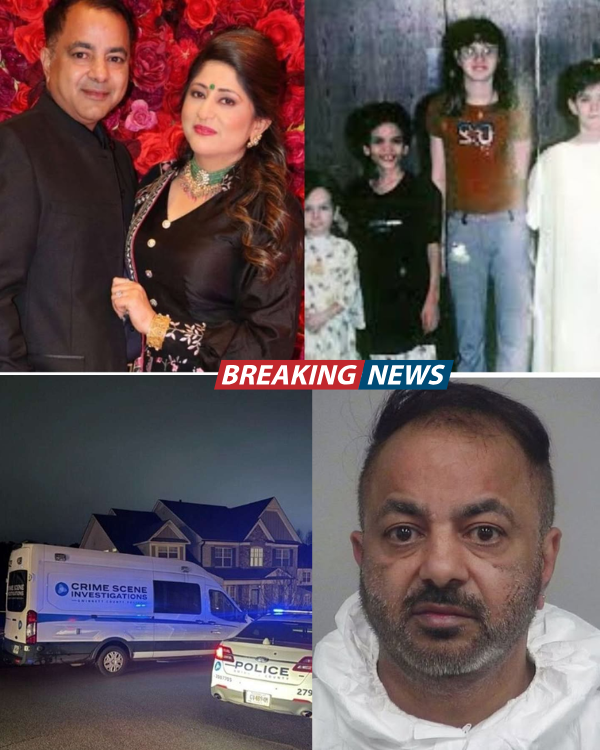
4 Family Members Dead in Midnight Massacre—3 Kids Survive in a Closet! 📉
4 Family Members Found Dead with Bullet Wounds – Kids 7, 10, 12 Hid Terrified in Closet for Hours!
A quiet suburban home in Lawrenceville, Georgia, has become the center of a devastating domestic homicide case—one that is now forcing authorities, community leaders, and the justice system to confront the brutal reality of violence that erupts behind closed doors.

In the early hours of January 23, Gwinnett County police were jolted into action by a 911 call placed just after 2:30 a.m. The call came from inside the residence. When officers arrived, they secured the scene and quickly discovered something far more horrific than anyone anticipated.
Four adults were dead inside the home.
The victims were identified as Meenu Dogra, 43; Gourav Cumar, 33; Nidhi Chander, 37; and Harish Chander, 38—members of the same extended family. Inside the house, officers also located children who were physically unharmed, immediately placing them into protective care under child welfare protocols. Though they survived, authorities say the children were exposed to extreme danger.
Shortly afterward, police located Vijay Kumar, 51, Dogra’s husband, a short distance from the residence. He was taken into custody without incident. Investigators have confirmed there are no other suspects at this time.
A CASE MOVING THROUGH THE JUSTICE SYSTEM
Kumar now faces a sweeping list of charges under Georgia law, including multiple counts of malice murder, felony murder, and cruelty to children. Prosecutors allege that while the minors were not physically injured, they were placed in life-threatening circumstances—a factor that carries serious legal consequences.
Police have described the incident as domestic-related, but have deliberately withheld details regarding motive, the nature of the dispute that preceded the killings, and the precise sequence of events. Officials stress that such information will be addressed in court, where evidence and testimony—not speculation—will determine responsibility.
Captain Angela Carter of the Gwinnett Police Department called the case “deeply distressing,” particularly because of the presence of children. She emphasized that incidents like this require immediate coordination between law enforcement, child services, and victim support organizations.

A COMMUNITY IN SHOCK—AND IN MOURNING
The impact of the killings has extended far beyond the neighborhood. The Indian Mission in Atlanta released a statement expressing grief and confirmed that consular assistance is being provided to the victims’ families. Community members have come forward to honor the lives lost, describing the victims as hardworking, family-oriented, and deeply connected to those around them.
One victim, Nidhi Chander, was identified by the Gun Violence Memorial as an elementary school teacher in Gwinnett County—an educator whose death has shaken students, parents, and colleagues alike. Meenu Dogra, a mother of two originally from Pathankot, India, has also been remembered through social media tributes and fundraising efforts.
GoFundMe campaigns have been launched to help with funeral costs and family support, reflecting a familiar but heartbreaking pattern: communities rallying together while the legal process stretches on for months—sometimes years.
THE UNSEEN DANGER OF DOMESTIC VIOLENCE
Experts in domestic violence prevention warn that cases like this often show few outward warning signs before escalating. Conflicts that remain inside private homes may never come to the attention of authorities until a breaking point is reached—leaving little opportunity for intervention.
From a legal standpoint, the charges filed underscore how the justice system addresses not only the loss of life, but also the psychological harm to children who witness or are endangered by violence. Research consistently shows that exposure to such events can leave lasting trauma, even when no physical injuries occur.
A BROADER NATIONAL CONTEXT
While this case will be decided strictly on its own evidence, it unfolds against a sobering national backdrop. According to Everytown for Gun Safety, firearms are involved in more than two-thirds of intimate partner homicides in the U.S. Data from the Pew Research Center shows that in 2023 alone, more than 47,000 Americans died from gun-related injuries, with firearms involved in the majority of homicides.
These figures don’t determine guilt—but they help explain why cases like this reverberate so deeply and spark urgent questions about prevention.
THE QUESTION THAT REMAINS
As the Lawrenceville case moves into pretrial review and the courts begin their work, one truth is already clear: four lives are gone, children have been forever changed, and a community is left searching for answers.
The unresolved question now looms larger than any single courtroom:
How can legal systems, social services, and communities identify domestic risk sooner—before private conflicts turn into irreversible tragedies?
For now, justice will proceed step by step.
But the consequences of that January night will last far longer.