The Signal That Changed Everything
Elon Musk’s Starlink Switches On Free Internet for Venezuela After Maduro’s Capture, Marking a Dramatic Turning Point for a Nation Cut Off From the World
In a move that has sent shockwaves through both the political and technological worlds, Elon Musk’s satellite internet company Starlink has announced it will provide free high-speed broadband access to the people of Venezuela, following the dramatic capture of longtime strongman Nicolás Maduro.
The announcement, made late Sunday via Starlink’s official social media account, framed the decision as an emergency measure to ensure “continued connectivity” during a moment of profound national upheaval. For a country long plagued by censorship, blackouts, and digital isolation, the timing could not be more consequential.
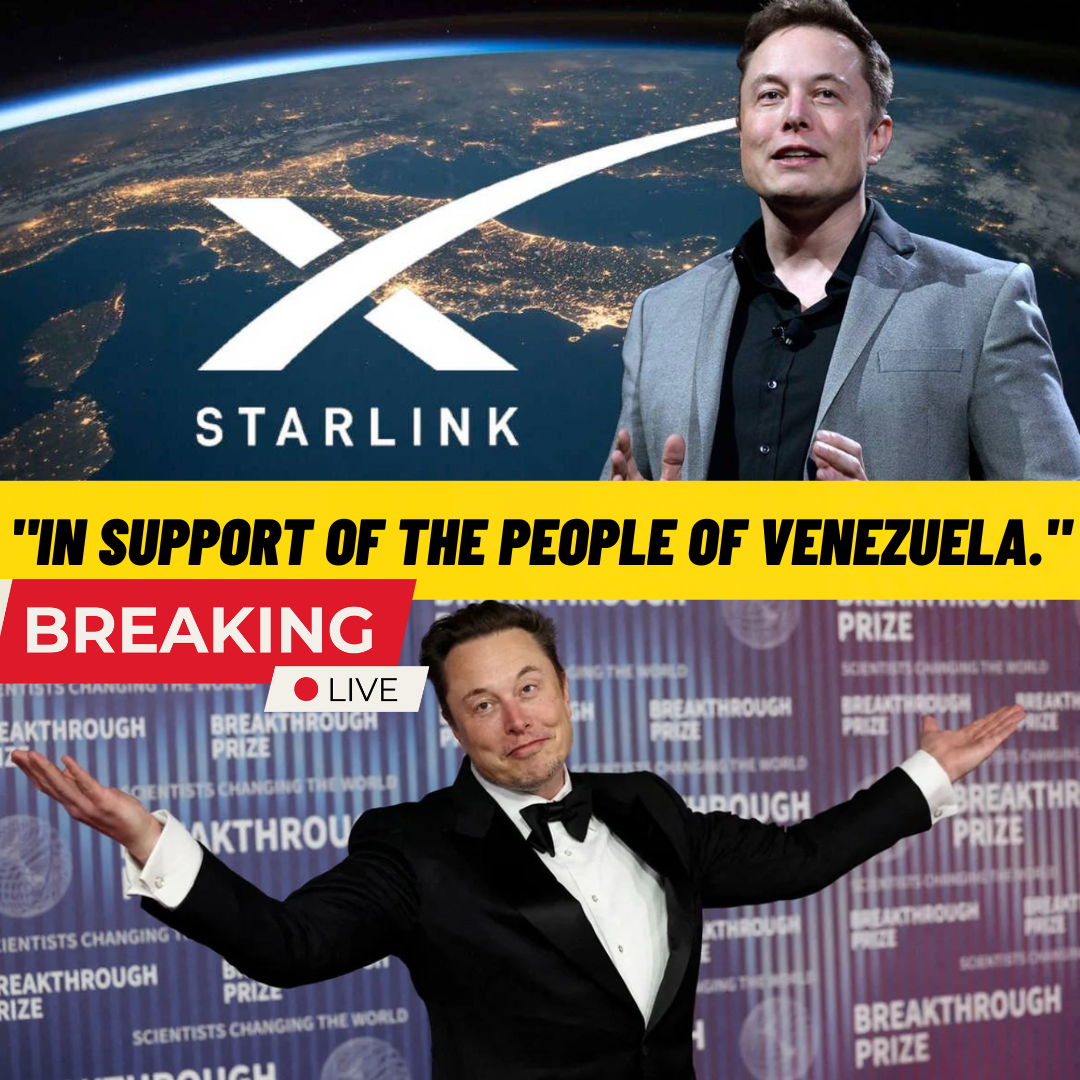
“In support of the people of Venezuela,” Musk wrote simply, reposting the statement alongside the Venezuelan flag—six words that instantly reverberated across global media, financial markets, and diplomatic circles.
A Nation Long Cut Off From the Digital World
For years, Venezuela’s internet infrastructure has been among the most fragile in the Western Hemisphere. Chronic power failures, state-controlled telecommunications, and deliberate service throttling during protests left millions effectively disconnected from the outside world.
Human rights organizations have repeatedly documented how internet shutdowns were used as a political weapon—particularly during periods of unrest, elections, or opposition mobilization. Social media platforms were often restricted, independent news sites blocked, and messaging services intermittently disrupted.
Against this backdrop, Starlink’s announcement represents far more than a temporary tech gesture. For many Venezuelans, it could mean unfiltered access to news, communication with family abroad, digital payments, education, and organizing tools—all without passing through state-controlled networks.
The Announcement That Lit Up Social Media
Starlink confirmed that free broadband service would be extended nationwide through early February, allowing users with compatible equipment to connect without subscription fees. While the company did not initially specify how access would be distributed or expanded, the message was unmistakable: connectivity would not be a privilege reserved for elites or institutions.
Within minutes of the announcement, social media platforms were flooded with reactions. Supporters hailed the move as a humanitarian lifeline. Critics questioned the geopolitical implications. Analysts debated whether private tech companies were now stepping into roles traditionally occupied by governments.
What was undeniable, however, was the scale of attention. Few corporate announcements in recent years have blended technology, revolution, and global power so dramatically.
Elon Musk’s Growing Political Shadow
Elon Musk has never been shy about wading into global affairs. From Ukraine to Iran, from free speech debates to satellite diplomacy, the billionaire has increasingly positioned himself as a consequential actor on the world stage—sometimes to applause, sometimes to outrage.
In the days leading up to Maduro’s capture, Musk had already signaled his support for efforts aimed at dismantling Venezuela’s authoritarian grip. Writing online, he predicted that “long overdue prosperity” was finally within reach for the country’s people.
Those words now read less like commentary and more like a declaration of intent.
By activating Starlink access at this precise moment, Musk has effectively inserted himself—and his company—into Venezuela’s transitional chapter. For supporters, it is a bold stand for freedom. For skeptics, it raises unsettling questions about the power of unelected tech leaders to shape national outcomes.
How Starlink Works—and Why It Matters Here
Unlike traditional internet infrastructure, Starlink relies on a vast constellation of low-Earth orbit satellites that beam internet signals directly to ground terminals. This allows connectivity even in regions where fiber networks are damaged, censored, or nonexistent.
Currently serving more than six million active users worldwide, Starlink has been deployed in war zones, disaster areas, and remote regions where governments cannot—or will not—provide reliable service.
In Venezuela’s case, that technological independence is crucial. Because Starlink does not rely on state-run telecoms, it can bypass bottlenecks that have historically been used to control information flow.
For journalists, activists, businesses, and ordinary citizens, this could mark the first time in years that digital access feels genuinely free.
A Turning Point After Years of Crisis
Maduro’s capture represents a seismic moment in Venezuela’s modern history. After years of economic collapse, hyperinflation, mass migration, and political repression, the country now faces an uncertain but potentially transformative transition.
Internet access during such moments is not merely a convenience—it is a stabilizing force. Communication enables coordination of aid, transparency in governance, and real-time accountability.
Analysts note that in previous transitions across the globe, information vacuums often allowed chaos, misinformation, or power grabs to flourish. By contrast, widespread connectivity can help anchor societies during volatile change.
Starlink’s move, intentional or not, may significantly shape how Venezuela navigates the days ahead.
Praise, Skepticism, and Global Reaction
International reaction has been swift and polarized.
Human rights groups welcomed the announcement, calling it a rare example of private-sector action aligning with civilian needs. Tech advocates praised the demonstration of how decentralized infrastructure can empower populations under pressure.
Yet critics warned of precedent. Some questioned whether corporate-controlled connectivity could be withdrawn just as quickly as it was granted. Others expressed concern over data sovereignty and the absence of democratic oversight.
Governments across Latin America have remained cautious in their public responses, aware that today’s humanitarian gesture could redefine tomorrow’s diplomatic norms.
What Happens Next?
Key questions remain unanswered. How widely available will Starlink terminals be inside Venezuela? Will access expand beyond existing users? What happens when the free-service window ends?
Starlink has not yet detailed its long-term plans, though sources familiar with the company suggest discussions are ongoing about extending coverage depending on conditions on the ground.
For now, the message is symbolic as much as practical: the world is watching, and Venezuela is no longer digitally isolated.
A New Role for Technology in Global Change
Whether viewed as humanitarian aid, strategic intervention, or technological opportunism, Starlink’s move underscores a broader reality of the 21st century: power is no longer held solely by states.
Connectivity itself has become a lever of influence—and those who control it can alter the trajectory of nations.
As Venezuela stands at a crossroads, millions of citizens are logging on with a freedom long denied to them. For the first time in years, the flow of information is not dictated by a regime, but by satellites orbiting silently overhead.
And behind those satellites stands Elon Musk—once again at the center of a story where technology, politics, and history collide.