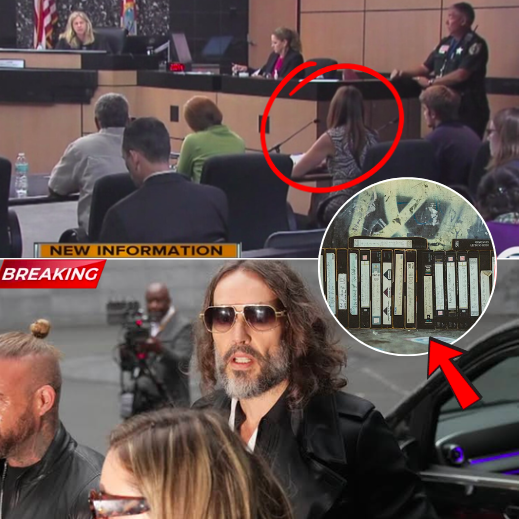
🚨 SHOCKING UPDATE: DECLASSIFIED AUDIO & SECRET TAPES EXPOSED IN RUSSELL BRAND TRIAL — COURTROOM LEFT IN SILENCE OVER APOLLO THEATRE VICTIM!
LONDON — Inside Court 1 of the Old Bailey, the atmosphere did not merely turn tense; it solidified into an suffocating, electric stillness.
As a veteran court reporter who has sat through decades of high-profile criminal trials, gruesome evidence, and celebrity downfalls, I have rarely witnessed a courtroom lose its collective breath in such a singular, synchronized moment.
Today was meant to be a procedural session in the ongoing legal saga surrounding comedian and actor Russell Brand. Instead, it escalated into a harrowing reckoning with the past—a session defined by declassified law enforcement audio recordings, handwritten tape labels with deeply disturbing epithets, and a single 38-second video clip that brought the room to a standstill.
Below is the firsthand account of how the day unfolded inside Court 1, from the chilling playing of the 2025 police interview to the moment a familiar face flashed across the courtroom’s monitor.
Part I: The Voice from the Shadows — “Ms. X” Takes the Stand via Audio
The afternoon session commenced with the prosecution requesting permission to play a newly declassified law enforcement recording. Taken during an extensive police interrogation in early 2025, the audio contained the formal statement of a witness officially identified in court documents only as “Ms. X.”
Now in her late twenties, Ms. X was just 22 years old when she was hired as a junior wardrobe and hair assistant on Brand’s touring team. For over three years, her role placed her inside his innermost orbit—traveling on private transport, managing backstage dressing rooms, and standing just feet away from the stage wings during his stand-up runs.
As the sound technician initiated playback, Ms. X’s voice echoed through the courtroom speakers. Soft, slightly trembling, but unwavering in detail, her testimony reconstructed the frantic, predatory environment behind the curtain at the Apollo Theatre during one of Brand’s most celebrated comedy runs.
“You learned very quickly what your real job was,” Ms. X stated on the recording. “It wasn’t just ironing suits or fixing hair before he went on stage. It was managing the door. It was making sure certain people stayed in the room and other people were kept out. There was an open secret about his preferences—his fixations on extraordinarily young, vulnerable women, almost girls, who were brought backstage under the guise of ‘mentorship’ or ‘private post-show debriefs.'”
Ms. X detailed a systematic operation wherein staff members were allegedly instructed to scour the front rows and stage-door crowds for specific demographics. According to her statement, backstage passes were treated as currency, distributed selectively to individuals who matched a particular profile.
For forty-five minutes, the courtroom listened in complete silence as Ms. X recounted instances of intimidation, coercive control, and the strange, ritualistic behavior that occurred behind locked dressing room doors. Brand sat at the defense table, his hands clasped beneath his chin, staring straight ahead at the timber paneling of the dock, his expression unreadable.
Part II: The Evidence Box — Labels That Chilled the Jury
If Ms. X’s audio recording established the atmospheric narrative of the Apollo Theatre backstage culture, the physical evidence introduced immediately after provided a stark, tangible reality.
Prosecuting counsel unsealed a heavy, gray evidence crate marked with Metropolitan Police evidence tags. From inside, the prosecutor produced a series of physical media storage formats—older digital tapes, custom-cased mini-DV cassettes, and labeled hard drives retrieved during executed search warrants.
As the items were logged into the official record, the prosecution read aloud the custom, handwritten label tags affixed to each tape. The words resonated through the room with heavy, disturbing weight:
-
“Apollo VIP Specimen”
-
“Little Angels 2009”
-
“Private Auditions – DO NOT ERASE”
The defense lodged an immediate objection regarding the admissibility and contextual relevance of the labeled media, arguing that the handwritten titles were speculative or lacked verified authorship. However, after a brief bench conference, the presiding judge overruled the objection, allowing select digitized excerpts to be admitted into evidence for jury review.
Members of the jury—seven women and five men—leaned forward, notebooks poised, as the prosecution prepared the video display system. Overhead monitors throughout the courtroom, including the public gallery feed, were brought online.
Part III: The 38-Second Mark — A Courtroom Frozen
The prosecution selected the exhibit cataloged under the title “Apollo Backstage Special.”
The digital transfer began with grainy, low-light footage timestamped from late late-2000s era backstage cameras. The video initially depicted standard green-room banter: blurred figures moving through dimly lit hallways, ambient laughter, and the muted roar of the Apollo Theatre audience echoing in the background.
At the 20-second mark, the camera swung into a private side-office adjacent to the main dressing area. The audio was muffled, picking up hushed exchanges and the distinct sound of a door bolt sliding shut.
Then came the turning point.
As the digital timecode on the courtroom monitors ticked to 00:00:38, the camera angle shifted sharply, panning toward a couch situated in the corner of the room. The lighting cleared as an overhead lamp was adjusted.
The face captured in the frame was crisp, unmistakable, and instantly recognizable to virtually everyone in the courtroom.
An audible gasp rippled through the gallery. Several journalists sitting in the press bench froze mid-keystroke. A member of the jury involuntarily raised a hand to her mouth.
The individual captured on the tape—whose identity had never previously been publicly linked to the investigation or listed among the alleged victims—was a former high-profile media personality who had risen to prominence during that exact era. On screen, she appeared visibly distressed, young, and entirely isolated within the chaotic backstage environment. The 38-second mark captured a direct, unguarded moment of vulnerability that starkly contradicted years of public press statements and industry narratives surrounding the Apollo events.
Part IV: Legal Implications and Next Steps
The court immediately went into a brief recess following the video playback to allow counsel to address procedural motions outside the presence of the jury.
Legal analysts observing the proceedings note that today’s revelations mark a pivotal juncture in the trial:
-
Corroboration of Pattern: The introduction of physical media matching the exact timeline and location described by “Ms. X” lends significant evidentiary weight to claims of systematic misconduct at the venue.
-
Unsealed Identities: The unexpected emergence of prominent figures on the evidentiary tapes could prompt further witness disclosures or additional legal filings as the defense prepares its cross-examination.
-
Defense Strategy: Defense counsel is expected to aggressively challenge the chain of custody regarding the digital media and question the context in which the recordings were made and preserved over the past decade and a half.
As proceedings adjourned for the evening, crowds gathered outside the historic Old Bailey under the London drizzle. Inside, the legal teams remained locked in closed-door discussions.
The trial resumes tomorrow morning at 10:00 AM, with the defense set to begin its cross-examination regarding the newly declassified audio files and the contents of the Apollo Theatre evidence collection.
This is a developing legal story. Updates will follow as official court transcripts are released.