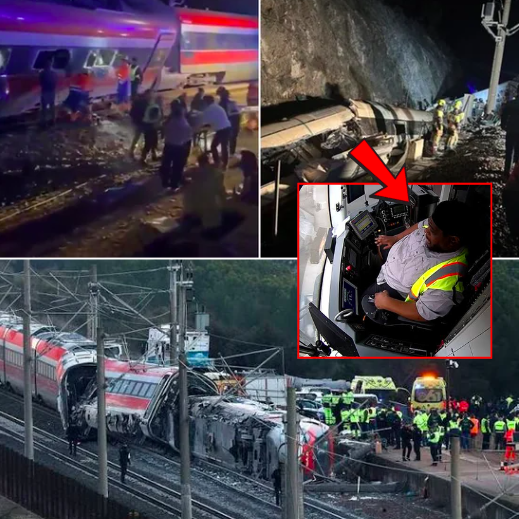
🚨 LEAKED CABIN CCTV: THE CHILLING 5-SECOND DECISION BEFORE SPAIN’S DEADLY HIGH-SPEED TRAIN CRASH!
MADRID — Inside the emergency operations center in Toledo, just south of the Spanish capital, the steady hum of forensic servers was cut short by a sudden, collective intake of breath.
Investigators, rail safety engineers, and criminal prosecutors stood gathered around a high-definition monitor displaying digitized footage newly extracted from the armored event recorder of a damaged train engine. As a veteran international correspondent who has covered major transit disasters across Europe, I have sat through technical briefings, black-box audio analysis, and sobering press conferences. Rarely, however, has a single fragment of security footage reframed an entire national tragedy so instantly and decisively.
The official casualty count following the horrific collision between two high-speed passenger services on the busy Madrid-Seville arterial line has reached at least 39 dead, with dozens more critically injured. What was initially treated as a catastrophic mechanical failure or an automated signaling glitch has now taken a haunting, complex turn.
The key to understanding the final moments of the disaster lies inside the lead driver’s cab. Below is a comprehensive report on the unsealed CCTV footage, the minute-by-minute timeline leading up to the crash, the technical breakdown of the 5-second decision that chilled investigators to the bone, and the legal and structural ramifications shaking Spain’s rail network.

Part I: Disaster on the Madrid-Seville Line
The incident unfolded shortly after 9:00 AM on a clear autumn morning along the high-speed rail corridor connecting Madrid to the southern region of Andalusia. The stretch of track passing through the rolling terrain of Toledo is engineered for extreme velocity, with trains routinely operating at speeds exceeding 250 km/h (155 mph).
Two major commercial operators were involved:
-
The Lead Train: An Iryo high-speed service bound for Madrid, carrying hundreds of morning commuters and international tourists.
-
The Trailing Train: A Renfe AVE service traveling on the same northbound track, operating under dense morning schedule intervals.
According to initial reports from Spain’s rail infrastructure manager, Adif, the trouble began when the tail end of the Iryo service experienced an unexpected mechanical anomaly, causing its rear carriage to derail partially while negotiating a subtle curve. The train ground to a sudden, jarring halt, straddling the line.
Behind it, approaching at full cruising velocity, was the Renfe AVE train.
Under normal operating conditions, European Train Control System (ETCS) safeguards are designed to automatically enforce safe braking distances, tripping emergency brakes long before a trailing driver even registers a hazard visually. Yet, on this morning, the fail-safe protocols failed to prevent the collision. The trailing train smashed directly into the rear of the derailed Iryo carriage, sending multiple cars careening down a steep embankment in a tangle of twisted metal, shattered glass, and flying ballast.
First responders rushed to the rural site, setting up field hospitals in nearby sports halls and deploying medical helicopters to airlift victims to trauma centers in Toledo and Madrid. But even as rescue crews labored to extract survivors trapped in the wreckage, forensic investigators focused their attention on a primary objective: retrieving the lead engine’s sealed cockpit camera and data recorder.

Part II: Inside the Cockpit — Minute-by-Minute Timeline
When the recovered digital storage block was brought to the forensic lab, technicians worked around the clock to restore the synchronized multi-angle video and audio feed. The recording from the driver’s cabin of the trailing train provides an unvarnished, second-by-second chronicle of the final three minutes before impact.
+-------------------------------------------------------------------------+
|                    COCKPIT CCTV TIMELINE SUMMARY                        |
+----------+--------------------------------------------------------------+
| Timecode | Observed Action & Cabin Status                               |
+----------+--------------------------------------------------------------+
| 09:04:12 | Normal operation at 245 km/h. Track ahead visually clear.    |
| 09:05:30 | First automated cab signal alert (Yellow/Caution) activates. |
| 09:06:01 | Red Master Warning flashes. Audible emergency chime sounds.  |
| 09:06:14 | Driver engages manual override lever; warning silenced.      |
| 09:06:19 | Driver reaches for personal phone / manual bypass interface. |
| 09:06:24 | VISUAL IMPACT with stationary rear carriage. Feed terminates. |
+-------------------------------------------------------------------------+
09:04:12 AM — Cruising Velocity
The camera shows a calm cabin. The veteran driver is seated at the ergonomic controls of the high-speed locomotive. Sunlight sweeps across the dashboard. Speedometers read steady at 245 km/h. Track conditions appear clear through the sweeping front windshield.
09:05:30 AM — The First Warning
The primary cab signal console illuminates with a yellow caution indicator, signaling an unexpected occupied block two kilometers ahead. The system generates a low-frequency auditory pulse. The driver looks at the central screen, shifts slightly in his seat, but does not immediately initiate manual service braking, relying on the automated speed profile system to adjust velocity smoothly.
09:06:01 AM — Critical Red Shift
Suddenly, the automated safety panel turns bright red. A high-decibel emergency alarm fills the small cabin space. The automated system initiates soft emergency braking, as designed, to bring the heavy train to an absolute halt well before the obstacle.
At this point, collision was still entirely avoidable. The automatic braking curve had sufficient distance to bring the train to a safe stop or reduce impact velocity to near zero.
Then came the sequence of events that transformed a manageable system failure into a historic disaster.
Part III: The 5-Second Decision That Stunned Investigators
What happened between 09:06:14 AM and 09:06:19 AM—exactly five seconds before impact—has become the central axis of the entire criminal investigation.
As the master warning lights flashed red and the automated system began executing an emergency stop, the driver exhibited signs of intense frustration rather than protocol compliance. Instead of bracing for an emergency stop or verifying the track hazard with central dispatch, the driver engaged in a sequence of manual interventions that left crash analysts utterly speechless.
1. Manual System Override
At 09:06:14, the driver reached across the primary control panel and manually flipped the high-level safety bypass switch—a protected toggle intended strictly for yard maneuvers or verified equipment failures under strict controller authorization. By activating this switch, the driver manually overrode the automatic ETCS emergency braking system.
The automated brakes immediately released. The heavy train, carrying immense momentum, ceased decelerating and resumed rolling forward at high speed toward the stationary train ahead.
2. The Bizarre 5-Second Action
At 09:06:19—with the stationary carriages of the derailed Iryo train now coming into direct visual line of sight around the bend—the driver did not pull the primary emergency brake handle.
Instead, CCTV footage reveals the driver holding a secondary mobile device in one hand while using his other hand to input a series of rapid manual override codes into the diagnostic terminal, apparently operating under the fatal assumption that the red alert was merely a recurring software “ghost signal” that had plagued that specific corridor during maintenance testing earlier in the week.
Rather than looking through the windshield at the track ahead, the driver’s eyes remained locked onto the diagnostic screen for those critical five seconds, attempting to clear the error code manually so the train would not lose its scheduled arrival slot in Seville.
“When you watch the footage, the silence in the analytical suite is absolute,” remarked one senior rail safety expert familiar with the evidence. “You are watching a human mind become completely consumed by procedural confirmation bias. He was so convinced the system was giving him a false positive that he fought the machine’s attempt to save his life. He manually unlocked the throttle seconds before impact.”
By the time the driver looked up from the diagnostic panel at 09:06:22, it was far too late. The massive red tail lights of the stopped train filled the windshield. The driver made a desperate, panicked lunging motion toward the mechanical brake emergency dump valve at 09:06:23, but physics offered no mercy. One second later, the video feed went black as the impact crushed the cab structure.
Part IV: Legal, Technical, and Industry Fallout
The unsealing of the cabin CCTV footage has sent shockwaves through the Spanish Ministry of Transport, rail operator executives, and international safety regulatory bodies.
Criminal Investigation and Charges
Spain’s National Police and judicial authorities in Toledo have impounded all operational logs, radio communications, and maintenance records associated with the run. The driver, who survived the initial impact with severe injuries and remains hospitalized under police custody, faces potential formal charges including:
-
Multiple counts of reckless homicide by gross negligence.
-
Failure to adhere to critical rail safety protocols.
-
Unauthorized manual override of automated safety systems.
Legal representatives for the victims’ families have issued statements demanding full transparency, questioning why a single operator possessed the physical capability to bypass automated emergency braking without dual-authorization verification from central dispatch.
Systemic Questions for European Rail Networks
The disaster has opened a fierce debate across the European rail sector regarding human-machine interface (HMI) design and safety override architecture:
-
Override Vulnerabilities: Why did the locomotive software permit a manual override of absolute stop signals without mandatory confirmation from an independent rail traffic controller?
-
Software “Ghost Signals”: Investigators are probing whether previous false-alarm incidents along the recently upgraded line created a dangerous culture of alarm fatigue among drivers, leading them to treat legitimate warning signals as technical glitches.
-
Cabin Distraction Protocols: Strict secondary device policies within driver cabs are coming under intense scrutiny, with calls for mandatory cabin camera monitoring systems across all high-speed operators in Europe.
Conclusion: A Nation Awaits Answers
As workers continue the arduous task of clearing twisted wreckage from the Toledo corridor, flags across public buildings in Madrid and Seville fly at half-mast.
The 38-second video clip from inside the driver’s cab will remain one of the most chilling pieces of evidence in modern transit history—a tragic testament to how a single, flawed human decision in a span of five seconds can override billions of euros in advanced engineering and cost dozens of innocent lives.
Formal judicial hearings are scheduled to convene next week in Toledo, where forensic experts will present full telemetry data alongside the cabin video to determine final legal accountability for one of Europe’s worst high-speed rail disasters.
This story continues to develop. Further reports will be published as official judicial transcripts and technical reports are released by Spanish transport authorities.