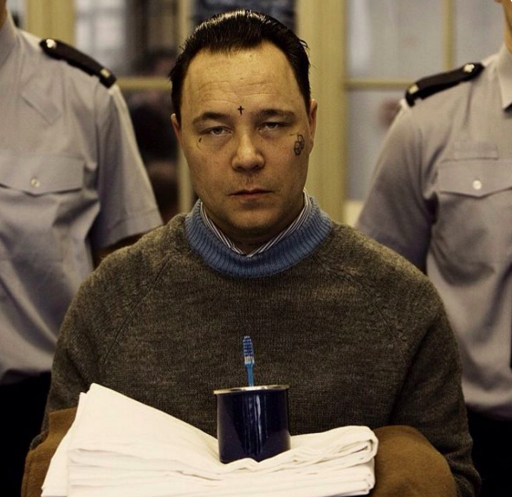
🚨 “THE LAST 20 MINUTES ARE ABSOLUTELY HEARTBREAKING!” — STEPHEN GRAHAM’S FOUR-EPISODE BRITISH CRIME DRAMA DELIVERS ONE OF THE MOST EMOTIONALLY POWERFUL FINALES ON TELEVISION!
STEPHEN GRAHAM’S MOST DEVASTATING BRITISH DRAMA? ‘THIS IS ENGLAND ’86’ EXPOSES A WORLD OF BROKEN FAMILIES, VIOLENT SECRETS AND A PAST THAT REFUSES TO STAY BURIED
THIS IS ENGLAND ’86 (2010) — British Drama | Crime | Social Realism | Psychological Trauma
Some television dramas entertain their audiences. Others disturb them, forcing viewers to confront uncomfortable truths long after the credits have finished rolling. Then there is This Is England ’86, Shane Meadows’ extraordinary four-part continuation of his acclaimed 2006 film — a raw, emotionally devastating portrait of working-class Britain in which friendship, loyalty, violence and buried trauma collide with horrifying consequences.
At the centre of its reputation stands Stephen Graham, whose portrayal of Andrew “Combo” Gascoigne in the original film remains one of the most frightening and psychologically complex performances in modern British cinema.
Yet the most surprising aspect of This Is England ’86 is that Graham’s terrifying character does not dominate the screen.
Combo’s absence becomes part of the story’s emotional landscape, while other characters step forward to reveal that the wounds left by violence cannot simply be erased when the person responsible disappears.
Instead of repeating the original film’s confrontations with racism and extremist ideology, the television sequel ventures into even darker territory: sexual abuse, domestic violence, emotional manipulation, fractured families and the desperate struggle to survive circumstances that offer little protection.
What begins as a nostalgic reunion with familiar characters gradually transforms into a deeply unsettling examination of suffering hidden behind ordinary doors.
And by the time the fourth episode reaches its devastating conclusion, Meadows has delivered something far more disturbing than a conventional crime thriller.
He has created a story about people who desperately want to escape their past — only to discover that the past has never truly released them.
1. THE RETURN TO A BRITAIN THAT HAS LOST ITS INNOCENCE

The story unfolds in 1986, three years after the events of the original This Is England.
Britain is changing. The country is living through economic uncertainty, cultural transformation and the lingering social divisions of the Thatcher years.
The music is louder, the hairstyles are changing and the young people who once found belonging in the skinhead movement are beginning to move toward adulthood.
But growing older does not necessarily mean growing wiser.
Shaun, played by Thomas Turgoose, is now a teenager attempting to navigate school, friendships, romance and his complicated relationship with the world around him.
The boy who once searched for a father figure among older outsiders is gradually discovering that adulthood brings its own frightening uncertainties.
Meanwhile, the familiar group of friends is preparing for a wedding.
Woody and Lol appear to be moving toward a future built around commitment and stability. Their relationship offers the possibility that the chaos of their younger years might finally give way to something more secure.
But the wedding preparations quickly expose tensions that neither character can comfortably ignore.
Beneath the humour, music and celebrations lies a growing sense that something is terribly wrong.
Meadows understands that the most frightening stories do not always begin with an obvious threat.
Sometimes they begin with laughter.
Sometimes with a family gathering.
And sometimes with a young woman returning to a house where she should feel safe.
2. STEPHEN GRAHAM’S SHADOW: THE CHARACTER WHO STILL HAUNTS THE STORY

Stephen Graham’s Combo was one of the original film’s defining figures.
Charismatic, volatile and deeply damaged, Combo embodied the terrifying intersection of personal insecurity, masculine aggression and political extremism.
Graham never portrayed him as a simple villain.
Instead, he exposed a man whose desperate need for belonging and authority made him both frighteningly persuasive and dangerously unstable.
His scenes with Shaun revealed how easily a vulnerable teenager could be drawn toward destructive ideas when those ideas were presented through the language of loyalty and friendship.
That history matters enormously to This Is England ’86.
Although Graham does not reprise Combo on screen in this particular series, the emotional damage associated with the earlier events remains essential background.
Shaun’s experiences have shaped the young man he is becoming.
The group’s relationships have changed.
And the audience understands that the apparent warmth of this community has always existed alongside the possibility of sudden violence.
Graham’s absence also allows Meadows to make an important creative decision.
Rather than relying on the familiar threat of Combo, the director shifts attention toward dangers that are more private, intimate and difficult to recognise.
The series suggests that brutality does not always announce itself through shouting, political slogans or public confrontation.
Sometimes it hides behind respectability.
Sometimes it belongs to someone who has been welcomed into the family.
And sometimes the people closest to a victim are the last to understand what has been happening.
3. VICKY MCCLURE DELIVERS THE PERFORMANCE THAT BREAKS THE SERIES OPEN
If Stephen Graham’s Combo dominated the original film, Vicky McClure becomes the emotional centre of This Is England ’86.
Her portrayal of Lol is astonishing in its restraint.
At first, Lol appears to be a young woman struggling with the familiar pressures of relationships, family expectations and uncertain adulthood.
She loves Woody, yet their relationship is becoming increasingly complicated.
Her friendships offer comfort, but they cannot solve the deeper problems consuming her life.
McClure gradually reveals a character whose emotional exhaustion is far greater than those around her understand.
There are moments when Lol barely needs to speak.
A glance, a hesitation or a sudden change in expression communicates a lifetime of anxiety.
This is what makes the performance so powerful.
McClure never asks the audience to admire Lol for her suffering. She presents her as a complicated human being who sometimes makes painful decisions while trying to survive circumstances that have already stripped away much of her control.
As the series progresses, Lol’s storyline becomes increasingly difficult to watch.
The revelation of trauma within her family transforms the drama from an ensemble portrait of working-class friendship into something far more intimate and horrifying.
And McClure handles that transformation with extraordinary emotional precision.
There is no glamorous suffering here.
No comforting suggestion that every wound can be healed through determination alone.
Instead, the audience witnesses fear, shame, anger and survival existing together inside one young woman.
It is a performance that gives the series its devastating emotional force.
4. THE RETURN OF COMBO: STEPHEN GRAHAM’S SHOCKING REDEMPTION
Major spoilers begin here.
Stephen Graham does, in fact, return as Combo in the closing episodes of This Is England ’86, and his reappearance is crucial to the finale.
After spending much of the series away from the central action, Combo unexpectedly returns near the end of the third episode, injured and visibly distressed.
His arrival immediately reintroduces a character associated with some of the original film’s most horrifying violence.
But this is not quite the same Combo.
When Shaun accompanies him to visit his dying mother, they discover that she has already passed away.
The scene that follows is among Graham’s most affecting moments in the entire franchise.
Gone is the intimidating figure who once controlled a room through anger and aggression.
In his place stands a grieving son confronting a loss he cannot reverse.
Graham communicates that helplessness through an astonishing mixture of physical stillness, vulnerability and emotional exhaustion.
For a character previously defined by explosive behaviour, the quietness is startling.
Then comes the finale’s extraordinary moral reversal.
Following a violent confrontation with her abusive father, Mick, Lol is left traumatised and terrified.
Combo arrives and discovers what has happened.
Rather than fleeing or responding with the same uncontrolled aggression that once defined him, he makes a deliberate decision to protect her.
He takes responsibility for Mick’s death, arranging the evidence to implicate himself.
It is an act that sends him back into custody.
The decision does not erase his earlier racist violence against Milky, nor does it absolve him of responsibility for his past.
But it reveals a dimension of Combo that the original film only occasionally allowed viewers to glimpse.
His desire to protect Lol becomes stronger than his instinct for self-preservation.
The transformation is emotionally complicated, morally uncomfortable and magnificently performed.
Some critics have questioned whether the finale offers Combo redemption too conveniently. Others have interpreted his sacrifice as the natural culmination of a character whose vulnerability was always present beneath his aggression.
britishtelevisiondrama.org.uk+1
That disagreement is precisely what makes the ending worth discussing.
Meadows refuses to give the audience an uncomplicated hero.
Instead, he asks whether a man responsible for terrible harm can nevertheless perform an act of genuine selflessness.
Graham makes that contradiction unforgettable.
5. THE MOST TERRIFYING VILLAIN IS HIDING INSIDE THE FAMILY
If Combo represents the visible danger of ideological hatred and violent masculinity, Mick represents something more intimate.
Played with chilling effectiveness by Johnny Harris, Mick is Lol’s father — a man whose return to the family home triggers fear that other relatives are unwilling to acknowledge.
He does not need to command a gang or dominate a public confrontation to become terrifying.
His power comes from his position within the family and the silence surrounding his history.
As the truth about his abuse emerges, the series reveals how family relationships can become mechanisms of intimidation.
Lol understands the danger long before others are prepared to confront it.
Her warnings are met with resistance, leaving her increasingly isolated.
The storyline becomes particularly disturbing when Mick sexually assaults Trev, a friend of the family.
Meadows presents the consequences of sexual violence without allowing the audience to treat the incident as merely another sensational plot twist.
The assault exposes the devastating cost of disbelief, denial and the protection of an abusive family member.
Harris’s performance is frightening because Mick frequently appears ordinary.
He occupies familiar domestic spaces.
He participates in everyday conversations.
He behaves as though he has a right to return to the lives of people he has already harmed.
That apparent normality becomes the source of the horror.
Unlike a conventional television villain whose intentions are announced through dramatic music or threatening speeches, Mick embodies the danger of abuse that survives because others refuse to recognise it.
The series’ most devastating message is not simply that monsters exist.
It is that they can be welcomed back into the home.
6. JOE GILGUN’S WOODY: A GOOD MAN WHO CANNOT FIND THE RIGHT WORDS
Amid the darkness, Joe Gilgun brings tremendous warmth and humanity to Woody.
Woody is affectionate, funny and deeply loyal to his friends.
He is also emotionally immature, uncertain about commitment and frequently unable to express what he actually feels.
His disastrous wedding day becomes one of the series’ most revealing moments.
What should be a celebration of love instead exposes the distance developing between him and Lol.
Woody’s hesitation is not presented as simple cruelty.
He loves Lol, but he struggles with the responsibilities that marriage represents.
Gilgun captures that contradiction beautifully.
His performance combines awkward humour with an underlying sadness that grows more pronounced as the series progresses.
Woody often appears to be the emotional centre of the friendship group, the person capable of turning an uncomfortable moment into laughter.
Yet when his own relationship begins collapsing, humour offers little protection.
The tragedy is that Woody does not fully understand what Lol is enduring.
Their emotional distance creates space for misunderstandings, betrayal and painful decisions.
And while Woody is attempting to repair his relationship, the audience knows that far more serious dangers are developing elsewhere.
That dramatic irony makes his optimism both touching and heartbreaking.
Gilgun deserves particular credit for ensuring that Woody remains recognisably human even when he behaves foolishly.
He is not a perfect partner.
He is a young man learning, often painfully, that loving someone and understanding their suffering are not necessarily the same thing.
7. THE 1986 WORLD CUP BECOMES A BACKDROP TO PERSONAL CATASTROPHE
One of Meadows’ most effective storytelling decisions is to place the drama against the 1986 FIFA World Cup.
For many British viewers, the tournament carries unforgettable associations with Diego Maradona, England’s quarter-final defeat to Argentina and the infamous Hand of God goal.
In This Is England ’86, football becomes more than historical decoration.
It creates a shared experience through which the characters express belonging, excitement and frustration.
While the nation watches events unfolding thousands of miles away, the people at the centre of the drama are confronting crises far closer to home.
The contrast is devastating.
The public excitement of a major sporting tournament exists alongside private suffering that receives no national attention.
Ordinary lives continue to unravel while the television broadcasts moments that will enter sporting history.
The period setting also provides important social context.
Channel 4’s original announcement highlighted the unemployment affecting millions of people in Britain during 1986, while Meadows described the characters as searching for work, relationships and something resembling a future.
Channel 4+1
That uncertainty is visible throughout the series.
Employment offers little security.
Relationships are unstable.
The young characters struggle to imagine what adulthood should look like.
Yet the drama never reduces them to symbols of economic hardship.
They remain funny, contradictory, affectionate and sometimes deeply frustrating individuals.
This is where Meadows’ approach becomes especially powerful.
The historical details make the world convincing, but the characters make it emotionally meaningful.
8. SHANE MEADOWS TURNS ORDINARY LIFE INTO UNBEARABLE SUSPENSE
The brilliance of This Is England ’86 lies partly in its refusal to behave like a conventional television thriller.
There is no detective following a trail of clues.
No elaborate conspiracy gradually revealing itself.
No sequence of artificial cliffhangers designed merely to keep viewers watching.
Instead, Meadows and co-writer Jack Thorne build tension through relationships.
The audience becomes familiar with the characters’ jokes, insecurities, habits and small acts of kindness.
Then the drama gradually exposes the terrible things happening beneath those ordinary interactions.
The tonal shifts can be startling.
One scene may feature playful banter among friends.
Another may reveal emotional betrayal.
A later sequence may become almost unbearable in its depiction of violence.
This mixture of comedy and suffering is fundamental to Meadows’ storytelling.
Without the lighter moments, the darkness would risk becoming monotonous.
Without the darkness, the humour would lose much of its emotional significance.
The direction also makes effective use of silence and close-up photography.
Rather than constantly explaining how characters feel, the camera often remains close enough to register small changes in their expressions.
The result is an intimacy that makes the viewer feel less like an observer and more like an uncomfortable witness.
The soundtrack reinforces that intimacy.
Music evokes the period and the characters’ shared culture, while more restrained musical passages heighten moments of grief and isolation.
At its best, the series understands that the most powerful emotional response often comes when the camera simply allows an actor to remain present.
No speech is necessary.
The pain is already visible.
9. FOUR EPISODES THAT BECOME INCREASINGLY IMPOSSIBLE TO WATCH
The structure of This Is England ’86 is deceptively simple.
The opening episode establishes the characters’ changing relationships, using a disastrous wedding and Shaun’s uncertain future to introduce both humour and conflict.
The second episode deepens the emotional complications.
Relationships become increasingly unstable, old loyalties are tested and the return of Lol’s father introduces a frightening new threat.
By the third episode, the drama has transformed.
The familiar atmosphere of friendship and youthful recklessness gives way to scenes of disturbing psychological and physical violence.
Then comes the fourth episode.
Here, seemingly separate storylines converge in an extraordinary examination of guilt, sacrifice and the possibility of redemption.
The emotional impact is intensified by the series’ short running time.
There is little opportunity for the audience to distance itself from what is happening.
Every relationship matters because the characters have already been established through the original film.
Every betrayal feels personal.
Every moment of kindness carries additional significance because the viewer understands how fragile these relationships have become.
The result is a drama that becomes progressively harder to watch, not because it relies on escalating spectacle, but because its characters become increasingly vulnerable.
10. IS THE FINALE TOO SHOCKING — OR EXACTLY WHAT THE STORY NEEDS?
The final episode remains the series’ most controversial achievement.
Lol’s confrontation with Mick is emotionally overwhelming, while Combo’s decision to take responsibility for his death introduces a complicated moral question.
Can a character associated with racist brutality find a measure of redemption through an act of sacrifice?
Does the ending offer Lol meaningful freedom, or does it risk suggesting that violence is the only way to escape violence?
And does Combo’s intervention provide emotional resolution too neatly for a drama otherwise committed to realism?
These are legitimate criticisms.
The finale’s convergence of tragedy, sacrifice and attempted reconciliation can feel dramatically heightened compared with the naturalistic storytelling of the earlier episodes.
Yet its emotional force is undeniable.
Stephen Graham’s final scenes work because they do not transform Combo into an entirely different person.
The character remains damaged, contradictory and responsible for his past actions.
What changes is his willingness to accept suffering himself rather than inflict it on someone else.
Meanwhile, Lol’s future remains uncertain.
Surviving an abusive parent does not erase the psychological consequences of years of trauma.
The series recognises that even when an immediate threat disappears, emotional recovery may take much longer.
This refusal to offer a completely reassuring ending is central to the drama’s lasting power.
11. WHY STEPHEN GRAHAM’S PERFORMANCE STILL DESERVES ATTENTION
Stephen Graham has built a career around characters whose outward toughness conceals profound emotional vulnerability.
But Combo remains a particularly fascinating example.
Across the original film and This Is England ’86, Graham portrays a man capable of cruelty, tenderness, ideological hatred, shame and self-sacrifice.
His achievement lies in making those contradictions believable without excusing the character’s behaviour.
Graham understands that genuine vulnerability does not automatically make someone innocent.
Nor does a terrible past necessarily prevent a person from making a compassionate choice.
The briefness of his appearance in This Is England ’86 actually strengthens its impact.
He does not need to dominate all four episodes.
By the time Combo returns, the audience already carries powerful memories of his earlier actions.
A single expression can therefore communicate more than an extended explanation.
And when his final decision arrives, Graham brings together everything that has made Combo such a difficult character to understand.
It is not a simple transformation from villain to hero.
It is the portrait of a man confronting the possibility that he might, for once, choose to protect rather than destroy.
12. FINAL VERDICT: A BRITISH TELEVISION DRAMA THAT REFUSES TO BE FORGOTTEN
This Is England ’86 is not comfortable viewing.
Its depictions of sexual violence and abuse are deeply distressing, and some audiences may find the later episodes overwhelming.
The series also has imperfections. Certain comic subplots feel disconnected from the central tragedy, and the finale occasionally stretches the boundaries of the drama’s otherwise convincing realism.
Yet these weaknesses do little to diminish its extraordinary performances and emotional ambition.
Vicky McClure gives the story its wounded heart.
Joe Gilgun provides warmth and tragic vulnerability.
Johnny Harris creates a profoundly unsettling antagonist.
Thomas Turgoose continues Shaun’s journey from childhood toward adulthood with convincing uncertainty.
And Stephen Graham, despite appearing relatively briefly, delivers the moments that give the ending its most complicated moral resonance.
What makes the series exceptional is not simply its willingness to depict darkness.
It is its understanding that friendship, love and laughter can exist alongside suffering without necessarily being strong enough to prevent it.
The characters are not heroes in any conventional sense.
They make mistakes.
They hurt people they love.
They sometimes fail to recognise suffering until the consequences become impossible to ignore.
But they continue searching for connection.
That search gives the story its humanity.
Ultimately, This Is England ’86 is far more than a nostalgic sequel or a showcase for Stephen Graham’s extraordinary acting. It is a devastating portrait of a generation trying to build a future while carrying wounds inherited from the past.
And its most haunting achievement is the uncomfortable truth it leaves behind: sometimes the people who appear strongest are barely surviving, while those who have caused terrible harm may still possess the capacity to do one profoundly selfless thing.
The final images do not offer easy forgiveness.
They offer something far more complicated.
A glimpse of humanity in a world where humanity has too often been absent.
And that is why, long after its four episodes have ended, This Is England ’86 remains so difficult to forget.