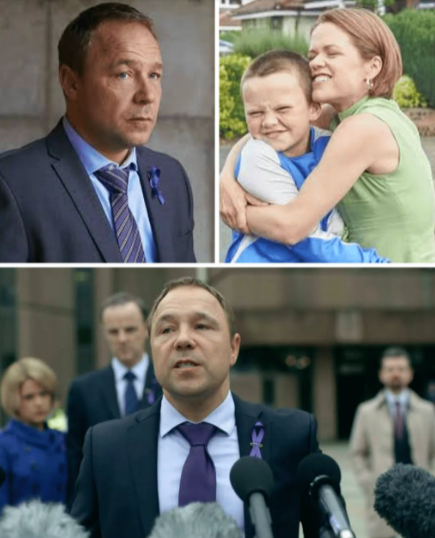
🚨 “VIEWERS WERE LEFT IN TEARS!” — STEPHEN GRAHAM’S FORGOTTEN ITV MASTERPIECE PACKS MORE EMOTION INTO FOUR EPISODES THAN MOST CRIME DRAMAS MANAGE IN AN ENTIRE SEASON!
LITTLE BOY BLUE (2017) REVIEW: STEPHEN GRAHAM DELIVERS A HEARTBREAKING PERFORMANCE IN A TRUE-CRIME DRAMA THAT BRITAIN WILL NEVER FORGET
One innocent child. One devastating tragedy. A family’s unimaginable grief. And a determined search for justice that exposes the terrible human cost of violence.
Genre: British true-crime / Crime drama | Episodes: 4 | Broadcaster: ITV | Starring: Stephen Graham, Sinead Keenan, Brían F. O’Byrne and Matthew Roberts | Written by Jeff Pope

Some television dramas are designed to entertain. Others challenge audiences to confront uncomfortable realities. And then there are rare productions that carry the weight of a real tragedy, reminding viewers that behind every headline, every investigation and every courtroom decision are people whose lives have been changed forever.
Little Boy Blue belongs firmly in that final category.
Originally broadcast on ITV in 2017, this four-part drama revisits the killing of 11-year-old Rhys Jones, who was fatally shot in Liverpool in August 2007 while walking home from football practice.
The tragedy shocked Britain, but the series refuses to treat the child’s death merely as the starting point for a conventional murder mystery.
Instead, it explores the devastating consequences for Rhys’s family, the painstaking investigation that followed and the culture of intimidation and silence that complicated the pursuit of justice.
At the centre of the investigation is Detective Superintendent Dave Kelly, portrayed by Stephen Graham. His character is determined to bring those responsible to justice, but the drama makes clear that determination alone cannot overcome the enormous obstacles facing investigators.
Meanwhile, Sinead Keenan and Brían F. O’Byrne deliver deeply affecting performances as Rhys’s parents, Melanie and Steve Jones, whose ordinary family life is destroyed in a single moment.
Written by Jeff Pope and directed by Paul Whittington, Little Boy Blue is not simply a story about solving a crime.
It is a story about grief, courage, community responsibility and the painful difference between obtaining a conviction and finding peace.
Content note: This review discusses the real-life death of a child, gun violence and bereavement. As the drama is based on a well-documented case, some historical outcomes are mentioned.
1. A Normal Childhood Destroyed by an Unthinkable Act
The most devastating aspect of Little Boy Blue is the ordinary life at the centre of its story.
Rhys Jones was an 11-year-old boy who loved football. He was returning home from practice when he was caught in gunfire associated with gang violence in the Croxteth area of Liverpool.
He was not involved in the conflict.
He was simply a child going home.
The drama understands the importance of this distinction.
Rather than presenting the tragedy as an abstract criminal incident, it reminds viewers that Rhys had a family, interests, routines and a future that should have stretched decades ahead.
The early scenes establish the normality of family life before that normality is shattered.
The emotional effect comes not from exaggerated storytelling but from recognising how quickly an ordinary evening can become the defining tragedy of a family’s existence.
There is no dramatic warning that could prepare Rhys’s parents for what happens.
No opportunity to reverse the events.
No explanation capable of making the loss acceptable.
This sense of helplessness remains central throughout the series.
Even as the investigation progresses and evidence begins to emerge, the audience never forgets that the most important thing cannot be restored.
Rhys will not come home.
That truth gives the drama its emotional foundation.
2. Stephen Graham Brings Quiet Determination to Dave Kelly

Stephen Graham is widely admired for portraying volatile, emotionally complicated characters.
In productions such as This Is England, The Virtues and Time, he has demonstrated an extraordinary ability to reveal vulnerability beneath anger and toughness.
His performance in Little Boy Blue is different.
As Dave Kelly, Graham plays a senior investigator whose greatest strength is not aggression but persistence.
Kelly understands that the case requires patience, sensitivity and the cooperation of people who may be frightened to speak openly.
Graham avoids turning him into an exaggerated television detective.
He is not presented as a genius who solves the case through sudden flashes of intuition.
Instead, Kelly is a professional facing an enormously difficult responsibility.
He must lead a complex investigation while recognising the emotional devastation experienced by Rhys’s family.
His conversations are measured. His frustration is often controlled. His determination becomes most visible when progress is slow and the obstacles appear overwhelming.
This restraint makes Graham’s performance especially effective.
The actor communicates the pressure of responsibility without demanding attention in every scene.
He understands that the emotional centre of the drama belongs to the family, not the investigator.
Consequently, his portrayal of Kelly becomes an essential supporting force within the larger story.
The character’s commitment matters because it represents a promise: that Rhys’s death will not simply become another unresolved act of violence.
3. Sinead Keenan Delivers the Drama’s Most Devastating Performance
Although Stephen Graham provides the series with a recognisable leading presence, Sinead Keenan arguably delivers its most emotionally overwhelming performance.
As Melanie Jones, Rhys’s mother, she portrays grief with extraordinary honesty.
The challenge of representing a real parent’s suffering is immense.
An overly theatrical performance could feel exploitative. An excessively restrained portrayal might fail to communicate the magnitude of the loss.
Keenan finds a deeply affecting balance.
Her performance moves between disbelief, devastation, exhaustion and the desperate need for answers.
She captures the unbearable contradiction faced by parents after the death of a child: the world continues functioning even though their own lives have stopped making sense.
Ordinary activities become reminders of absence.
Conversations that once seemed trivial acquire a terrible significance.
And moments of apparent composure can collapse without warning.
Keenan’s greatest achievement is that Melanie never becomes simply a symbol of grief.
She remains a person with anger, love, memories and a determination to see justice done.
The performance also avoids suggesting that bereavement follows a predictable emotional sequence.
Grief can be quiet one moment and overwhelming the next.
It can create distance between people who love one another, even when they are suffering from the same loss.
Through Keenan’s portrayal, Little Boy Blue gives that complexity the attention it deserves.
4. A Father’s Grief: Brían F. O’Byrne as Steve Jones
Brían F. O’Byrne brings equal emotional depth to Steve Jones, Rhys’s father.
His portrayal offers a different expression of grief.
Where Melanie’s suffering can become openly overwhelming, Steve often appears to struggle with the expectation that he must remain strong.
This creates an emotionally painful tension within the family.
Both parents have lost the same child, but they do not always know how to comfort each other.
O’Byrne captures the exhaustion of a father trying to support his family while carrying a level of pain he cannot adequately express.
The drama is especially effective when it focuses on the ordinary details of their relationship.
A conversation interrupted by emotion. A moment of silence at home. The difficulty of discussing what the future might look like.
These scenes are devastating because they refuse to offer easy reassurance.
The family cannot simply return to its previous life.
Every relationship must now exist in the shadow of Rhys’s absence.
Keenan and O’Byrne make that reality painfully believable.
Their performances ensure that the investigation never overwhelms the human story.
No matter how much evidence is gathered or how many suspects are questioned, the emotional stakes remain grounded in the family whose loss began everything.
5. The Investigation: A Case Where Knowing the Truth Was Not Enough
One of the most compelling aspects of Little Boy Blue is its portrayal of the investigation.
In many fictional crime dramas, identifying a suspect represents the most important breakthrough.
Here, the challenge is considerably more complicated.
Investigators must establish what happened, gather reliable evidence and persuade frightened witnesses to cooperate.
The series explores the difference between believing someone is responsible and possessing sufficient evidence to secure a conviction.
This distinction gives the investigation its dramatic tension.
The community is affected by fear, gang loyalties and an unwillingness among some individuals to provide information openly.
Dave Kelly and his team encounter repeated frustrations as they attempt to build a case capable of surviving courtroom scrutiny.
Graham’s performance becomes particularly effective during these sequences.
His character cannot simply intimidate witnesses into telling the truth. He must navigate relationships, assess credibility and continue working even when progress appears painfully slow.
The drama reveals how difficult it can be to obtain justice when those with important information are afraid of the consequences of speaking.
The tension does not depend upon an elaborate mystery about the killer’s identity.
It comes from a more troubling possibility: that those responsible might escape accountability despite the determination of everyone investigating the case.
Contemporary reviews particularly praised the series for showing the obstacles investigators faced in turning widespread suspicions into evidence.
The Guardian+1
6. The Culture of Silence Becomes a Central Antagonist
The most disturbing force in Little Boy Blue is not simply the individual responsible for Rhys’s death.
It is the wider environment of intimidation and silence that surrounds the investigation.
The series depicts young men caught up in gang rivalries, families protecting their own and witnesses reluctant to become involved.
These dynamics make the investigation more difficult and expose how criminal violence can damage an entire community.
The drama does not suggest that everyone living in the affected neighbourhoods shares responsibility for the crime.
Instead, it distinguishes between those who perpetuate violence and the many ordinary residents who must live with its consequences.
That distinction matters.
Liverpool is not presented merely as a dangerous city.
It is also shown as a place of compassion, solidarity and people determined to support a grieving family.
The contrast gives the series greater emotional depth.
The culture of silence becomes frightening precisely because it allows a small number of individuals to exert influence far beyond their numbers.
Fear affects conversations, relationships and decisions.
People who might otherwise want to help must consider the potential consequences for themselves and their families.
The series shows that justice depends not only on the dedication of investigators but also on the willingness of communities to resist intimidation.
7. Liverpool Is More Than a Backdrop
The city of Liverpool plays an essential role in the drama.
Filmed in Liverpool and the surrounding region, Little Boy Blue uses recognisable streets, homes and public spaces to create a strong sense of authenticity.
ITV News Granada+1
The setting is never merely decorative.
Liverpool’s working-class communities, football culture and close family relationships are integral to the story.
Rhys’s love of Everton Football Club becomes particularly important.
Football represents the ordinary childhood pleasures that should have continued shaping his life.
Instead, it becomes part of the community’s response to his death.
One of the drama’s most moving sequences recreates the tribute paid to Rhys by Everton supporters at Goodison Park.
The scene carries enormous emotional weight because it shows thousands of people acknowledging the loss of a child whose death affected far more than his immediate family.
It also demonstrates the power of collective grief.
The tragedy belongs most profoundly to Rhys’s loved ones, but the wider community refuses to allow his memory to disappear.
The production’s involvement with local people adds authenticity to this portrayal. Critics noted the emotional significance of the football tribute and the participation of Liverpool residents.
The Guardian+1
These moments prevent the drama from becoming solely a portrait of violence.
They remind viewers that the city also possesses extraordinary resilience and compassion.
8. Jeff Pope’s Writing Avoids Turning Tragedy Into Entertainment
Adapting a real child’s death for television presents serious ethical challenges.
There is always a risk that dramatic reconstruction will transform suffering into spectacle.
Writer Jeff Pope approaches the material with considerable restraint.
The series focuses on the consequences of the crime rather than attempting to make the killing sensational or visually exciting.
The violence is presented as devastating, not glamorous.
The people responsible are not transformed into fascinating antiheroes whose personalities overshadow the victim.
Instead, the drama consistently returns to Rhys and his family.
This approach reflects the production’s relationship with the real people involved.
Melanie and Steve Jones supported the adaptation, and the drama was developed through careful research. Members of the cast also met the family while preparing their performances.
ITV News Granada+1
That involvement does not make every dramatic choice immune from criticism, but it demonstrates an effort to approach the subject responsibly.
Pope also understands that a factual drama needs a coherent narrative without pretending that reality follows the neat structure of fiction.
The investigation involves delays, disappointments and painstaking work.
These elements might seem less immediately exciting than spectacular detective breakthroughs, but they are essential to the story’s credibility.
The drama succeeds because it recognises that the pursuit of justice can be emotionally exhausting and procedurally difficult.
9. Paul Whittington’s Direction Makes the Quiet Moments Unbearable
Director Paul Whittington gives Little Boy Blue a restrained visual style that suits its subject.
Rather than relying on exaggerated camera movements or dramatic effects, he allows the performances to carry the emotional intensity.
Domestic spaces become particularly important.
The Jones family home, once associated with ordinary routines, becomes a place defined by absence.
Rooms remain familiar, but their meaning has changed.
The camera often stays close to the characters, allowing viewers to observe the smallest emotional reactions.
This is especially effective during scenes involving Melanie and Steve.
Their grief does not need constant explanation.
A look across a room or a pause in conversation can communicate more than an extended speech.
The investigative sequences are handled with similar restraint.
Interview rooms, offices and ordinary streets become settings for confrontations that are psychologically intense rather than visually spectacular.
Whittington also allows moments of silence to remain uncomfortable.
He does not rush to fill every pause with music or dialogue.
That patience gives the drama much of its power.
The audience is forced to remain with the characters’ suffering rather than being hurried toward the next plot development.
10. The Courtroom and the Long Road to Justice
The later episodes move toward the legal consequences of the investigation.
Because Little Boy Blue is based on a real case, the outcome is part of the historical record.
Sean Mercer, who was 16 when Rhys was killed, was convicted of murder in 2008 and sentenced to life imprisonment with a minimum term of 22 years. Other individuals were also convicted of offences connected to the killing and its aftermath.
The Standard+1
The drama does not present these outcomes as a miraculous restoration of order.
A conviction matters enormously, but it cannot reverse the loss.
For Rhys’s parents, the conclusion of the case represents an important moment in a much longer experience of grief.
The courtroom sequences therefore carry a complicated emotional weight.
There is relief that accountability has been established.
There is also the unbearable knowledge that the family’s life will never return to what it was.
This distinction is one of the drama’s greatest strengths.
Many fictional crime stories conclude with the arrest of a suspect, implying that justice restores balance.
Little Boy Blue understands that real life is not so simple.
The legal system can determine responsibility and impose punishment.
It cannot return a child to his parents.
The series never allows viewers to forget that difference.
11. Why Little Boy Blue Still Matters
Nearly a decade after its original broadcast, Little Boy Blue remains an important example of British factual drama.
Its subject is specific, but its themes are painfully universal.
The series explores the vulnerability of children, the destructive consequences of criminal violence and the difficulties faced by families seeking justice.
It also raises questions about collective responsibility.
What happens when intimidation prevents people from speaking openly?
How can communities protect themselves from individuals who use fear to maintain influence?
And how should television portray real tragedies without exploiting the suffering of those involved?
The series does not offer simple answers.
Instead, it encourages viewers to consider the human consequences of events that might otherwise be reduced to brief news reports.
The response to the original broadcast demonstrated its emotional impact.
ITV reported that viewers described the opening episode as heartbreaking and difficult to watch, with many expressing sympathy for Rhys’s family.
ITV News Granada
Critical reception also recognised the strength of the performances and the care taken with the material.
The Guardian+1
The drama’s continuing relevance lies in its insistence that victims should remain at the centre of stories about violence.
Rhys Jones was not simply a name associated with a criminal case.
He was a child whose life mattered.
And the series is most successful when it reminds viewers of that fundamental truth.
FINAL VERDICT: ONE OF STEPHEN GRAHAM’S MOST POWERFUL TRUE-CRIME DRAMAS
9/10 — Devastating, compassionate and unforgettable
Performance · Emotional impact · Authenticity · Storytelling
Little Boy Blue is an exceptionally moving television drama that combines a compelling investigation with an intimate portrayal of family grief.
Stephen Graham delivers a controlled and deeply human performance as Dave Kelly, demonstrating that his greatest strength as an actor is not simply intensity but emotional intelligence.
Sinead Keenan and Brían F. O’Byrne are equally extraordinary as Melanie and Steve Jones, bringing painful authenticity to a story that could easily have become overwhelming in less careful hands.
Jeff Pope’s writing and Paul Whittington’s direction give the material the restraint it deserves.
There are moments when the series is almost unbearably difficult to watch.
Yet that discomfort serves a meaningful purpose.
The drama asks viewers to recognise the terrible consequences of violence and the courage required of those who continue living after unimaginable loss.
Most importantly, it never allows the investigation to overshadow the child at the centre of the tragedy.
Rhys Jones was just 11 years old. He should have had an entire lifetime ahead of him.
That is the truth Little Boy Blue leaves behind.
And it is why this four-part drama remains one of the most heartbreaking and essential works in Stephen Graham’s television career.