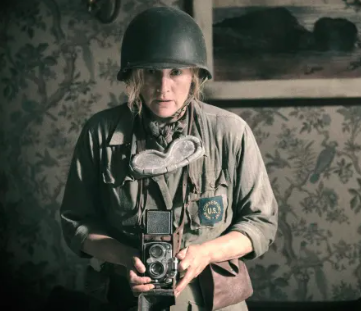
🚨 ‘THE BRUTALITY WILL BREAK YOUR SOUL’: KATE WINSLET’S MOST HAUNTING TRANSFORMATION HAS VIEWERS ABSOLUTELY HOOKED!
Kate Winslet’s Most Haunting Transformation: Lee Throws Her Into the Horrors of War — and the Final Price of the Truth Is Devastating
Cinema has long possessed a complicated relationship with the camera. It is at once a mechanism of wonder, a tool of artifice, and, in its most urgent iterations, a weapon of historical witness. Few professions bridge these identities quite like photojournalism. To look through a lens at human suffering is to make a chilling moral choice: to capture the frame or to drop the camera and offer aid. In her feature directorial debut, Ellen Kuras chooses a subject who walked that razor-thin line with ferocious, uncompromising grace. Lee is not a standard biographical portrait; it is a visceral, unblinking excavation of a woman who stared directly into the abyss of the 20th century and refused to blink. Anchored by a career-defining, fearless performance from Kate Winslet—who also spearheaded the project as a producer over many years of tireless development—the film rescues Lee Miller from the historical footnotes of being merely a muse, a model, or a footnote in the shadow of the men she loved. Instead, it thrusts her into the mud, ash, and blood of a shattered Europe, presenting a haunting testament to the cost of bearing witness.

From Surrealist Muse to Vanguard of Reality
To understand the ferocious vitality Kate Winslet brings to the screen, one must first grapple with the remarkable trajectory of Elizabeth “Lee” Miller herself. Long before she was dodging shrapnel on the front lines of World War II, Miller was an icon of the avant-garde. She was the face of Vogue, Man Ray’s muse and secret lover, a darling of Parisian surrealism who eventually stepped behind the camera to forge an artistic vision uniquely her own. Kuras’s film wisely acknowledges this glamorous prologue not as a separate life, but as the aesthetic training ground for what was to come. Miller’s early immersion in surrealism taught her how to look past the conventional surface of things, to find the grotesque poetry in an isolated eyeball, a severed torso, or the harsh juxtaposition of light and shadow.
When war erupted, that artistic eye transformed into a tactical instrument of truth. Defying the archaic military restrictions that barred women from the front lines, Miller fought tooth and nail for her accreditation as a war correspondent for British Vogue. Winslet captures this transition with electric tension. We see a woman chafing against the polite tea-party expectations of London society, desperate to trade the safety of fashion shoots for the chaotic thunder of the battlefield. The film brilliantly illustrates how Miller’s background was not a contradiction to her war work, but its catalyst: who better to capture the surreal, nightmarish architecture of total war than a surrealist who had spent years training her gaze on the bizarre and the broken?
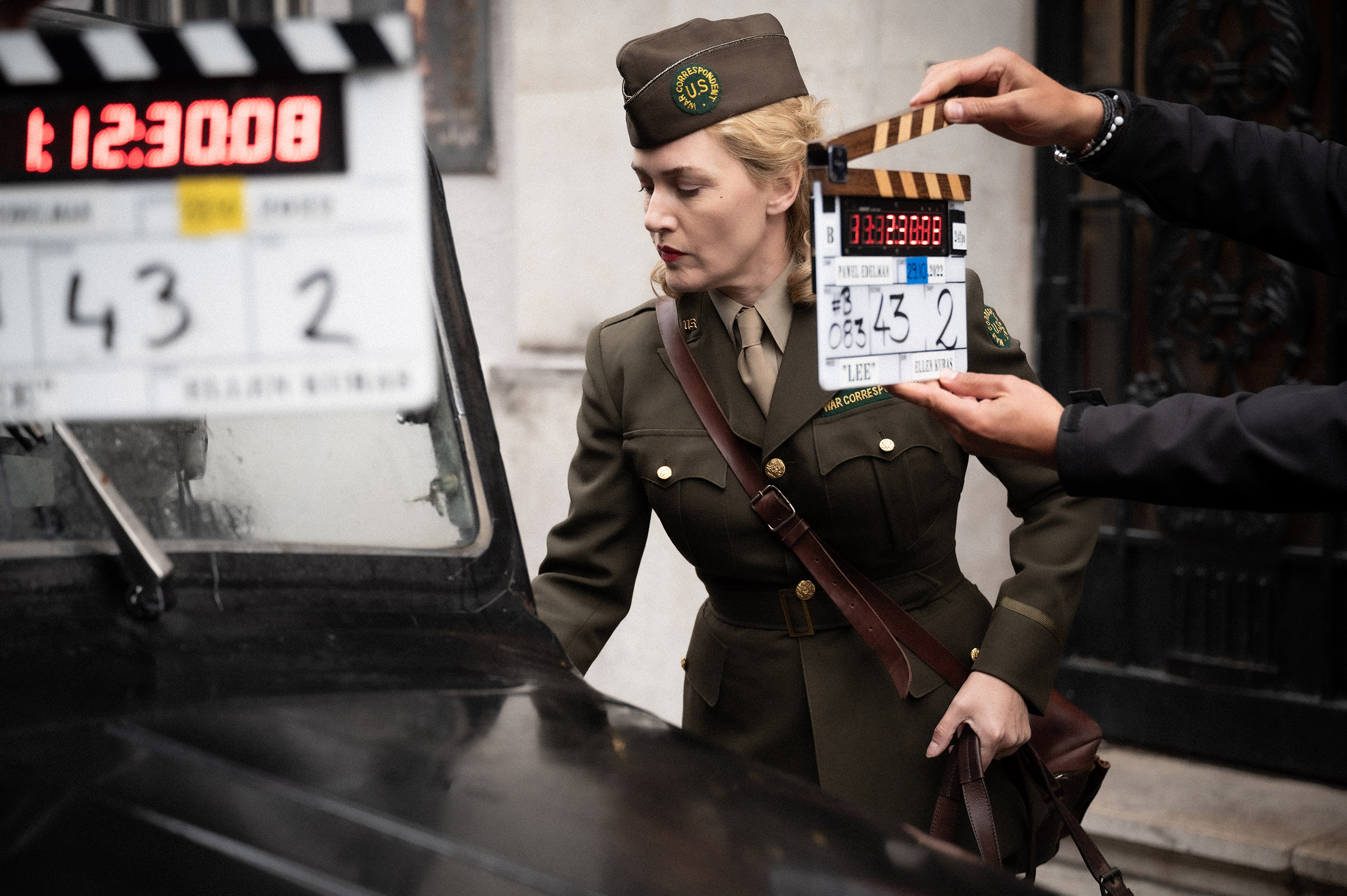
Kate Winslet’s Masterclass in Physical and Emotional Transformation
It is impossible to discuss Lee without placing Kate Winslet’s performance at the very center of the cinematic architecture. Winslet has built an enviable, legendary career on playing complex, emotionally turbulent women, but Lee Miller represents something entirely distinct. There is a raw, weathered gravity to her work here that strips away any lingering vestiges of movie-star vanity. Winslet does not play Miller as a Hollywood archetype of a “strong woman”; she plays her as a human being cracking under the immense atmospheric pressure of history.
Watch Winslet’s eyes in the sequences following the Blitz or during the liberation of France. They are the eyes of a person absorbing sights that the human brain was never evolved to process. There is a palpable physicality to her performance. She lugs heavy equipment through deep mud, stumbles through choking smoke, and sleeps in ruined, rat-infested rubble. Yet, the true triumph of Winslet’s transformation lies in her handling of Miller’s internal armor. Lee was a woman known for her fierce independence, heavy drinking, sharp wit, and emotional guardedness. Winslet portrays this armor with acute precision, showing how the steady accumulation of trauma slowly fractures it. Every cigarette smoked down to the filter, every heavy exhale, and every micro-expression of dread communicates a profound internal toll. It is a performance of immense physical courage and emotional depth, anchoring every frame of a film that threatens at times to buckle under the sheer weight of its historical horrors.

The Horror of the Lens: Navigating the Front Lines
Ellen Kuras, an acclaimed cinematographer making her narrative feature directorial debut, brings a distinct visual mastery to Lee. Collaborating with cinematographer Pawel Edelman, Kuras frames the war not with the sanitized, sweeping grandeur of epic battle films, but with an intimate, claustrophobic immediacy. The camera tracks Miller as she embeds herself with the U.S. Army, moving from the horrific aftermath of the St. Malo bombings to the grueling push across France and Germany.
The film does not shy away from the moral complexities of Miller’s profession. Through sharp exchanges between Miller and her fellow correspondents—particularly David Scherman, brilliantly played by Andy Samberg in a role that showcases his dramatic gravity—Lee explores the agonizing burden of the photograph. Scherman and Miller form a vital creative and emotional partnership, a lifeline of gallows humor and shared trauma amidst the devastation. Samberg provides a grounded, soulful counterbalance to Winslet’s restless intensity, illustrating the deep camaraderie forged in the trenches.
One of the film’s most striking thematic threads is the conflict between Miller’s dispatches for Vogue and the reality she was witnessing. While the magazine’s editors in London fretted over whether images of dead soldiers or ruined cities were too grim for their high-society readership, Miller and Scherman understood that sugarcoating the conflict was an act of supreme violence against the truth. They captured the absolute mechanization of death, the shattered infrastructure of humanity, and the eerie, desolate quiet that follows artillery fire. Kuras treats these photographic moments with reverence, freezing the frame at crucial intervals to remind the audience of the exact perspective from which history was permanently recorded.
The Devastating Climax: Confronting the Abyss
All the narrative momentum of Lee builds inexorably toward its most harrowing and morally definitive sequence: the liberation of Dachau and Buchenwald concentration camps. It is here that the film reaches its emotional and thematic zenith, and where Winslet delivers her most shattering work.
Nothing in Miller’s prior experiences—not the Blitz, not the sniper fire, not the destruction of entire cities—could have prepared her for the systematic, industrialized atrocities uncovered within the camp gates. The scenes set at Dachau are handled with a devastating, respectful sobriety. Kuras refuses to sensationalize the horror, instead aligning the viewer’s perspective entirely with Miller and Scherman as they take in the human cost of Nazi ideology.
The emotional centerpiece of this sequence is the iconic, deeply surreal photograph of Lee Miller bathing in Adolf Hitler’s private bathtub in his Munich apartment. Captured by Scherman, the image features Miller submerged in the tub, her mud-caked combat boots resting deliberately on the bathmat, bringing the filth of the camps directly into the dictator’s sanctum. In the film, this moment is not presented as a moment of triumphant celebration, but as a chilling act of psychological exorcism. Winslet portrays Miller in this scene not with a victorious smile, but with a haunted, hollow expression. She is washing the stench of genocide from her skin, yet she knows deep down that no amount of scrubbing will ever cleanse the images burned into her retinas.
The Permanent Price of Truth
The true brilliance of Lee lies in its refusal to offer a neat, comforting Hollywood resolution. Surviving the war was only the first battle; living with the memories was the war that never ended. In its framing devices—which feature an older Miller being interviewed by a persistent young journalist (played by Josh O’Connor)—the film slowly reveals the profound psychological fallout of her experiences.
Miller returned home suffering from what we now recognize as severe Post-Traumatic Stress Disorder (PTSD), though in the post-war era, it was largely dismissed, misunderstood, or medicated away with alcohol and silence. She buried her wartime photographs in the attic, retreating to a quiet life as a gourmet cook in Sussex, unable to speak about the horrors she had witnessed to her husband, Roland Penrose (played with quiet, devastating empathy by Alexander Skarsgård).
Skarsgård’s portrayal of Penrose highlights the collateral damage inflicted upon the loved ones of trauma survivors. He watches helplessly as the vibrant, fierce woman he loved slowly disintegrates under the weight of ghosts she cannot outrun. The film posits that the price of truth is often the loss of peace. To look directly at the worst of humanity is to be permanently altered by it.
A Monument to an Unflinching Witness
Lee is an arduous, emotionally taxing cinematic experience, but it is an essential one. At a time when the documentation of truth is increasingly contested, fractured, and manipulated, the film serves as a timely reminder of the vital, dangerous necessity of independent, unblinking journalism.
Ellen Kuras has crafted a biographical drama that respects the complexity of its subject, avoiding hagiography in favor of a messy, brilliant, deeply flawed human being who chose courage over comfort. And at the heart of it all is Kate Winslet, delivering a performance of staggering intensity and emotional courage. She does not merely play Lee Miller; she resurrects her spirit, dragging us through the mud and the ash to remind us what it costs to keep our eyes wide open when the world is burning. The final price of the truth may be devastating, but as Lee so powerfully demonstrates, looking away is a luxury humanity can never afford.