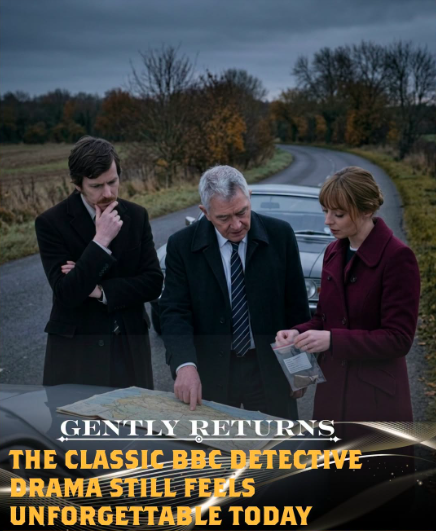
🚨 Missing Those Atmospheric BBC Detective Dramas With Feature-Length Cases? Inspector George Gently Still Feels Almost Impossible to Replace
🚨 BBC VIEWERS ARE REDISCOVERING THIS GRIPPING DETECTIVE DRAMA — WHERE EVERY MURDER HIDES A DEADLIER SECRET AND NOBODY CAN BE TRUSTED!
There was a particular kind of British detective drama that knew how to take its time.
No frantic editing. No endless barrage of twists every five minutes. No detective magically solving a murder after staring at a computer screen.
Instead, there were rain-darkened streets, smoky pubs, battered cars, uncomfortable interviews and suspects who seemed to carry entire histories behind a single nervous glance.
And few programmes captured that atmosphere quite like Inspector George Gently.
Led by the formidable Martin Shaw and strengthened enormously by Lee Ingleby as his younger, more impulsive partner John Bacchus, the BBC drama transported viewers into a Britain undergoing enormous social change.
The murders provided the mysteries.
But Britain itself was arguably the bigger story.
Beginning in 2007 and eventually running for eight series and 25 feature-length episodes, Inspector George Gently adapted characters created by novelist Alan Hunter while building a television identity unmistakably its own.
Years after its final episode, it remains the sort of drama capable of making modern viewers wonder why television doesn’t make quite as many detective series like this anymore.
Because George Gently wasn’t simply about finding a killer.
It was about watching an old world collide with a new one.

MARTIN SHAW WAS BORN TO PLAY GEORGE GENTLY
At the centre of everything is George Gently.
Martin Shaw plays him with the quiet authority of a man who doesn’t need to announce that he is in charge.
Gently is experienced, disciplined and difficult to intimidate.
He has spent enough time around criminals to recognize dishonesty before somebody has finished delivering it. But perhaps more importantly, he has spent enough time around other policemen to recognize corruption there, too.
That gives the character an intriguing edge from the beginning.
Gently isn’t a bright-eyed newcomer discovering that the world can be ugly.
He already knows.
He has seen violence.
He has seen corruption.
He has seen how institutions can protect themselves.
He understands that possessing authority does not automatically make somebody honorable.
Shaw brings all of this history into the character without constantly explaining it.
There is weight in the way Gently walks into an interview room.
There is patience in his silences.
He listens.
He watches.
He waits.
And when he finally speaks, people tend to pay attention.
It’s wonderfully old-fashioned detective acting.
Rather than giving Gently eccentric habits or turning him into another tortured genius, the drama makes his greatest weapon experience.
He knows people.
That is enough.
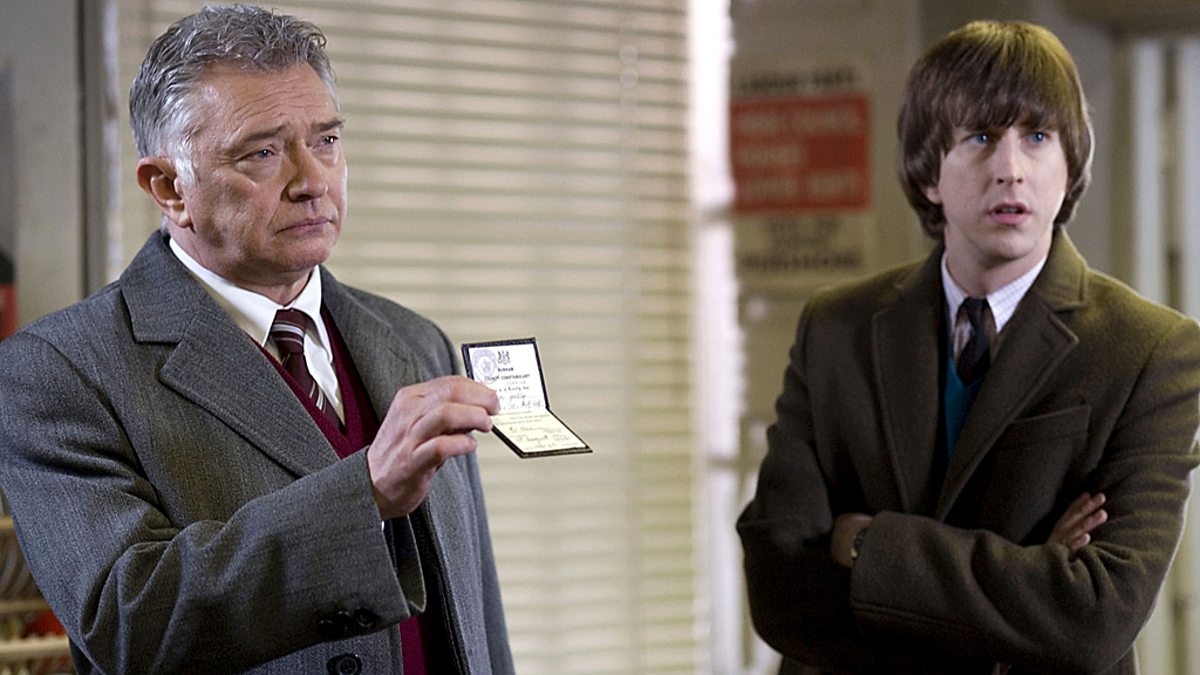
THEN JOHN BACCHUS WALKS IN — AND EVERYTHING GETS MESSIER
If Gently represents experience and restraint, Detective Sergeant John Bacchus represents almost everything capable of testing that restraint.
Lee Ingleby’s performance is one of the great reasons the partnership works.
Bacchus is younger, ambitious, impatient and frequently convinced that he already understands the world.
He doesn’t.
And Gently knows he doesn’t.
That difference creates some of the show’s most entertaining scenes.
The relationship could easily have followed the familiar formula of wise mentor and enthusiastic apprentice.
But George Gently makes things considerably more complicated.
Bacchus can be stubborn.
He can be prejudiced.
He can be reckless.
He can make assumptions based on the attitudes of the era.
At times, viewers may find themselves intensely frustrated with him.
That is deliberate.
Because Bacchus is not merely Gently’s sidekick.
He represents part of the Britain the series is examining.
And that Britain is changing faster than some of its people are prepared to change with it.
Gently repeatedly challenges his younger colleague’s assumptions.
Sometimes Bacchus listens.
Sometimes he resists.
Sometimes he learns.
Sometimes he disappoints.
Their partnership therefore becomes much more interesting than the usual detective double act.
Gently isn’t simply teaching Bacchus how to investigate murder.
In many episodes, he is forcing him to reconsider the kind of man—and policeman—he wants to become.
THE 1960s AREN’T JUST BEAUTIFUL SCENERY
Period crime dramas can sometimes treat history like expensive wallpaper.
Put a few classic cars outside.
Dress everyone correctly.
Remove smartphones.
Add cigarettes.
Job done.
Inspector George Gently aims for something deeper.
The 1960s setting isn’t simply there to make the programme look atmospheric.
It affects everything.
Britain is changing.
Old assumptions about class, gender, race, sexuality and authority are increasingly being questioned. Younger generations are challenging the rules inherited from their parents.
Music is changing.
Fashion is changing.
Relationships are changing.
The country is moving forward—but certainly not evenly.
That tension runs beneath many investigations.
A murder may provide the immediate reason Gently and Bacchus enter a community, but the investigation often exposes something larger underneath.
Resentment.
Hypocrisy.
Class divisions.
Institutional prejudice.
Family secrets.
People desperately attempting to protect reputations built according to rules that are beginning to disappear.
This makes the mysteries feel rooted in their time rather than merely decorated by it.
The detectives aren’t investigating crimes in a modern society wearing vintage clothing.
They are investigating crimes shaped by the values and conflicts of the 1960s.
That distinction matters.
THE NORTH EAST BECOMES A CHARACTER OF ITS OWN
Then there is the landscape.
Although Alan Hunter’s novels originally placed Gently elsewhere, the television adaptation relocated much of the action to North East England.
It proved an inspired decision.
Industrial landscapes, coastal communities, working-class neighborhoods and open countryside give the programme an identity immediately distinguishable from the countless London-based detective dramas surrounding it.
The scenery can be beautiful.
It can also feel lonely.
A road stretching across an empty landscape suddenly becomes ominous.
A quiet coastal location feels capable of hiding something terrible.
A modest house can contain decades of resentment behind its front door.
The production understands that atmosphere isn’t created merely by making everything dark.
Sometimes the most unsettling crime scene is one surrounded by breathtaking countryside.
That visual contrast became part of the show’s signature.
There is also a physical texture to George Gently that many newer crime dramas inevitably lack.
Documents must be handled.
Witnesses must be visited.
Information must be gathered through conversations.
There is no convenient smartphone to locate somebody instantly.
No modern DNA database waiting to provide an answer before the next commercial break.
Detective work feels physical.
Gently and Bacchus have to go somewhere.
Knock on doors.
Sit opposite people.
Ask questions.
Notice contradictions.
Return when something doesn’t add up.
It gives the investigations a satisfying procedural rhythm.
FEATURE-LENGTH EPISODES MAKE ALL THE DIFFERENCE
One of the greatest pleasures of Inspector George Gently is its scale.
These aren’t tiny mysteries racing toward a solution.
The feature-length format gives each investigation room.
Suspects can breathe.
Supporting characters can become actual people rather than pieces of evidence.
False assumptions have time to develop naturally.
Most importantly, viewers get time to inhabit the world.
A strong episode can feel closer to watching a self-contained detective film than a conventional television installment.
The opening crime establishes the question.
Gently and Bacchus arrive.
Then the layers slowly begin peeling away.
The person who initially appears suspicious may be hiding something entirely unrelated to the murder.
A seemingly reliable witness suddenly contradicts themselves.
An old relationship acquires new importance.
A tiny detail that appeared meaningless half an hour earlier returns with entirely different significance.
The programme rarely seems desperate to shock you.
Instead, it wants to pull you deeper.
That slower rhythm will be precisely what makes the show appealing to viewers exhausted by hyperactive modern thrillers.
Put your phone away.
Make tea.
Settle in.
You are going to be here for a while.
THE MURDERS ARE ONLY THE BEGINNING
What separates memorable detective drama from disposable detective drama is rarely the complexity of the murder puzzle alone.
It is what the murder reveals.
George Gently understands this extremely well.
Death tears open communities.
Secrets begin spilling out.
People who believed their private lives were safely hidden suddenly find themselves answering uncomfortable questions.
Families fracture.
Old grudges return.
Respectable reputations begin collapsing.
And slowly, Gently discovers that the neat version of events everyone initially offered him is almost never the whole truth.
This structure allows individual episodes to explore different corners of British society.
The investigation becomes a door.
Once Gently walks through it, the episode can examine the people living behind it.
That is why the series often feels closer to social drama than a simple whodunnit.
Yes, viewers want to know who committed the crime.
But by the final act, another question frequently matters just as much:
What created the circumstances in which this happened?
The answer is rarely comfortable.
GENTLY’S MORAL CODE MAKES HIM FASCINATING
George Gently is not interesting because he is perfect.
He is interesting because he possesses a strong sense of what the job should mean.
That places him in conflict with people who view authority differently.
The series repeatedly examines the enormous power given to institutions and the people operating within them.
Gently knows what happens when that power is abused.
His determination to uncover truth can therefore become stubborn, even when doing so makes his life more difficult.
Martin Shaw is excellent at communicating that stubbornness without transforming Gently into a sermon-delivering hero.
He doesn’t need to explain his principles every episode.
They emerge through decisions.
Who does he believe?
Who does he challenge?
What shortcuts does he refuse to accept?
How does he respond when Bacchus crosses a line?
Those moments define him.
And because Bacchus remains imperfect, their conversations can become confrontations about far more than the case immediately in front of them.
BACCHUS MAY BE THE SHOW’S MOST IMPORTANT GAMBLE
It would have been much easier to make John Bacchus endlessly likable.
The series doesn’t.
That is one of its smartest decisions.
He can reflect uncomfortable attitudes associated with the period, and the drama doesn’t always soften them for modern viewers.
This creates friction—not only between Bacchus and Gently, but between Bacchus and the audience.
Yet it also gives the character somewhere to go.
Lee Ingleby doesn’t play him as a cartoon bigot or foolish young detective waiting for Gently to correct him.
He gives Bacchus pride.
Insecurity.
Ambition.
Anger.
Vulnerability.
The younger detective wants respect.
He wants advancement.
He wants to prove himself.
Sometimes those desires make him better.
Sometimes they make him worse.
That inconsistency makes him human.
Watching the partnership evolve across eight series becomes one of the drama’s greatest rewards.
Their relationship accumulates history.
Arguments from earlier years matter.
Trust becomes earned rather than assumed.
Gently sees potential in Bacchus even when Bacchus makes that faith difficult to justify.
And Bacchus, beneath all the clashes, gradually understands just how much Gently has shaped him.
THE SERIES KNOWS WHEN TO BECOME DARK
Do not mistake the measured pacing for gentleness.
This can be a deeply bleak programme.
Some cases move into uncomfortable territory, and the historical setting means victims can find themselves trapped by social structures that offer little protection.
But the darkness generally has purpose.
Violence is not merely there to provide a sensational opening.
The consequences matter.
Families carry them.
Communities carry them.
Sometimes the detectives carry them.
Gently’s calm demeanor becomes more affecting because viewers increasingly understand the things he has absorbed over the years.
This is a man who has witnessed humanity at its worst and nevertheless continues to believe that finding the truth matters.
That quiet persistence becomes heroic without the series needing to proclaim him a hero.
AND THEN THERE IS THAT WONDERFUL BBC ATMOSPHERE
Certain British dramas have an atmosphere almost impossible to manufacture artificially.
Inspector George Gently has it.
Perhaps it is the combination of landscape, costume, restrained performances and patient storytelling.
Perhaps it is the lack of technological noise.
Perhaps it is simply Martin Shaw walking slowly toward a suspect who already knows the next conversation is going to be unpleasant.
Whatever the reason, the series has a distinct mood.
You can almost smell the cigarette smoke.
Hear the pub chatter.
Feel the cold air outside the station.
See the rain collecting on the windscreen of an old car.
That atmosphere gives the drama enormous rewatch value.
Even when you remember who committed the crime, spending time inside this world can remain satisfying.
And that is perhaps the ultimate test of a detective series.
A weak mystery becomes useless once you know the solution.
A great detective drama remains enjoyable because the solution was only part of the experience.
EIGHT SERIES LATER, IT KNEW WHEN TO SAY GOODBYE
The programme eventually reached eight series and 25 episodes before concluding in 2017.
That relatively compact episode count is slightly deceptive because of the feature-length format. These were substantial stories rather than quick weekly installments.
More importantly, the show was allowed to build toward an ending.
By then, Gently and Bacchus had travelled a considerable distance from the men viewers first met.
Britain had changed around them.
Their relationship had changed.
The world they worked within was changing too.
That sense of time passing gives the entire series an emotional coherence that becomes particularly noticeable when watching it from beginning to end.
You aren’t merely moving from murder to murder.
You are watching an era gradually disappear.
And Gently, in some respects, belongs to the world being left behind.
Not because his principles have become irrelevant.
Quite the opposite.
His integrity often feels strikingly modern.
But the type of detective he represents—the patient investigator relying on instinct, conversation and accumulated human experience—seems increasingly endangered by the future arriving around him.
That gives later episodes an underlying melancholy.
WHY IT STILL DESERVES TO BE REDISCOVERED
For viewers missing substantial British detective dramas, Inspector George Gently remains an enormously rewarding rediscovery.
Martin Shaw gives the series authority.
Lee Ingleby gives it friction.
The 1960s setting gives it identity.
The North East gives it atmosphere.
And the feature-length mysteries give everything room to breathe.
But perhaps its greatest strength is simpler.
The programme trusts its audience.
It doesn’t need constant explosions of information to maintain attention.
A conversation can matter.
A silence can matter.
A suspicious glance can matter.
A disagreement between two detectives can reveal more about an era than an enormous speech.
The show understands that suspense does not always mean speed.
Sometimes suspense means waiting.
Watching.
Realizing that somebody’s story doesn’t quite fit.
Then waiting for George Gently to realize it too.
For anyone who remembers the golden pleasure of settling down for a long BBC mystery—one case, one evening, one beautifully tangled collection of suspects—returning to Inspector George Gently can feel like opening a door to another era of television.
And Martin Shaw is waiting on the other side.
Calm.
Watchful.
Determined.
With Lee Ingleby’s perpetually impatient John Bacchus probably somewhere nearby, already getting himself into trouble.
Twenty-five episodes.
Eight series.
Countless secrets.
And one classic detective partnership that remains remarkably difficult to forget.