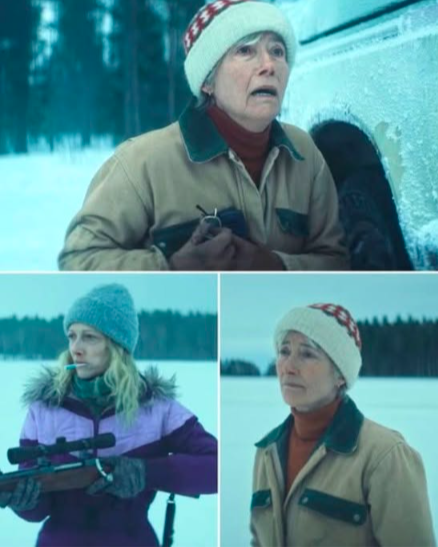
❄️ EMMA THOMPSON LIKE YOU’VE NEVER SEEN HER BEFORE — THE OSCAR WINNER TURNS BRUTAL IN THE MOST FROZEN, UNFORGIVING THRILLER OF HER CAREER!
DEAD OF WINTER REVIEW: EMMA THOMPSON LIKE YOU’VE NEVER SEEN HER BEFORE — A BRUTAL, FROZEN SURVIVAL THRILLER THAT TURNS GRIEF INTO PURE FURY
There is a moment in Dead of Winter when it becomes almost impossible to reconcile the Emma Thompson on screen with the performer audiences have known for decades.
Gone is the polished elegance.
Gone is the comforting warmth.
Gone, too, is any sense that her character is protected simply because an Academy Award-winning legend happens to be playing her.
Instead, Thompson is battered, freezing, frightened and isolated in an unforgiving landscape where survival depends not on cinematic superpowers but on instinct, stubbornness and the willingness to keep moving when the body is screaming to stop.
And that is precisely why Dead of Winter works.
Director Brian Kirk takes what could easily have become a conventional wilderness thriller and gives it an unexpectedly powerful weapon: Emma Thompson playing against virtually every expectation audiences may bring with them.
The result is a lean, nasty and surprisingly emotional survival story that proves one of Britain’s most celebrated actors can be every bit as compelling with a rifle in her hands as she is delivering razor-sharp dialogue in a drawing room.

A JOURNEY INTO THE COLD
Thompson plays Barb, a recently widowed woman carrying a grief that seems almost as heavy as the winter surrounding her.
Her destination is deeply personal.
She is travelling through the snow-covered wilderness of northern Minnesota to scatter the ashes of her late husband at a remote lake connected to their past. It is the kind of pilgrimage that should offer closure — a final private goodbye in a place filled with memories.
Instead, it becomes a nightmare.
After becoming lost in the frozen landscape, Barb encounters an isolated property and begins noticing details that don’t feel right.
Blood in the snow.
An unsettling stranger.
Sounds that suggest something inside the house is terribly wrong.
Eventually, Barb discovers the horrifying truth: a young woman named Leah is being held captive by a desperate and dangerous couple.
There is no convenient rescue team waiting nearby.
There is no reliable phone signal.
Civilization is hours away.
And Barb suddenly understands something terrifyingly simple.
If she leaves, Leah may die.
If she stays, Barb may die with her.
That decision becomes the engine driving Dead of Winter.
And crucially, Barb doesn’t suddenly transform into an invincible action hero.
She is scared.
She makes mistakes.
She gets hurt.
She struggles.
But she refuses to abandon someone who has nobody else.
That distinction makes all the difference.

EMMA THOMPSON’S MOST UNEXPECTED TRANSFORMATION
Thompson has spent decades building one of the most respected careers in modern British cinema, but Dead of Winter asks something strikingly different from her.
This isn’t action performed with glamorous choreography.
Barb doesn’t move like someone who secretly spent twenty years training as an assassin.
When she fights, it looks exhausting.
When she runs, the cold matters.
When she is injured, the injury doesn’t magically disappear in the following scene.
Her survival feels physical.
One particularly harrowing sequence sees Barb forced to deal with a gunshot wound herself. Alone and without proper medical help, she must rely on whatever knowledge and supplies she has available.
The scene captures what is so effective about Thompson’s performance.
She doesn’t play Barb as fearless.
She plays her as someone who is terrified but capable.
There’s an enormous difference.
Thompson allows us to see the pain before the determination takes over. She lets exhaustion creep into Barb’s face. Her pauses become important. Her breathing becomes part of the performance.
Sometimes the most compelling moments involve Thompson saying almost nothing.
The camera simply stays with her.
And she holds it.
That’s star power stripped down to its most fundamental form.
THE ANTI-ACTION HERO
Hollywood thrillers frequently tell audiences that strength looks like physical dominance.
Dead of Winter proposes something more interesting.
Barb’s greatest weapon isn’t strength.
It’s experience.
She understands the environment.
She understands cold.
She understands fishing.
She understands improvisation.
And perhaps most importantly, she understands what it means to lose somebody.
That grief initially appears to be her weakness.
Gradually, it becomes part of what makes her dangerous.
Barb has already endured the disappearance of the person around whom she built her life. The flashbacks to her younger years and marriage therefore aren’t merely sentimental interruptions. They explain why this apparently ordinary widow refuses to surrender.
The memories give emotional meaning to the violence happening in the present.
She hasn’t travelled into the wilderness looking for a fight.
She has travelled there to say goodbye.
Instead, she finds another human being who desperately needs someone not to walk away.
That transforms the film from a straightforward rescue thriller into something more emotionally resonant.
Saving Leah becomes, in a strange way, connected to Barb saving herself.
THE SNOW IS ANOTHER VILLAIN
Perhaps the movie’s most consistently effective element beyond Thompson is its landscape.
The film is set in northern Minnesota, with Finland standing in for the region during production, and cinematographer Christopher Ross turns the wilderness into something simultaneously beautiful and threatening.
The snow isn’t picturesque decoration.
It’s hostile.
The frozen lakes feel enormous.
The roads disappear into whiteness.
Cabins that would ordinarily suggest warmth instead feel like traps surrounded by miles of nothing.
Every journey across the landscape carries risk because nature itself seems indifferent to whether these characters survive.
Brian Kirk understands how to use that isolation.
Wide shots repeatedly emphasize just how small Barb is compared with the environment around her.
There may be nobody coming.
Nobody may hear a gunshot.
Nobody may know where she is.
That allows simple actions to become suspenseful.
Walking between two locations becomes dangerous.
A vehicle becomes precious.
Warmth becomes a resource.
Shelter becomes strategic.
The film doesn’t need an army of villains because the environment is already trying to kill everyone.
Volker Bertelmann’s score adds another layer of unease, moving from atmospheric sounds into more urgent suspense as Barb’s situation deteriorates.
The combined effect is wonderfully claustrophobic despite the enormous open spaces.
That paradox is one of the movie’s greatest strengths.
Barb can see for miles.
And yet there is nowhere to go.
JUDY GREER IS TERRIFYING
If Thompson is the emotional heart of the movie, Judy Greer provides its most unsettling energy.
Greer has spent much of her career demonstrating impeccable comic timing and supporting-character brilliance.
Here, that familiarity works against the audience.
Her character is volatile, desperate and increasingly frightening.
The performance avoids turning her into a conventional horror-movie monster because desperation remains visible underneath the cruelty.
That doesn’t excuse what she does.
It makes her more disturbing.
This is somebody operating from a place where morality has collapsed beneath obsession and survival.
Greer brings unpredictability to every confrontation.
You never quite know whether the next moment will involve manipulation, rage or violence.
Marc Menchaca, meanwhile, plays her partner with a different energy, giving the central threat an uneasy dynamic rather than presenting the kidnappers as interchangeable villains.
Laurel Marsden’s Leah completes the central group.
Importantly, Leah isn’t simply treated as an object waiting for Barb to rescue her. Her terror gives urgency to every decision Barb makes.
The film ultimately becomes a brutal contest between people trying to survive for radically different reasons.
WHERE DEAD OF WINTER WORKS BEST
The movie is strongest when it keeps things simple.
Barb has limited resources.
Leah needs help.
The kidnappers cannot allow Barb to interfere.
The weather is worsening.
That’s enough.
Kirk creates tension through geography and limitation rather than endlessly expanding the conspiracy.
The audience learns where objects are located.
We understand what Barb has available.
We know which places might offer safety.
Then the screenplay begins rearranging those pieces.
This gives the confrontations a tactile quality.
Barb isn’t James Bond.
She can’t summon technology.
She can’t call headquarters.
She has an old vehicle, outdoor knowledge, fishing equipment, weapons she knows how to use and whatever she can improvise from her surroundings.
The film repeatedly asks:
What would this particular woman realistically do with what she has?
That question is far more interesting than simply watching another indestructible action protagonist mow through anonymous enemies.
BUT THE FILM ISN’T PERFECT
The movie’s greatest strength — its simplicity — occasionally becomes its weakness.
Some plot mechanics require generosity from the viewer.
There are moments when characters make decisions because the thriller needs them to remain in danger.
Certain revelations surrounding the kidnapping stretch credibility.
And depending on your tolerance for genre conventions, the escalation toward the finale may feel either gloriously pulpy or increasingly implausible.
Critical reaction reflected that divide.
Some reviewers praised the movie as tense, old-fashioned entertainment driven by Thompson’s charisma, while others argued that the screenplay relies too heavily on familiar survival-thriller machinery. Rotten Tomatoes currently summarizes the critical response as broadly positive but notes complaints about excess backstory, while highlighting Thompson as the film’s central attraction.
Those criticisms aren’t unreasonable.
But there’s another argument.
Dead of Winter knows what kind of movie it is.
It isn’t trying to reinvent the thriller.
It is trying to execute one effectively with an actor we rarely see placed inside this kind of story.
And Thompson makes that gamble worthwhile.
GRIEF BENEATH THE GUNFIRE
The smartest choice in Nicholas Jacobson-Larson and Dalton Leeb’s screenplay is connecting Barb’s survival instinct to her marriage.
Without the flashbacks, Barb could easily become another resourceful protagonist dropped into a genre machine.
With them, her actions carry history.
We see glimpses of the relationship that shaped her.
We understand why this particular lake matters.
We understand why returning there hurts.
The presence of Gaia Wise — Thompson’s real-life daughter — as the younger Barb adds another intriguing emotional layer to those sequences.
The contrast between past and present is deliberately painful.
Warm memories collide with frozen reality.
Love collides with loss.
The woman Barb once was exists alongside the woman grief has forced her to become.
This is where Thompson’s casting becomes more than a gimmick.
An actor with less emotional weight might have delivered the survival sequences perfectly well.
Thompson makes us believe in the life that existed before the thriller began.
When Barb remembers her husband, it doesn’t feel like exposition.
It feels like absence.
That gives Dead of Winter something many survival thrillers lack:
A reason to care about the survivor beyond whether she reaches the final scene.
THE FINAL STRETCH
By the time the story moves toward its climactic confrontations on the frozen landscape, the movie has fully embraced its pulp-thriller identity.
The violence becomes harsher.
The physical punishment accumulates.
The environment becomes increasingly weaponized.
And Thompson and Greer are given room to abandon the kinds of performances audiences typically associate with them.
There is something enormously entertaining about watching two acclaimed performers throw themselves into material this physical.
Yet Kirk doesn’t entirely sacrifice the emotional foundation.
Underneath the gunfire, blood and freezing temperatures remains the same question established near the beginning:
How much are you willing to endure for another human being?
Barb could have walked away.
That possibility hangs over everything.
Her heroism isn’t defined by being uniquely powerful.
It’s defined by staying.
EMMA THOMPSON CARRIES THE MOVIE
Ultimately, every conversation about Dead of Winter returns to Emma Thompson.
And rightly so.
The film works because we believe her.
We believe the widow.
We believe the fisherwoman.
We believe the fear.
We believe the stubbornness.
And, eventually, we believe that this ordinary-looking woman might be the worst possible stranger for these kidnappers to have encountered.
Not because she is secretly extraordinary.
Because they underestimate what ordinary people become capable of when circumstances leave them no alternative.
Thompson never abandons Barb’s humanity in pursuit of action-star credibility.
She doesn’t suddenly acquire swagger.
She doesn’t become cool.
She’s still Barb.
She’s just Barb with absolutely no intention of leaving a terrified young woman behind.
That makes her far more compelling than another invincible cinematic killing machine.
VERDICT
Dead of Winter isn’t revolutionary cinema.
Its basic ingredients are familiar: an isolated wilderness, unreliable communication, dangerous strangers, a captive victim and an unlikely rescuer forced to discover how far she can go.
But familiar ingredients can still produce gripping entertainment when assembled with confidence.
Brian Kirk understands the elemental appeal of the setup.
Christopher Ross makes the frozen landscape simultaneously gorgeous and terrifying.
Judy Greer embraces a strikingly sinister change of pace.
And Emma Thompson delivers the reason to watch.
At approximately 98 minutes, the film doesn’t overstay its welcome. It arrives, traps its characters in the snow, tightens the screws and keeps moving.
More importantly, it gives Thompson something genuinely unusual.
Not another elegant matriarch.
Not another literary heroine.
Not another sophisticated authority figure.
A bruised widow in winter gear, standing alone in the middle of nowhere, realizing that nobody else is coming to save the day.
So she will have to.
That image alone makes Dead of Winter memorable.
For viewers expecting the Emma Thompson of Sense and Sensibility, Love Actually or Saving Mr. Banks, prepare for a shock.
This Emma Thompson bleeds.
She freezes.
She shoots.
She fights.
She falls.
And she gets back up.
The movie around her occasionally strains credibility, and its genre machinery is visible beneath the snow. But Thompson attacks the material with such conviction that those weaknesses rarely destroy the ride.
What begins as a widow’s heartbreaking journey to say goodbye becomes a brutal test of whether grief has emptied her life — or left her with one final reason to fight.
And somewhere across that endless frozen lake, Dead of Winter discovers its most powerful idea:
Sometimes the person who appears to have lost everything is the one you should be most afraid to underestimate.