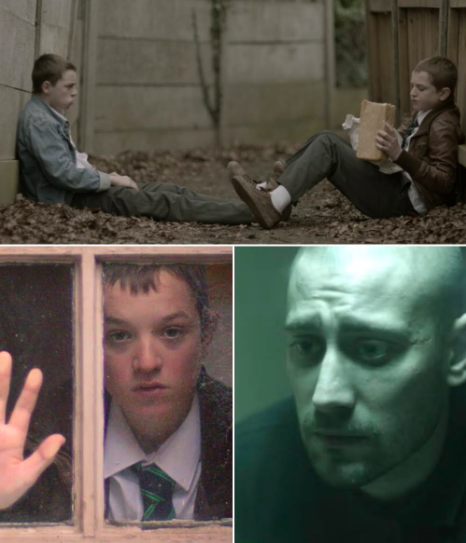
💔😭 I THOUGHT I WAS READY FOR MICHAEL SOCHA’S TRUE-STORY DRAMA… BUT NOTHING PREPARED ME FOR HOW HEARTBREAKING THIS WOULD BE.
Big Boys Don’t Cry Review: Michael Socha Is Heartbreaking in a True-Story Drama That Refuses to Let the Past Stay Buried
There are films that shock you with twists, films that terrify you with what might happen next, and films that quietly leave you carrying someone else’s pain long after the credits have rolled.
Big Boys Don’t Cry belongs firmly in the last category.
Inspired by the real experiences of Paul Connolly, Steve Crowhurst’s 90-minute British drama confronts childhood institutional abuse and the devastating reality that surviving something does not necessarily mean escaping it.
At the centre of it all is Michael Socha.
Best known to many viewers for his work in This Is England and Being Human, Socha gives Big Boys Don’t Cry the bruised emotional centre it desperately needs. His Paul is angry, defensive, unpredictable and sometimes difficult to understand — but beneath all of that toughness is something much more painful.
He is still carrying the frightened boy he once was.
And that is what makes this film so difficult to shake.
The film is based on true events surrounding Connolly, who spent years of his childhood at St Leonard’s Children’s Home in Essex. The production itself is officially described as being inspired by real events, with Connolly serving as an executive producer, while critics have noted that elements of his adult life were fictionalised for dramatic purposes.
That distinction matters.

This is not a documentary, nor should every scene involving the adult Paul be treated as a literal reconstruction of Connolly’s biography. Instead, Big Boys Don’t Cry uses the machinery of a gritty British crime drama to explore something less straightforward: what happens when the experiences a person has spent years suppressing suddenly refuse to remain in the past.
The film’s Paul appears to have constructed his adult identity around toughness.
He works as a bouncer. Violence is familiar territory. Vulnerability is considerably more complicated.
But his carefully built emotional defences begin to collapse when a police investigation connected to his childhood and the death of a boyhood friend forces him to revisit St Leonard’s.
Suddenly, memories that have been pushed into the darkest corners of his mind begin returning.
And Big Boys Don’t Cry understands something crucial about trauma: the past does not politely wait to be remembered.
It intrudes.
A face, a sound, a place or a question can collapse decades in an instant.
The adult Paul may have physically left St Leonard’s, but emotionally, part of him appears never to have escaped.
Michael Socha gives the film its heartbeat
Socha could easily have played Paul as an archetype — the damaged, angry man with a tragic past.
Instead, his performance is far more uncomfortable.
There are moments when Paul seems capable of exploding, but there are equally important moments when Socha does almost nothing.
A stare lasts slightly too long.
His shoulders tighten.
His face changes when a memory surfaces.
The aggression begins to look less like strength and more like armour.
That distinction is everything.
The title Big Boys Don’t Cry carries its own cruel irony. Paul has grown up in an environment where vulnerability can be dangerous and where emotional survival requires a performance of toughness.
The boy learns to suppress fear.
The man inherits the consequences.
Socha’s achievement is making those two versions of Paul feel inseparable.
Even when adult Paul is at his hardest, you can sense the frightened child underneath.

That becomes particularly powerful because Crowhurst structures the story across different periods of Paul’s life.
Mitchell Norman plays the younger Paul, while Joshua Coombes plays his childhood friend Liam. The younger cast members carry some of the film’s most distressing material, and their performances give the adult storyline its emotional context. The British Council lists Norman and Coombes among the film’s principal cast alongside Socha and Zoë Tapper.
The film does not need constant graphic imagery to communicate terror.
Sometimes a child anticipating what might happen is worse.
Sometimes silence is enough.
Sometimes watching a boy realise that the adults who are supposed to protect him are the people he needs protection from is more disturbing than anything a film could explicitly show.
That is where Big Boys Don’t Cry is at its strongest.
It understands that abuse is not merely a collection of terrible incidents. It changes the atmosphere in which a child exists.
Safety disappears.
Trust becomes dangerous.
Authority becomes frightening.
And childhood itself becomes something to survive.
The horror lies in knowing there was nowhere safe to go
There is an especially painful contradiction at the heart of this story.
A children’s home is supposed to represent protection.
For vulnerable children, it should be the place where instability ends.
In Big Boys Don’t Cry, that idea is turned upside down.
The institution becomes the source of fear.
That gives the flashbacks a suffocating quality because the children cannot simply return home after something terrible happens.
This is home.
The film’s depiction draws on Connolly’s experiences at St Leonard’s, where he spent much of his childhood. Contemporary reviews of the film have described his experiences there as involving severe physical abuse, while the institution became associated with wider allegations of physical and sexual abuse involving children in its care.
Knowing the film originates in real experiences changes the way its quieter moments land.
A fictional horror movie eventually allows the viewer to retreat into the comforting thought that none of it happened.
Big Boys Don’t Cry offers no such easy escape.
Behind the dramatization is a real person who grew up carrying memories of institutional brutality.
That reality hangs over every scene.
Zoë Tapper brings warmth to an intentionally cold story
Zoë Tapper plays Anthea, whose relationship with Paul provides a glimpse of the life he might still be capable of building.
Their relationship matters because the film could otherwise become overwhelmingly defined by the past.
Anthea represents something different.
Connection.
Possibility.
The terrifying idea of trusting another human being.
For somebody whose childhood taught him that closeness and authority could bring danger, intimacy is hardly simple.
Paul’s struggle is therefore not merely to remember what happened.
He must work out whether those experiences will dictate everything that happens next.
Can he love someone without expecting abandonment?
Can he trust without anticipating betrayal?
Can he become something other than the version of himself created by the people who hurt him?
The film never pretends those questions have easy answers.
And Socha is particularly good when Paul seems almost embarrassed by tenderness. His character appears far more comfortable with confrontation than emotional honesty.
That makes the softer moments feel strangely dangerous.

Where the film struggles
For all its emotional power, Big Boys Don’t Cry is not flawless.
In fact, its greatest weakness may be that Paul Connolly’s story is simply too large for the film containing it.
The British Council gives the running time as just 90 minutes.
That brevity keeps the story moving, but it also creates frustration.
There are moments when the film feels as though it is racing through material that deserves considerably more space. Supporting characters sometimes appear before the audience has enough time to understand them fully, while the shifts between crime drama, romance, traumatic memory and biographical storytelling do not always fit together seamlessly.
This criticism has appeared elsewhere.
The Guardian argued that the film’s dramatization turns parts of Connolly’s remarkable story into something resembling a more conventional gritty British crime drama, while another review praised its performances but suggested its short runtime prevented the story from reaching the complexity its subject deserved.
That feels fair.
There is enough material here for a limited series.
Perhaps that would have been the more natural format.
Six episodes could have allowed the filmmakers to explore St Leonard’s more deeply, develop the friendships between the children, examine the institutional mechanisms that allowed abuse to persist and give more attention to Connolly’s later achievements.
Instead, Big Boys Don’t Cry occasionally feels like a much larger story compressed into a small container.
Yet strangely, that limitation does not destroy the film.
The reason is Michael Socha.
Whenever the narrative threatens to become too conventional, his performance drags it back toward something rawer.
The real Paul Connolly’s life is even more remarkable
Perhaps the most important thing to understand after watching the film is that its version of Paul should not be confused completely with Connolly’s actual biography.
The Guardian noted a particularly significant difference: although the film presents a version of Paul whose adult life includes prison, the real Connolly did not go to prison. His real-life path included boxing and work as a gym instructor and personal trainer. The same review notes that he learned to read at 25 and later wrote about his experiences.
That context makes the real story arguably even more extraordinary.
Because Big Boys Don’t Cry is ultimately interested in damage.
Connolly’s broader life story also contains survival, reinvention and achievement.
And that is perhaps the one area where the film leaves you wanting considerably more.
We see what was done to Paul.
We see the anger it created.
We see the psychological consequences.
But there is another story waiting beyond the frame: the story of how somebody who had been made to feel worthless could gradually construct a life that contradicted that message.
The film hints at survival.
The real biography demonstrates it.
A film about the things children carry into adulthood
The most powerful idea in Big Boys Don’t Cry is not complicated.
Children grow up.
Their experiences grow up with them.
A frightened child does not magically become an emotionally untouched adult simply because enough birthdays pass.
Trauma changes shape.
Fear can become anger.
Shame can become silence.
Helplessness can become an obsession with control.
And sometimes toughness itself can be evidence of how badly somebody was once hurt.
That is what Socha captures beautifully.
His Paul does not walk around explaining his trauma.
He lives inside it.
It appears in his temper, his relationships, his posture and his inability to completely believe that the past is finished.
The police investigation therefore functions as more than a plot device.
It forces Paul to recognise something he has avoided for years: leaving St Leonard’s was not the same as leaving behind what happened there.
To move forward, he has to turn around.
That is an emotionally brutal proposition.
The young performances may be the hardest to forget
If Socha gives the film its adult emotional weight, the childhood sequences explain why that weight exists.
Mitchell Norman’s young Paul is especially affecting because the performance never feels designed simply to generate sympathy.
There is still personality there.
Still defiance.
Still the instinct to survive.
And that matters.
Films about abused children can sometimes reduce their young characters to symbols of suffering. Big Boys Don’t Cry is more effective when it allows its boys to remain recognisably boys — children trying to find friendship, identity and moments of normality inside an environment that repeatedly denies them those things.
That makes what happens around them feel even more unjust.
They should be worrying about ordinary childhood problems.
Instead, they are learning survival strategies.
The viewer knows these children will eventually become adults.
The terrible question hanging over the film is what kind of adults they will be allowed to become.
It isn’t an easy watch — nor should it be
Calling Big Boys Don’t Cry “entertaining” almost feels like using the wrong vocabulary.
It is compelling.
It is painful.
At times, it is deeply upsetting.
But the film’s value comes from its refusal to turn institutional abuse into a neat story in which suffering happens, justice arrives and everyone walks away healed.
Life rarely provides that kind of ending.
The consequences can continue long after institutions close and headlines disappear.
Survivors continue living.
That may be the film’s most important point.
The scandal is not finished when the abuse stops.
It continues in the lives shaped by it.
And when Big Boys Don’t Cry concentrates on that truth, rather than its more conventional crime-drama mechanics, it becomes genuinely powerful.
Michael Socha is the reason to watch
There are rough edges here.
The film occasionally feels compressed. Some characters deserve more development. Its crime-thriller elements can feel more familiar than the extraordinary true experiences underlying them.
But Socha makes those imperfections easier to forgive.
He refuses to make Paul easily digestible.
His performance is angry without becoming simplistic, vulnerable without becoming sentimental and heartbreaking without constantly asking the audience to cry for him.
That restraint matters.
Because the deepest sadness of Big Boys Don’t Cry comes not from watching a man collapse.
It comes from watching a man who learned, far too young, that collapsing was never an option.
The title initially sounds like an instruction.
By the end, it feels like an indictment.
Big boys don’t cry.
So frightened boys learn to swallow their fear.
They become men.
And decades later, they are still carrying everything they were never allowed to say.
Big Boys Don’t Cry may not be the definitive cinematic account that Paul Connolly’s extraordinary life deserves. Its 90 minutes cannot fully contain the scale of the story, and the decision to reshape parts of his adulthood into conventional crime-drama territory occasionally distracts from something much more powerful.
But when the film focuses on memory, childhood and the invisible distance between surviving and healing, it hits with enormous force.
Michael Socha gives it that force.
Mitchell Norman gives us the child behind the man.
And together, they make the central tragedy impossible to ignore.
Paul escaped the institution.
But escaping a building was only the beginning.
The real battle was learning how to live after leaving it behind.