🚨 Shocking Netflix Doc Exposes Controversial True Story of Professor and Nonverbal Student — Sparks National Debate Over Consent, Power, and Disability Rights!
Netflix has once again plunged viewers into controversy with the release of Tell Them You Love Me, a harrowing new documentary that chronicles the real-life story of Anna Stubblefield, a married ethics professor, and Derrick Johnson, a nonverbal Black man with cerebral palsy. The film explores the complexities of communication, consent, and power dynamics in ways few documentaries dare to attempt. It is already sparking nationwide debate, leaving audiences wrestling with uncomfortable questions about morality, disability, and the limits of human connection.
Directed by Nick August-Perna, known for The Swell Season, and executive produced by Louis Theroux (My Scientology Movie) and Arron Fellows (Louis Theroux Interviews), Tell Them You Love Me recounts the story that made headlines almost a decade ago. It is the story of a professor who, with the best intentions or misguided passion, became entwined in a relationship that would shake ethical boundaries and challenge societal assumptions about love, autonomy, and the rights of disabled people.

THE STORY THAT STARTED IT ALL
Anna Stubblefield, a respected Rutgers University-Newark ethics professor, met Derrick Johnson in 2009 through his brother, John Johnson, a student of Stubblefield’s. Derrick, 28 at the time, was nonverbal and relied on facilitated communication to interact with the world around him. Stubblefield, 39 and married, offered to help him improve his communication skills, believing she could empower him to live more fully. What began as mentorship soon evolved into a relationship Stubblefield describes as consensual and loving.
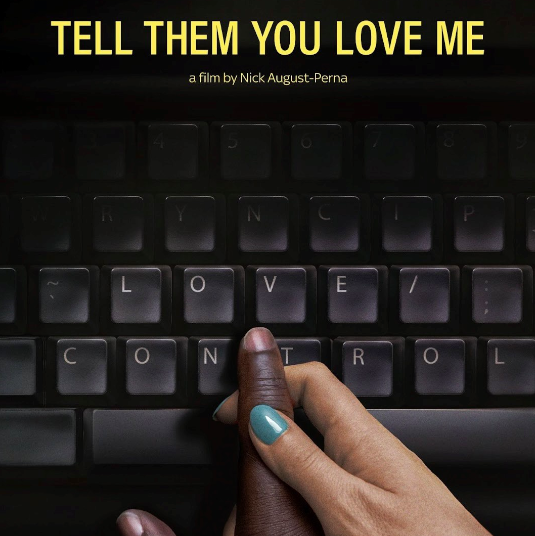
However, Derrick’s mother, Daisy Johnson, vehemently disagreed, claiming that her son was incapable of consent. She argued that the use of a keyboard with an LED screen, a method intended to help him communicate, was manipulated, and that any messages or physical interactions were influenced by Stubblefield. The resulting legal battle divided the public, igniting debates about consent, disability rights, and race in ways that are still reverberating today.
“It’s a complex film about some very nuanced ideas,” director Nick August-Perna told Netflix Tudum. “For me, it’s about people who became enmeshed in a tragedy together. You can’t look at this story in black and white terms—it sits at the intersection of so many societal questions.”
Louis Theroux, who served as an executive producer, shared a similar sentiment: “I came to this story originally via a New York Times article maybe ten years ago, and I was riveted by it. It sat on the fault lines of so many big social questions—around race, sexuality, and, yes, disability.”
WHAT VIEWERS WILL SEE
The documentary meticulously details Derrick Johnson and Stubblefield’s relationship, tracing their time together, the development of communication methods, and the legal proceedings that followed. Through exclusive interviews with Stubblefield, Daisy Johnson, John Johnson, facilitated communication advocate Rosemary Crossley, and Dr. Howard Shane, director of Boston Children’s Center for Communication Enhancement, the film presents all sides of a story steeped in tension and controversy.
The audience witnesses Stubblefield’s attempts to teach Derrick to use a keyboard to express his thoughts. She recounts the growing emotional bond she believed developed between them and the intimate relationship that followed. Meanwhile, Daisy Johnson offers a chillingly protective perspective, insisting that her son could not provide meaningful consent and that the tools used to facilitate communication were flawed, leaving him vulnerable.
Facilitated communication—also called FC, assisted typing, or supported typing—is a scientifically discredited technique intended to assist nonverbal individuals. It often involves a facilitator physically supporting the individual while they type or point to letters. Scientific consensus holds that FC typically reflects the facilitator’s input rather than the disabled person’s own messages. The American Speech-Language-Hearing Association, the American Psychological Association, and the Association for Science in Autism Treatment all caution against its use due to concerns about authenticity and reliability.
Yet, as Theroux points out, the controversy surrounding the documentary isn’t merely about FC. “Facilitated communication is definitely flawed, though I believe it can work in some cases. The greater issue is our presumption about what is best for someone,” he said. “Disabled people who are nonverbal or struggle to speak are inherently more vulnerable to misinterpretation, and that raises the stakes significantly.”
THE TRIAL THAT SHOCKED THE NATION
In 2015, Anna Stubblefield was convicted on two counts of first-degree aggravated sexual assault against Derrick Johnson. The case made headlines across the United States, not only because of the sensitive nature of the allegations but also due to the broader questions it raised about power, ethics, and communication.
Her conviction was later overturned in 2017 on appeal, following a technicality: testimony regarding facilitated communication had been excluded from the original trial. Stubblefield eventually accepted a plea deal for a lesser charge and served two years in prison. She was initially suspended from Rutgers-Newark, and after her release, struggled to regain employment due to the public scrutiny surrounding her case.
The documentary examines these events with painstaking detail. It doesn’t shy away from the legal complexities, but it also humanizes everyone involved. Derrick Johnson, the nonverbal man at the center of the story, is depicted not merely as a victim but as an individual with his own agency, living under the care of his mother and navigating life in ways that remain independent despite the controversy.

ETHICAL QUESTIONS AND PUBLIC DEBATE
Perhaps what makes Tell Them You Love Me so compelling—and so uncomfortable—is the way it raises fundamental questions about ethics and autonomy. Who truly has the right to define consent? How do we navigate the intersection of disability and human desire? What is the line between help and exploitation?
August-Perna emphasizes that the film’s intention is to challenge viewers without providing easy answers. “More than anything, I knew I had to get the balance and the integrity of the storylines just right, to reveal things at just the right times,” he said. The documentary’s structure ensures that each new piece of evidence or perspective reshapes the audience’s understanding, compelling viewers to grapple with ambiguity rather than comfort.
Theroux echoes this perspective. “Communication is power. We have a moral obligation to take it incredibly seriously when it’s either missing, or when it gets hijacked,” he said. “The bigger picture is about respecting the humanity of people who may not be able to articulate their thoughts conventionally.”
THE FILM’S IMPACT AND LEGACY
Since its release, Tell Them You Love Me has ignited conversation on social media platforms, academic forums, and in households across the world. Some viewers defend Stubblefield’s intentions, highlighting the potential for facilitated communication to empower nonverbal individuals. Others side with Daisy Johnson, stressing that vulnerability and dependency can too easily be exploited.
The documentary also invites reflection on the broader societal treatment of disabled individuals. It underscores the importance of access, agency, and ethical responsibility, particularly for those who rely on others to navigate the world.
Ultimately, the film closes with a powerful, humanizing moment: Derrick Johnson, now living with his mother in New Jersey, is shown in a quiet scene that reminds viewers that, despite all controversies, he is safe, healthy, and loved. The final images encourage reflection: how much more might his life have held if circumstances were different, and what obligations do we have to ensure that the most vulnerable among us are protected?
AN ETHICAL LANDSCAPE FOR THE FUTURE
Tell Them You Love Me doesn’t just recount a sensational story—it forces a reckoning with ongoing societal issues. By examining disability, consent, and communication with nuance, it highlights the need for legal and moral frameworks capable of protecting vulnerable populations without stripping them of agency.
The documentary’s team has expressed hope that the film will be a springboard for discussion in classrooms, legal settings, and public forums. “It’s not just a story about two individuals; it’s a story about how we, as a society, choose to navigate ethics, care, and respect,” August-Perna said.
Theroux added, “If the documentary can get people talking—truly talking—about these issues, then it has succeeded. We need more empathy, more understanding, and a deeper examination of what consent really means in complex situations.”
WHERE TO WATCH
Tell Them You Love Me is now streaming worldwide on Netflix. It is a documentary that challenges comfort zones, questions moral certainties, and forces viewers to confront one of the most difficult intersections of human experience: love, autonomy, and ethical responsibility.
FINAL THOUGHTS
Few documentaries manage to be as morally provocative and emotionally affecting as Tell Them You Love Me. It is a story that refuses to allow easy answers, demanding that viewers confront the nuances of human behavior, the limits of communication, and the societal obligations owed to the most vulnerable. In an era where conversations about disability, consent, and power are more urgent than ever, this film is both timely and necessary.
In the end, audiences are left with the haunting question: in a world of blurred boundaries and miscommunication, who truly holds the power, and how should it be wielded?
Stream it now on Netflix and prepare for a documentary experience that will stay with you long after the credits roll.