
Jurgen Klopp’s Secret Comeback Plan? Inside the Quiet Empire He’s Building Away from Liverpool
⚠️Jurgen Klopp’s Secret Comeback Plan? Inside the Quiet Empire He’s Building Away from Liverpool
When Jurgen Klopp waved goodbye to the Kop on that emotional May evening in 2024, Liverpool didn’t just lose a manager — it lost its heartbeat.
For nine years, Klopp wasn’t merely a coach; he was the living pulse of the club, the spark that reawakened the roar inside Anfield and reminded a generation what it meant to believe again.
And yet, 16 months on, the man who once lived and breathed every tackle, every goal, every touchline sprint, now says — almost with defiant calm — he doesn’t miss it at all.
The Silence After the Storm
For decades, Klopp thrived in chaos. The pressure, the expectations, the weight of millions of voices — he carried it like fuel. But even engines built for war eventually burn out.
When he stepped away from Liverpool, many assumed it was a sabbatical — a pause before his inevitable return. But the truth, as he now tells it, is much simpler and more haunting:
“Not. At. All. I miss nothing.”
No more pre-match nerves. No more sleepless nights before derbies. No more standing under the rain at Anfield, willing his players to give everything they had.
Instead, he discovered something managers rarely find — quiet.
He spends his days playing sports, traveling with his wife Ulla, spending time with grandchildren, and — for the first time in 23 years — waking up without a tactical meeting waiting for him.
“I watched some games,” he said, “but it wasn’t like before. I wasn’t counting down to kickoff anymore. I just… let go.”
From Red to Red Bull
Then came the surprise.
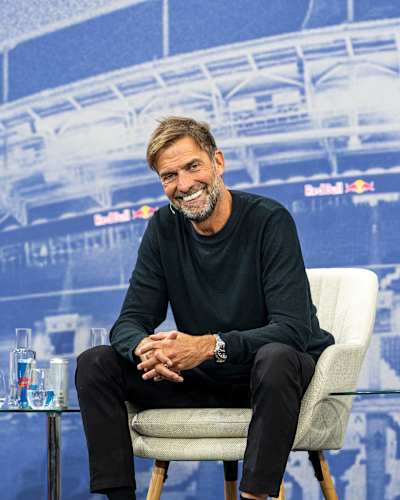
In January 2025, Klopp accepted the role of Head of Global Soccer at Red Bull, overseeing football strategy for RB Leipzig, Salzburg, and the company’s growing network of clubs around the world.
It wasn’t a coaching job. It wasn’t even management in the traditional sense.
It was a role that fit a man who still loved football — but no longer wanted to live inside it.
As Head of Global Soccer, Klopp shapes development programs, advises on recruitment, and helps create a unified identity across the Red Bull system.
He no longer has to win every Saturday. He just has to build — something that lasts longer than one season.
And perhaps that’s the point. Klopp has traded the fever of competition for the quiet satisfaction of architecture.

The Weight of Liverpool
To understand Klopp’s calm, you must first understand what Liverpool took out of him.
When he arrived in 2015, the club was broken. The glory days were folklore, the trophies a distant dream. Within four years, he’d rebuilt it from the soul out — Champions League winners in 2019, Premier League champions in 2020.
But that success came at a price. Klopp poured himself into the club with a kind of manic devotion. Every defeat looked personal. Every victory, a shared catharsis.
He often said, “We play heavy metal football,” but in truth, it was Klopp’s heart that carried the beat.
By 2023, however, that rhythm began to slow. The fixture overload, injuries, the constant emotional strain — it all wore him down. His final season, though respectable, carried an unmistakable fatigue.
He later admitted that his energy had simply “run out.”
“I knew if I kept going, I’d become a problem for the club I love.”
That self-awareness, in many ways, defined Klopp’s greatness. He didn’t cling to power. He chose to leave while the love was still mutual.
A Man Who Refused to Repeat Himself
The football world expected him to rest, then return. Maybe Bayern. Maybe Germany. Maybe one day back to Anfield.
But Klopp seems determined to defy that script.
He insists he has nothing left to prove. He has coached at Mainz, turned Dortmund into a powerhouse, and brought Liverpool back from the ashes.
What more can you give when you’ve already given everything?
Yet, there’s another layer — one that Klopp himself rarely admits.
He fears becoming a parody of himself.
Klopp has seen too many legends stay too long — chasing old glory, trying to recreate what once came naturally. That’s not who he wants to be.
And so, he chose the one thing football doesn’t understand: stillness.
The German Backlash
Not everyone welcomed his new chapter.
When news broke of his partnership with Red Bull, fans in Germany — especially at Mainz and Dortmund — reacted sharply.
To them, Red Bull represented everything Klopp once stood against: corporate football, artificial clubs, profit over passion.
Klopp, typically candid, shrugged off the criticism.
“Everyone can think what they want. I just do what I believe is right. I’m not hurting anyone.”
He’s pragmatic now, less romantic. Perhaps that’s what years in English football taught him — that purity rarely survives the business of the game.
Still, even his critics admit that Red Bull couldn’t have picked a better architect. If anyone can bring humanity to a machine, it’s Klopp.
The Rumors That Never Die
Of course, no football story is ever complete without whispers.
Every few weeks, a headline resurfaces: Klopp linked with Saudi club Al-Ittihad. Klopp to take over Germany after the Euros. Klopp open to Premier League return.
He laughs them off, but his words always carry an escape hatch:
“I don’t plan to coach again. But who knows? I’m 58. Maybe at 65 I’ll change my mind.”
That small sliver of possibility — that “maybe” — keeps hope alive for millions of fans who still can’t imagine football without him.
Because deep down, everyone knows: passion that burns as fiercely as Klopp’s doesn’t just die. It sleeps.
Why He Walked Away — and Why He Might Come Back
Klopp has always been about control.
Not of people — but of purpose.
At Liverpool, his vision was clear: build a team that outworked and outloved the opposition.
At Red Bull, it’s about legacy — creating a system that can thrive without him.
But here’s the irony: even in retirement from coaching, Klopp still coaches.
He mentors, inspires, and shapes philosophy across continents. He just does it from a different vantage point — higher, quieter, but still unmistakably his.
And yet, every time a Liverpool game ends with chaos in defence or a Dortmund crowd sings “You’ll Never Walk Alone,” you can’t help but wonder — does he feel that pull again?
Does he miss the sweat, the roar, the madness he once called home?
He says no. But maybe, just maybe, that’s the only lie he’s ever told in football.
A Legacy That Refuses to Fade
There’s a line Klopp once said that sums up his entire career:
“We have to change from doubters to believers.”
He did that. For Mainz, for Dortmund, for Liverpool — and maybe now, for Red Bull.
He never saw football as a job; it was a cause. Every team he touched became more than a club — it became a family bound by belief.
Now, as he walks the quieter path, his legacy continues to ripple through those who learned under him — Pep Lijnders, Thomas Tuchel, Julian Nagelsmann, and countless others who grew up studying his chaos-made-beautiful philosophy.
The Ending That Feels Like a Pause
Jurgen Klopp once turned football into theatre.
Every match was emotion made visible: the grin, the rage, the hugs, the tears.
Now, his stage is different. No spotlight. No anthem. Just a man who gave everything and finally chose peace.
He says he’s happy — truly happy — and you believe him.
But the world of football, restless and nostalgic, still keeps a light on in the window.
Because deep down, everyone knows… legends like Klopp never really retire.
They just wait for the right moment to return — when the game needs saving again.