
Countdown Creator Breaks Silence on Shocking Cliffhanger, Teases What’s Next
[Editor’s note: The following contains major spoilers for the finale of Countdown.]
In the season finale of the Prime Video series Countdown, entitled “Your People are in Danger,” the task force moved in to apprehend their suspect, only to realize that they’ve got the wrong guy. At the same time, we learn that DEA Agent Amber Oliveras (Jessica Camacho) has been kidnapped and is tied up in a closet after having been knocked out by the real culprit (Grant Harvey), and she’s very angry about it. But bad guys being bad guys, this one has planned ahead and knocks Oliveras out again so that he can drive her to the middle of nowhere and tell her to run. With no other options, Oliveras does just that, and we’re left hoping the series will get picked up for Season 2, so that we can find out whether someone or something stops the FBI-agent-turned-terrorist from pulling the trigger.

During this one-on-one interview with Collider, showrunner Derek Haas discussed why he chose to have more than one case during the season, what kept Mark Meachum (Jensen Ackles) and Oliveras from getting together, that moment when he called out her relationship, the terror of Oliveras getting kidnapped, why it had to be one of the task force members that was targeted, how Camacho was super game for everything that her character was put through in the finale, why he loves cliffhangers, choosing that particular moment to end on, knowing what would come next, that he’d pick up right where they left off for Season 2, and continuing with the show’s slow burn romances.
Collider: Rather than just stretching out one case over the 13 episodes, which you could have done, what made you decide to resolve one case and then start another? How did you figure out the best way to balance that?
DEREK HAAS: I thought it was a unique idea that I haven’t seen done a lot. What I was reacting to is watching streamer shows, knowing that for British shows they’re six episodes and for American shows they’re 10 episodes. When they have one plot, you can’t help but dismiss some of the middle episodes because you know they’re not getting to the climax yet and the danger doesn’t feel real. So, what I was trying to do was take that away from the audience and say, “You have to pay attention because we might be heading towards a climax that you didn’t know was coming, and a new case might start up before we get to the last bit of the season and I want you invested in the next one.” That way, there’s not a neat cut line. So, when I first conceived the story of Volchek and that case, I just mapped out nine episodes. And then, as I was writing it, I was like, “What would happen if I cliffhangered the ninth one so that it bled into the 10th?” And then, I went to Amazon and said, “Would it be crazy to finish this in the middle of 10 and then start a new case?” And they dug it. So, that’s where that came from.
‘Countdown’s Meachum and Oliveras Are Afraid to Act on Their Feelings for Each Other
“But maybe elsewhere isn’t the right answer either.”
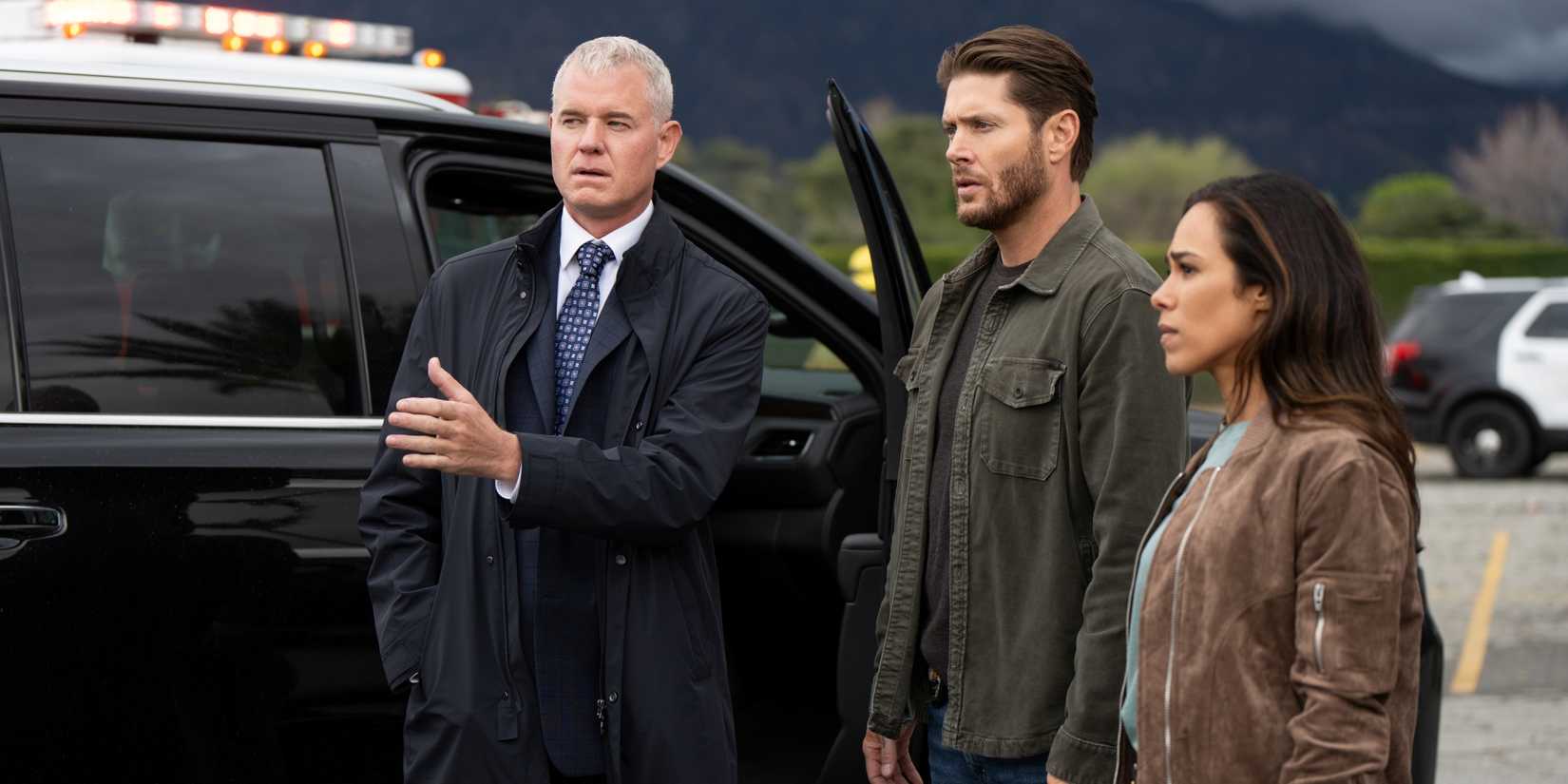
Eric Dane, Jensen Ackles and Jessica Camacho standing outside their car in Countdown
Image via Prime Video
At the end of episode 10, we were left to think that something might happen between Meachum and Oliveras after he finished his treatment. But then, they’re working on a case again together and she’s got this life with the doctor while he’s having booty calls. What led to that decision? What made you want to delay that relationship even longer?
HAAS: There are feelings there. They’re unsure of what would happen if they acted on those feelings. You’re always afraid of not only complicating a good thing you’ve got going on, on the job, but also the genuine, good partnership going on between the two of them. They like each other. They’re friends. Because of that, they look elsewhere, but maybe elsewhere isn’t the right answer either. I think what he’s doing is a reaction to what she did.
Meachum also calls Oliveras out for making the safe choice. That moment between the two of the when she’s telling her that there’s magic between them that can’t be faked and she calls him out for joking with her, as he walks away, you get the impression from the look on his face that he actually meant what he said, but was sort of covering because she thinks he’s bullshitting her. Was she just calling his bluff to see how he’d respond? Did she think he was playing games with her?
HAAS: I love the way that scene turned out, with the interpretation of their performances compared to what was written on the page. There’s always truth in jokes. Words are coming out of their mouths that they don’t mean to say. And then, they pull back from it and we, the audience, get to see the looks on their faces that are like, “That was a little more real than either of us intended.” Even Blythe at the beginning of that episode points out to Meachum, “You joke as a defense mechanism. You’re a smart ass as a defense mechanism. What you are is a leader.” That’s pretty much what’s happening in that scene between Oliveras and Meachum too.
It was such a great moment to have Oliveras sit in her car, have the car fill up with some kind of smoke, and then to see this figure in a gas mask outside of her window. When you decided to have one of your team members get kidnaped by the person who the case revolves around, was it important to have a slow reveal of what was going on in that moment, to make it even more terrifying?
HAAS: Yeah, that was the tone. I was going for terror. You see him making the mixture at the beginning of the episode, but you think that mixture is whatever he’s planning, or that’s the idea. There was the scene at the horse track that made you think, “Is he doing something there? Is this some sort of terrorism?” And then, the fact that her car starts to fill up with gas and some sort of chloroform, I just thought that whole thing would be like a horror movie, which was definitely how it was shot. We also did that in episode 12, when the officer in Wasco calls Bell to his house. I wanted that to play almost like a horror movie that resolves differently than you would have thought.
Was it always going to be Oliveras that he took?
HAAS: Yes. You don’t want it to be a stranger. You want it to have the most impact on all the characters. I just thought that would be super scary.
Before you put a member of your cast in a closet and blindfold and gag them, do you make sure they aren’t claustrophobic and won’t panic?
HAAS: It’s funny, they’re actors, so you write things and then hope that they’ll portray them. We have a lot of things on rooftops of buildings. What you’re hoping is that they’re up for any experience, but we also have great stunt people. What I was most worried about in that scene was Grant [Harvey] banging her. He scoops her up and takes her out the door, and I was worried about him hitting her head as he was going. Jessica is up for anything. There was not one thing that she was not up for this season. I give her a lot of credit. She was like, “Give me more. Give me more running, chasing, throwing scenes.” She was cool. She was up for it. Going way back to Chicago Fire, anything that the actors are up for, then let’s get the actors to do it. Anything that they’re not, we can shoot in a way that a stunt person can do it. I’m never like, “Oh, my God, come on. Get over yourself. Let’s do it.” That’s just not the way it works.
‘Countdown’s Creator Loves a Season-Ending Cliffhanger
“I love making people wait for it.”
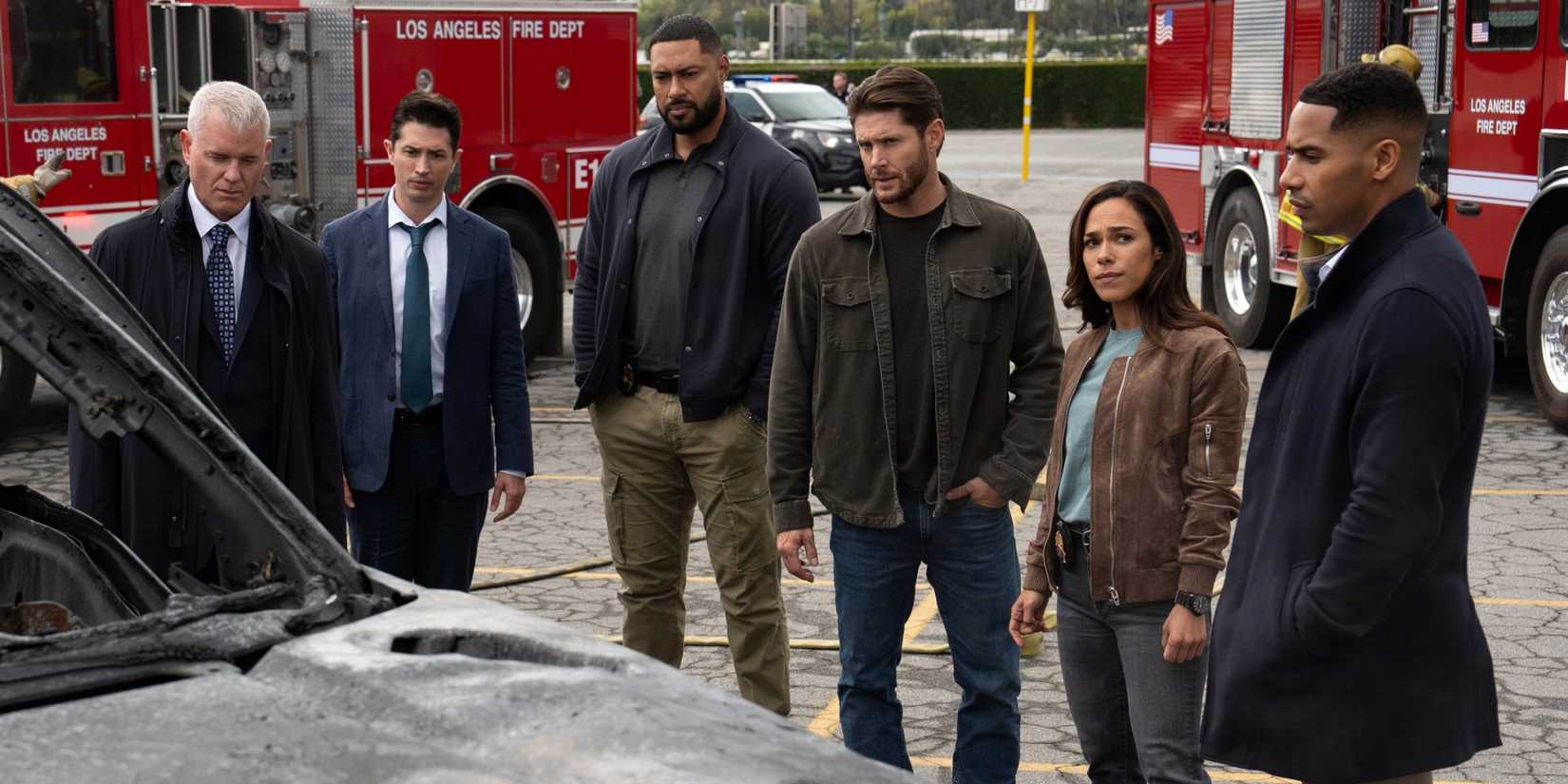
Eric Dane, Jensen Ackles, Jessica Camacho and the task force team looking at a burned car in Countdown
Image via Prime Video
Did you always know that you were going to end the season on a cliffhanger, or was that a decision that came later?
HAAS: I’ve done it. I used to work on the Chicago shows, and one of my favorite things in the world is to cliffhanger a season-ender. People pull their punches because they think, “Will we get renewed? If we don’t get renewed, then it’s not a complete story and audiences will feel betrayed.” I don’t give a shit, I’m doing it. I love making people wait for it. I like that it’s a weekly format. The show was written to be a weekly show. I know that modern viewers will watch it however they want to watch it, so some might wait and binge, but then the case gets truncated. Knowing that we were going to do it as a weekly, I knew that it would feel like a month or two months had gone by as you’re watching the show, so I just used that to my benefit. I love making people wait a week to find out what’s going to happen, and now a year.
You leave us with this final moment with Oliveras taking her blindfold off and running through the woods with this guy that has a rifle. And now, we have to wait for a possible Season 2 to find out what happens to her. What made you decide to leave it on that moment?
HAAS: I want the audience’s reaction to be, “I hate this guy.” You’re going to want that guy caught. And I want them screaming, “No way can you end it like that!” That, to me, is the best feeling. I did have that image in mind, way before writing it. I knew that I was going to set it up in episode 11, foreshadowing that. There’s lots of foreshadowing throughout the show. It just felt like the scariest moment. And I knew that people who are pulling for Oliveras and Meachum to someday get together are really going to be desperate to see what happens next.
‘Countdown’s Creator Already Knows What Would Happen in a Possible Season 2
“I’ve already told Amazon what I want to do.”
When you leave us with a moment like that, do you already know what happens next?
HAAS: Oh, yeah, I know. And I’ve already told Amazon what I want to do if we got another season. So, yeah, I know. I will say, sometimes on [previous] shows, we would write it having no idea what we were going to do, going into the next season. But I had thought about this one already. Sometimes you do write yourself into a corner, so to speak, and if it takes you a while to figure out how to get out of it, that makes for a better writing experience and viewing experience. If it takes you three weeks to figure out what you’re going to do, the audience isn’t going to be able to figure it out in the moment, and that’s exciting.
Would you pick back up in that moment?
HAAS: For sure, I would pick it back up there. I want to pick up in that moment because we also have Shepherd’s sister on life support after ODing. There are a few cliffhangers going on that I do want to resolve in the first 10 minutes of the new season if I get that chance.
You have this team, but then you have individual partnerships forming within that. Having done a season now, are there any character aspects you want to focus on or explore in a Season 2 that you couldn’t do in Season 1, or maybe even didn’t think about until you looked at Season 1?
HAAS: Yeah. I don’t like it when two people are always paired. That’s the old model of police shows, or law enforcement shows. I like that anybody can ride out with anybody else. And I also always love two people who don’t share a lot of scenes together, getting scenes together. I’d like to put Uli [Latukefu] and Eric Dane in a car together because we haven’t seen that dynamic yet. I was thinking that Shepherd and Fitz, if we get Fitz back for a second season, would be fun to see.
You’ve given yourself a lot of different possibilities, as far as how this team can work together. It leaves you a lot to play with.
HAAS: I agree. When I first pitched a task force show, one of the things I emphasized to Prime was that the task force can expand or contract, as needed. Real task forces can be the Coast Guard, NSA, and the Postal Service. The Postal Service helped with the anthrax case that happened right after September 11th. I just love the idea that anybody could come in. Somebody from the Department of Defense could come in. That just brings new character development and new dynamics among the task force, which is very exciting for me. As a show that could go for seasons and seasons, that’d be fun. I love surprising people. It’s my favorite thing to do, as long as the surprise feels earned. That’s what keeps you coming back and that makes good television.
In future seasons, do you want to keep having more than one case a season?
HAAS: Yeah. The idea is that, if the stars line up and we get to have a second season, you’re not going to know when case two ends or when case three ends, or if we’re starting case four. That also depends on whether Amazon maybe comes back and says, “We want 15 episodes,” or “We want eight episodes.” I can’t plan out yet what those stories will be, but I do have cases in mind.
The chemistry between Meachum and Oliveras is more apparent, but there’s also something simmering between Bell and Shepherd. Do you want to continue to explore both of those relationships? Do you want to dig deeper into both?
HAAS: And there’s a new guy on the task force and when the new case starts, which is Fitz, so will it be a Fitz-Shepherd-Bell triangle? I don’t know. Maybe we’ll see. Both of those burns are slow burning. I did like the fact that Shepherd thought that Bell had gotten together with her sister, but that’s not what happened.