
“Crowborough plunges into crisis after a prolonged construction dispute.”
The quiet market town of Crowborough, East Sussex, has been thrust into national attention following a fierce legal and community backlash against government plans to house hundreds of asylum seekers in a former military camp. What began as a policy decision aimed at easing pressure on the UK asylum system has escalated into a full-scale legal challenge, street protests, and rising concerns over public safety.
At the center of the controversy is the government’s proposal to relocate more than 500 asylum seekers to the Crowborough Training Camp, a 37-acre site that has recently been transferred from the Ministry of Defence to the Home Office.
Legal Action Launched at the High Court
A community-led campaign group known as Crowborough Shield has formally launched a legal challenge at the High Court, seeking a full judicial review of the Home Secretary’s decision. The group argues that the plan was introduced without adequate consultation, transparency, or consideration of its long-term impact on the town.
According to Crowborough Shield, the government’s approach breaches the community’s rights to procedural fairness and justice. The group has already raised nearly £70,000 in legal fees to pursue the case.
In a public statement, the organization confirmed that proceedings have been issued against the Home Secretary, asserting that residents were denied the opportunity to understand, scrutinize, or challenge the decision-making process.
Concerns Over Transparency, Policing, and Public Services
Opposition to the plan is not limited to legal arguments. Local residents and campaigners have raised serious concerns about how the camp would be staffed, whether local police forces could manage the additional strain, and how health services would cope with a sudden population increase.
Crowborough Shield argues that insufficient information has been provided regarding security arrangements, access to medical care, and long-term integration strategies. Many residents say the lack of clarity has fueled anxiety and speculation across the community.
Kim Bailey, director of Crowborough Shield, stated that frustration within the town is mounting.
She said the decision feels imposed rather than discussed, adding that the barracks site is unsuitable for housing vulnerable individuals who may have fled war, persecution, or trauma. Bailey also warned that the camp’s proximity to Ashdown Forest, a protected natural area, raises environmental concerns.
Tensions Spill Into Violence
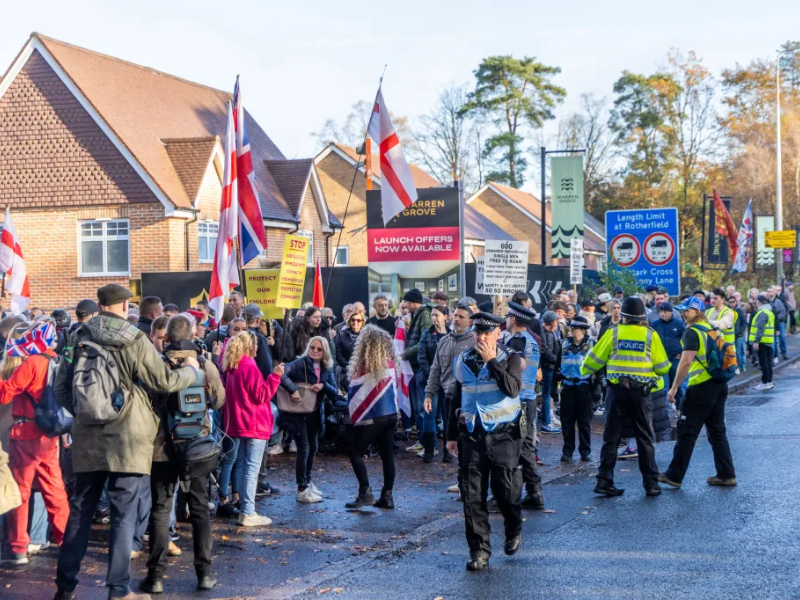
The situation escalated dramatically this week when police arrested a 44-year-old man on suspicion of violent disorder following an incident outside the barracks. According to Sussex Police, officers were called after an alleged confrontation between a protester and a worker attempting to leave the site.
Several police vehicles responded, and authorities issued a temporary Section 34 dispersal order, granting officers the power to clear roads surrounding the camp to prevent further disorder.
Chief Superintendent Nick Dias confirmed that investigations are ongoing into multiple reports of assaults and threats during the incident.
While police emphasized their commitment to protecting the right to peaceful protest, they warned that criminal behavior would not be tolerated.
Mass Protests and Community Division
The unrest comes amid growing public demonstrations. Earlier this week, approximately 1,500 residents marched through Crowborough’s streets, protesting the Home Office’s plans. The demonstrations reflect deep divisions within the town, which has a population of around 22,000 people.
Adding to the tension, a group calling itself the Crowborough Patrol has begun patrolling the town center wearing high-visibility jackets and red baseball caps. The group claims its aim is to deter antisocial behavior following the arrival of migrants.
However, critics have labeled the patrol members “vigilantes,” arguing that their presence risks escalating tensions rather than calming them. One resident warned that the town had become a “powder keg” and that self-appointed patrols could provoke further unrest.
Government Position: Ending Hotel Use for Asylum Seekers
The Home Office maintains that the Crowborough camp is part of a broader strategy to end the use of hotels to house asylum seekers, a policy that has drawn criticism over cost and long-term sustainability.
Officials argue that repurposing existing sites such as military camps offers a more efficient solution. The government has acknowledged shortcomings in how the plan was communicated locally and has issued an apology for its handling of the rollout.

Despite the backlash, the Home Office insists it remains committed to the strategy and has already begun work on upgrading the site. Construction is underway to install accommodation units, toilet facilities, and security fencing in preparation for housing up to 540 asylum seekers.
Local Authorities Explore Their Own Legal Options
In addition to the High Court challenge brought by Crowborough Shield, Weald District Council has confirmed it is seeking advice from senior barristers to explore potential legal avenues should the government press ahead with the plan.
Council representatives say they are assessing whether planning laws, environmental protections, or consultation requirements may provide grounds for further action.
The council’s involvement signals that resistance to the proposal extends beyond grassroots activism and into local governance.
A Site With a Complex History
The Crowborough Training Camp carries historical significance, having been used by Canadian forces during World War II as part of preparations for D-Day. Many residents see this legacy as incompatible with its proposed new role.
The site officially ceased to operate as a Ministry of Defence base earlier this week, with the Home Office assuming control as landlord.
For some in the community, the transformation of a historic military site into a large-scale asylum facility symbolizes broader national tensions surrounding migration, housing, and local consent.
Fear and Uncertainty Among Residents
As the dispute intensifies, some residents—particularly those living alone—say they are installing panic alarms and taking extra security measures due to safety concerns.
Campaigners stress that opposition is not rooted in hostility toward asylum seekers themselves, but rather in fears about infrastructure capacity, safety, and the lack of local engagement.
Nevertheless, the charged atmosphere has created an environment where fear, misinformation, and anger are increasingly difficult to contain.
What Happens Next?
With legal proceedings underway, protests continuing, and construction advancing at the camp, Crowborough now finds itself at a crossroads. The High Court’s response to the judicial review application could determine whether the government’s plan proceeds or is halted for further scrutiny.
More broadly, the situation raises fundamental questions about how national asylum policies are implemented at the local level—and how communities are consulted when decisions with far-reaching consequences are made.
As tensions remain high, residents, authorities, and campaigners alike are watching closely to see whether dialogue, legal intervention, or further unrest will define the next chapter of Crowborough’s unfolding crisis.