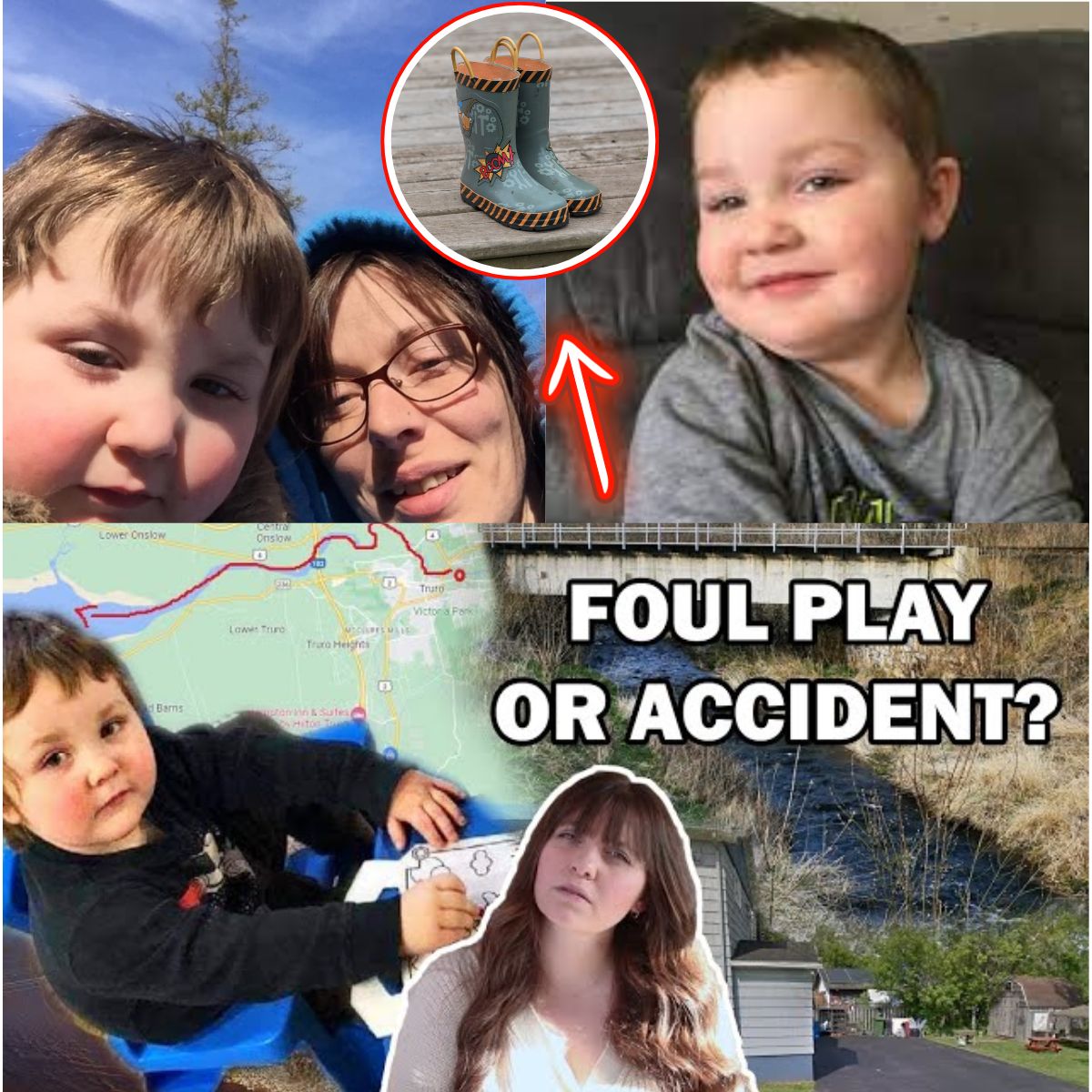
“WHERE DID OUR LITTLE BOY GO?” — SIX YEARS LATER, THE QUESTIONS REMAIN It has been six years since Dylan Ehler disappeared from his grandmother’s yard in Truro, Nova Scotia—and no clear answers have ever emerged.
It was a warm spring afternoon on May 6, 2020, when three-year-old Dylan Ehler was playing happily in the backyard of his grandmother’s home on Elizabeth Street in Truro, Nova Scotia.
One moment the lively little boy with brown hair and hazel eyes was there, toddling around with his grandmother’s dog nearby. The next moment — in what his grandmother Dorothy Parsons later described as possibly just 18 to 20 seconds — he was gone.
Vanished without a trace.
Nearly six years later, as Dylan would be turning nine years old this month, his disappearance remains one of Canada’s most haunting and unresolved missing child cases. Despite massive ground and water searches, underwater cameras, thermal imaging, and repeated volunteer efforts, no further sign of the boy has ever been found — except for his small grey and orange rubber boots, discovered hours later in the nearby Lepper Brook.
The boots, one tangled in debris inside a submerged shopping cart and the other lodged further downstream near where the brook feeds into the powerful Salmon River, became the only physical evidence in a mystery that has torn his family apart and left an entire community desperate for closure.
Truro Police have maintained that there is “no evidence to suggest foul play” and that the most likely scenario is a tragic accidental drowning. But Dylan’s parents, Jason Ehler and Ashley Brown, along with supporters, have long questioned whether investigators pursued other possibilities with enough vigour — accusing police of “tunnel vision” that focused too quickly on the waterway theory.
As fresh volunteer searches continue and an “item of interest” was reportedly found near the grandmother’s house as recently as 2025, the pain for Dylan’s loved ones has not faded. It has only deepened with time.
The day everything changed
Dylan’s mother Ashley had dropped him off at his grandmother Dorothy Parsons’ house that afternoon while she met a friend for coffee. Parsons later told reporters she was in the backyard with her grandson and the family dog. She turned away briefly to tether the dog to its lead.
When she looked back, Dylan was nowhere to be seen.
“I went to tie the dog on her lead and I turn around and Dylan is just gone. Gone. I have no explanation,” Parsons said in one of her rare interviews.
The backyard was not fully enclosed by fencing — there was a gap near the driveway that opened onto Elizabeth Street. Lepper Brook, a fast-flowing waterway swollen by spring snowmelt and recent rain, ran close behind the property, roughly 100 yards away in some accounts.
Within minutes, a frantic search began. Neighbours, police and volunteers combed the area. By evening, the first of Dylan’s rubber boots was pulled from Lepper Brook. About an hour and a half later, the second boot was recovered further downstream, near the point where the brook joins the Salmon River — a waterway known for its strong undercurrents that eventually flows into the massive tides of the Bay of Fundy.
Search efforts intensified over the following six days. Divers, helicopters, dogs, and even a mannequin dressed in similar clothing to test water flow were deployed. But nothing else belonging to Dylan — no clothing, no body — was ever recovered.
The powerful currents and murky waters of the Salmon River and Bay of Fundy have led some experts to suggest that if Dylan did enter the water, his body could have been carried far out to sea or buried deep in silt and debris, making recovery extremely difficult.
A family fractured by grief and doubt
Dylan’s disappearance has not only left a hole in his family — it has driven a painful wedge between them.
His parents, Jason and Ashley, have been vocal in criticising the initial police response. They filed complaints against the Truro Police Service, alleging “tunnel vision” that locked onto the drowning theory too quickly and failed to adequately explore other possibilities, including abduction.
In 2023, the Nova Scotia Police Review Board heard their appeal but ultimately dismissed the complaints. Police have repeatedly stated that the case remains an active investigation with no evidence of criminal activity.
Yet the family’s doubts persist. They point to the speed with which the boots were found and the lack of any other trace as reasons to keep an open mind. Some supporters have questioned how a three-year-old could have made it all the way to the brook so quickly without being noticed, especially if the grandmother only turned away for seconds.
Grandmother Dorothy Parsons has expressed her own belief that “somebody has him,” though she has also cooperated with investigators.
The emotional toll has been immense. Jason Ehler has participated in volunteer searches alongside groups like Please Bring Me Home. In 2021, the family released paper boats into the brook as a memorial. Age-progressed images of what Dylan might look like today have been circulated widely.
In June 2025, five years after the disappearance, a dozen volunteers conducted fresh ground searches near the Salmon River. They reportedly found an “item of interest” about 160 metres from the grandmother’s house, which was turned over to police for analysis. As of early 2026, no major breakthroughs have been publicly announced.
The boots that became the focal point
The discovery of Dylan’s rubber boots remains the most poignant and puzzling detail.
One boot was found submerged in a shopping cart caught in the brook. The second was lodged in debris roughly 60 feet further downstream. Searchers described the water as fast-moving and difficult to navigate even for adults.
Police and some experts believe the boots came off as Dylan entered the water, possibly while trying to play or cross the brook. A three-year-old’s rubber boots can slip off easily in strong currents or mud.
But critics of the official theory ask: If Dylan drowned, why has no other trace — clothing, remains, or even DNA — ever surfaced despite extensive searches? The Bay of Fundy’s extreme tidal ranges (among the highest in the world) could explain why a body might never be recovered, but that same force makes the complete absence of evidence frustrating for the family.
Dylan was last seen wearing a dark green camo jacket with fur around the hood, dark green camo pants, a red T-shirt, and those now-famous rubber boots.
Six years on: Still no closure
As Dylan’s ninth birthday approaches in April 2026, his case continues to tug at hearts across Canada and beyond.
Truro Police have confirmed the investigation remains open and active. They urge anyone with information, no matter how small, to come forward. The tip line is 902-895-5351.
The province has declined to add Dylan’s case to its major unsolved crimes reward program, stating that because foul play is not suspected, it does not meet the criteria. That decision has only added to the family’s frustration.
Volunteer organisations like Please Bring Me Home continue to keep the search alive, organising periodic efforts and raising awareness. Social media groups dedicated to Dylan regularly share age-progressed photos and appeals for tips.
Documentaries and investigative reports, including a W5 special, have examined the case, highlighting alleged shortcomings in the initial response and the emotional toll on the family.
For Jason and Ashley, the pain is compounded by the uncertainty. They have spoken of wanting a place to grieve properly — a grave, a memorial, anything that provides closure. Instead, they live with the daily ache of not knowing.
The wider questions the case raises
Dylan’s disappearance has sparked broader conversations about missing children in Canada, the challenges of searching waterways, and how quickly a toddler can wander out of sight.
It has also highlighted tensions between grieving families and law enforcement when theories diverge. Police must balance thoroughness with limited resources, while families cling to any possibility that their loved one might still be found alive.
In small communities like Truro, such cases leave a lasting scar. Residents still talk about the massive searches in 2020. Some volunteers have never stopped looking.
As one searcher told media during a 2025 effort: “There’s a grieving family behind us right now, and they want their son back.”
A mother’s, father’s and community’s enduring hope
Ashley Brown and Jason Ehler have both expressed the impossible mix of hope and despair that comes with a missing child.
They continue to mark milestones — birthdays, holidays — with heavy hearts. They wonder what Dylan would look like now, what his voice would sound like, what dreams he might have.
The community of Truro has shown remarkable support through vigils, fundraisers and ongoing awareness campaigns. Yet for Dylan’s closest family, no amount of sympathy can replace the little boy who disappeared that May afternoon.
As the sixth anniversary approaches, the message from those who love Dylan remains the same: Do not forget him. Keep looking. Keep asking questions.
Somewhere, they believe, there must be answers — whether in the deep waters of the Bay of Fundy, in overlooked evidence near Elizabeth Street, or in the memory of someone who saw something that day but has never come forward.
Dylan Norman John Ehler was three years old when he vanished. He would be turning nine soon — a school-age boy with brown hair and hazel eyes, who loved playing outside.
His rubber boots were found in the brook. But Dylan himself has never been found.
His family refuses to give up. And neither, it seems, will the people who still hold out hope that one day, this little boy’s story will have an ending — whatever that ending may be.
Anyone with information about Dylan Ehler is urged to contact the Truro Police Service at 902-895-5351 or Crime Stoppers.