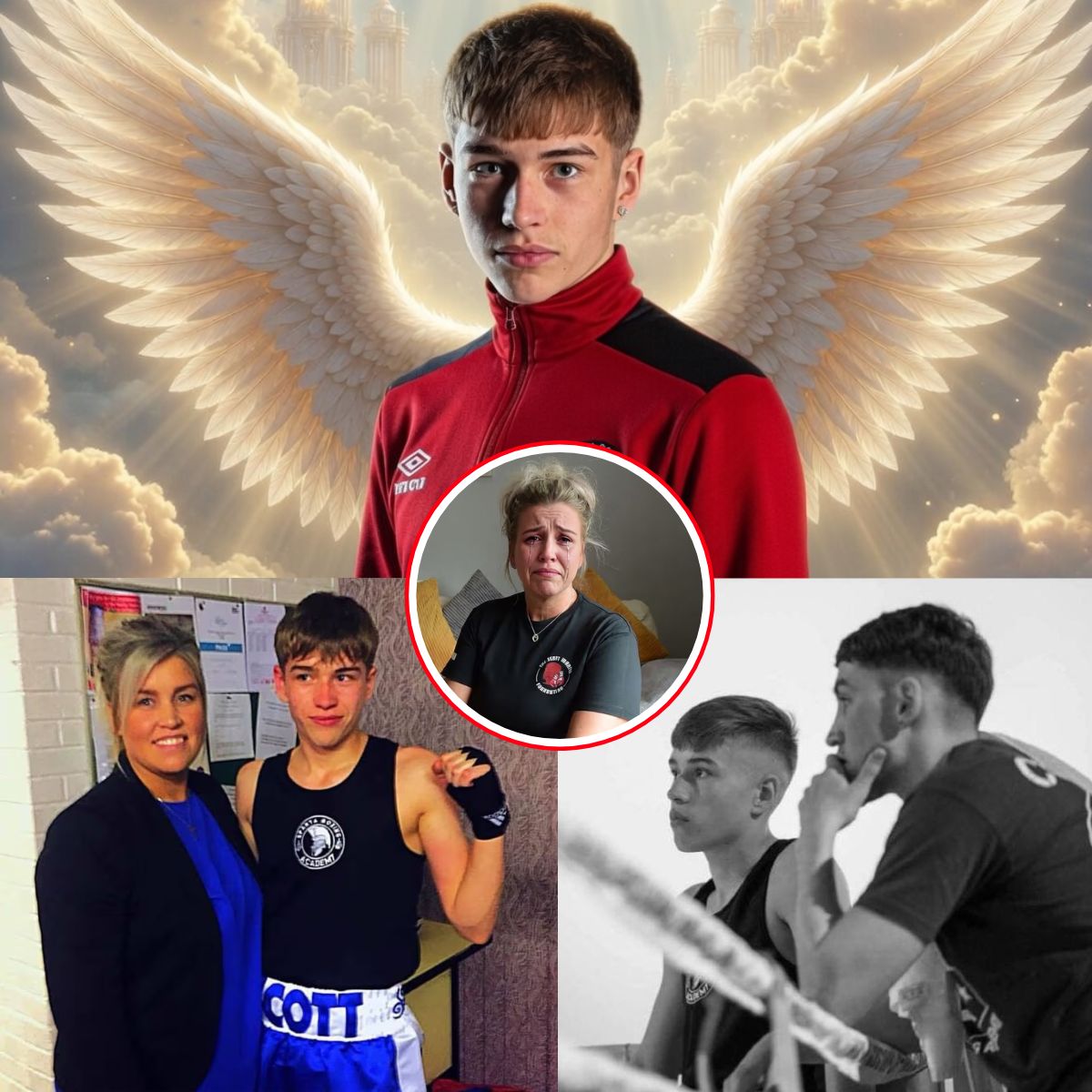
“IT’S A DISGRACE” — a mother’s desperate struggle to save her teenage son has laid bare a deep crisis in Scotland’s child mental health services.
A devastated mother has spoken for the first time in harrowing detail about how her talented teenage son was repeatedly denied urgent mental health care in the desperate months before he took his own life — despite two terrifying suicide attempts and clear signs of a rapidly deteriorating condition.
Samantha Merrilees, 46, from Falkirk, has bravely revealed how her 16-year-old son Scott Martin — a gifted young sportsman who had become Scottish Amateur Boxing Champion just two years earlier — was left waiting nearly a year for specialist help while his paranoia and despair spiralled out of control.
Despite repeated pleas from his desperate family, Scott was turned away from hospital, fobbed off with brief phone calls, and twice almost discharged from the waiting list for Child and Adolescent Mental Health Services (CAMHS) because officials claimed he was “not ill enough”.
Just days after what should have been his first proper assessment — where he openly described believing people could read his thoughts — Scott died by suicide on December 30, 2020.
Five years on, Samantha has hit out at the latest shocking figures showing that young people in Scotland have collectively waited more than 4.5 million days for CAMHS treatment since 2019. She branded the statistics “disgusting” and declared that the system remains “not fit for purpose”.
“It’s a disgrace that kids are still being turned away and that they aren’t being heard, taken seriously or supported,” Samantha told the Record in an emotional interview. “Scott died five years ago in desperate need of help and the latest figures are disgusting. They show that drastic changes are needed.”
Her powerful testimony has reignited fury over the state of children’s mental health services in Scotland, with politicians describing the failures as “inhuman” and “barbaric”.
Scott Martin: A Bright, Talented Boy With Everything to Live For
Scott Peter Martin was born on January 6, 2004, the middle of three brothers. From an early age he was full of character and energy. He loved sport and showed real promise as a footballer, playing youth football for several clubs including Falkirk FC, Hearts, Rangers and Partick Thistle.
In 2018 he discovered boxing and threw himself into it with the same dedication. Within a year he had won the Scottish Amateur Boxing Championship — an incredible achievement for a teenager that filled his family with pride.
He left St Mungo’s High School in Falkirk in 2020 and began working as an apprentice joiner alongside his father David. To the outside world, Scott seemed like any normal, hard-working lad building a future.
But behind the smiles and sporting success, a darker battle was raging.
At just 12 years old, Scott had faced a terrifying health scare when a tumour was removed from his bladder. The trauma of that experience left deep emotional scars. By the time he was 15, he was struggling with self-harm and growing paranoia. His worried family took him to their GP, but the symptoms were dismissed as little more than “teenage hormones”.
It was a catastrophic misjudgement.
First Suicide Attempts — and the System’s First Failures
When Scott confided in a family member that he had self-harmed and even walked out in front of a car in a suicide attempt, Samantha knew she had to act fast. She phoned the NHS immediately and rushed her son to hospital.
“I phoned the NHS straight away and took Scott to hospital,” she recalled. “I asked them to keep him in, to keep him safe. I didn’t know what else to do.”
Her desperate plea for Scott to be admitted for his own protection was refused. Instead, he was discharged and sent back to the GP surgery, where he was prescribed medication and referred to CAMHS.
A few months later, the nightmare deepened. Staff at a local shop became concerned when Scott tried to buy items linked to suicide and refused the sale, contacting the family. That same night, a frightened Scott slept in his mother’s bed seeking comfort.
The GP changed his medication again and upgraded the CAMHS referral to “urgent”. But even an urgent referral came with a chilling warning — it could still take up to 18 weeks just to receive an initial acknowledgement letter.
Eleven Months of Heartbreaking Delay
For the next 11 long months, Scott languished on the CAMHS waiting list. The only support offered was occasional brief telephone calls every couple of weeks — conversations that provided little real help as his condition worsened dramatically.
Samantha repeatedly contacted services to report that her son’s mental health was collapsing. She believed he was developing psychosis, tormented by delusions that he was being filmed 24/7 and that strangers could read his thoughts simply by looking at him.
Despite her warnings, CAMHS attempted to discharge Scott from the waiting list not once, but twice. Officials claimed he did not meet the threshold for immediate specialist care — an assessment that now seems incomprehensible given his history.
Samantha fought back each time, refusing to let her son be forgotten. But the system felt deaf to her increasingly desperate cries for meaningful intervention.
Finally, on December 21, 2020, Scott was given his first proper face-to-face CAMHS appointment. During the session he openly told the clinician about his terrifying belief that people could read his thoughts. Yet the notes from that meeting described him as appearing relatively well, with “good eye contact”. He was told to come back in four weeks’ time.
Just nine days later, on December 30, 2020 — six days before what would have been his 17th birthday — Scott took his own life.
The family was shattered. Samantha has since spoken movingly of the guilt, anger and exhaustion of fighting alone against a system that seemed unable — or unwilling — to act in time.
“If Scott had been properly assessed, I honestly believe he would still be here today,” she has said. “We begged for help for so long and weren’t heard.”
“Disgusting” Figures Spark Fresh Outrage
Samantha’s account comes as shocking new data reveals the scale of the crisis in Scotland’s CAMHS services. Since April 2019, children and young people have collectively waited more than 4,532,581 days beyond the 18-week target for treatment.
The figures, highlighted by the Scottish Liberal Democrats, paint a damning picture of systemic delay. In some health boards, waits have been particularly severe, with NHS Lothian alone accounting for nearly 200,000 excess days.
Samantha did not hold back when reacting to the statistics: “Scott died five years ago in desperate need of help and the latest figures are disgusting. They show that drastic changes are needed and the system is not fit for purpose.”
Scottish Liberal Democrat leader Alex Cole-Hamilton described the situation as “inhuman, barbaric and wrong”.
“This is a tragedy that should never have happened,” he said. “Scott’s experience illustrates that we are dealing with a broken system in urgent need of repair. It is impossible to fathom how Scott could have been neglected like this.”
Scottish Labour’s health spokesperson Jackie Baillie called the failures “scandalous”, pointing out that far too many vulnerable young people continue to face painfully long waits or are turned away entirely.
From Tragedy to Action: The Birth of The Scott Martin Foundation
In the darkest days after losing Scott, Samantha and her family made a vow: his death would not be in vain.
They established The Scott Martin Foundation, a charity dedicated to raising awareness of youth suicide and youth mental health while providing rapid, practical support for young people in the Falkirk area and beyond.
Unlike the slow, bureaucratic NHS pathway, the foundation allows parents or children to self-refer and access funded counselling and therapy sessions almost immediately. It has already helped more than 200 children through community donations and fundraising events.
“Parents or children can refer themselves and get help straight away,” Samantha explained. “If someone asks for help, they will get it.”
The foundation has become a lifeline for families who feel let down by official services — offering the swift intervention that Scott so desperately needed but never received.
Samantha has also thrown herself into campaigning, working with the Daily Record’s Save Young Lives initiative to demand shorter waiting times, better training for frontline staff, and the introduction of suicide prevention education in schools.
The Wider Crisis: A Generation Crying Out for Help
Scott’s story is tragically far from isolated. Across Scotland — and the rest of the UK — child and adolescent mental health services have been stretched to breaking point for years. The COVID-19 pandemic, social media pressures, academic stress, family breakdowns and the lingering effects of lockdown have driven a surge in demand.
Referrals to CAMHS have risen sharply, yet resources have struggled to keep pace. Young people with serious issues — including self-harm, suicide attempts and emerging psychosis — are too often told they are “not ill enough” for urgent care, only to deteriorate while they wait.
Experts warn that every unnecessary delay can have fatal consequences. Suicide remains one of the leading causes of death for young people in Scotland, and campaigners argue that the current system is simply not equipped to respond with the speed and compassion required.
While the Scottish Government claims progress — with some boards reporting that 90% of young people now start treatment within 18 weeks and waiting lists at historic lows in certain areas — families on the ground tell a different story. Many still face months of uncertainty, inconsistent support, and assessments that fail to capture the true severity of a child’s distress.
Politicians from across the spectrum have called for urgent investment: more specialist staff, better integration between GPs, hospitals and CAMHS, mandatory suicide prevention training, and a complete overhaul of referral and triage processes.
Yet for grieving mothers like Samantha Merrilees, warm words and target statistics offer little comfort when the human cost has already been paid.
A Mother’s Unbreakable Love and a Call for Change
Five years after losing her son, Samantha Merrilees continues to fight — not just for justice for Scott, but for every other child who might be slipping through the same cracks today.
Her courage in speaking out so openly has touched hearts across the country. It has forced uncomfortable questions about whether a wealthy nation like Scotland can truly claim to value its young people when so many are left waiting in despair.
Scott Martin was a talented boxer, a loving son and brother, a boy with dreams and potential. He should have been given every chance to overcome his struggles and live a full, happy life.
Instead, his final months were marked by fear, isolation and a system that repeatedly failed to hear his cries — or his mother’s desperate pleas.
As Samantha continues her tireless work through the Scott Martin Foundation, she carries a simple but powerful message: when a child asks for help with their mental health, they must be heard, taken seriously, and supported — immediately.
Anything less is not just a failure of policy. It is a failure of humanity.
The figures may show some improvement on paper, but for families who have lived through the nightmare, the reality remains painfully clear: drastic changes are still needed. The system must become fit for purpose — before more bright young lives like Scott’s are lost forever.
Scott’s memory, and the love of a mother who refused to stay silent, demand nothing less.