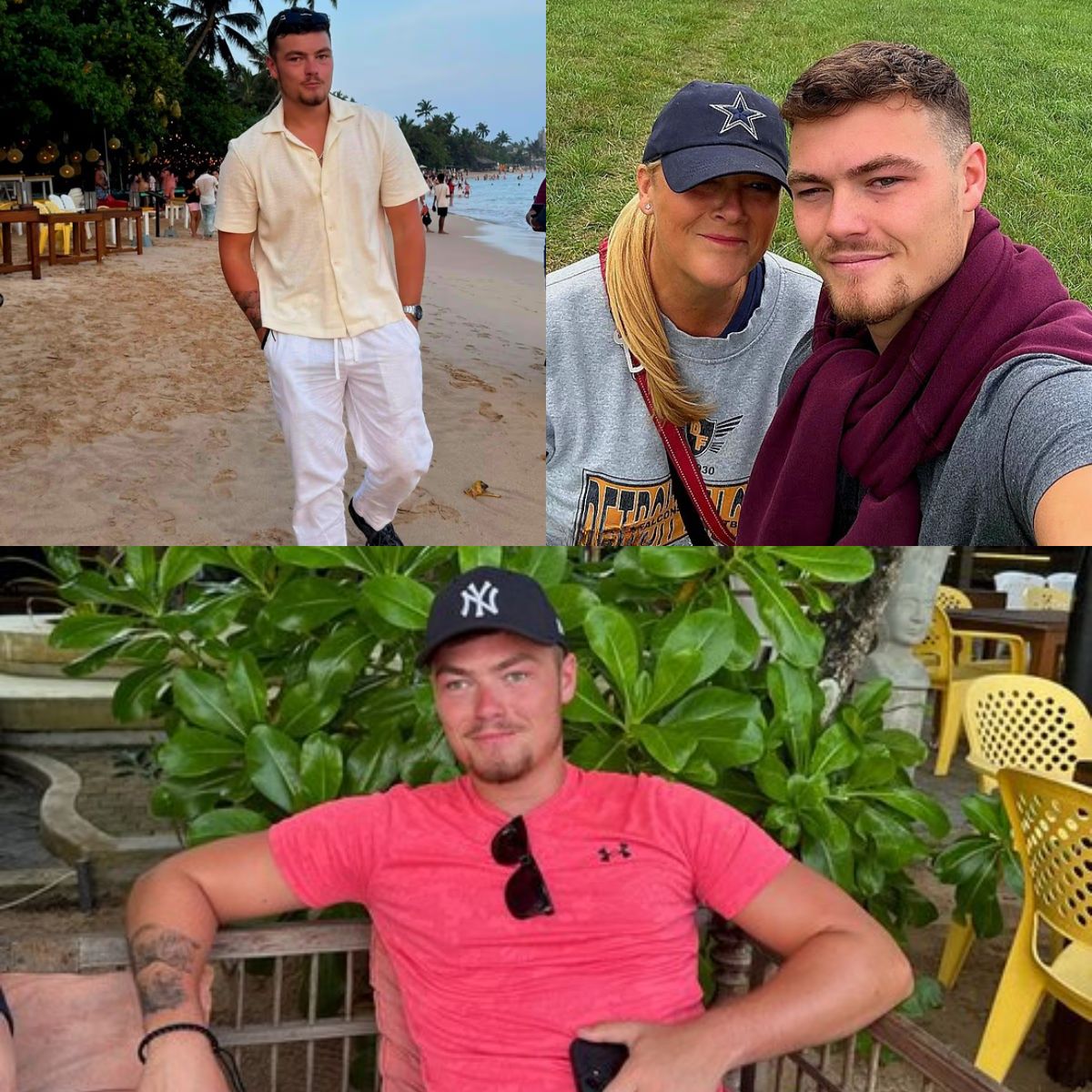
“IF LOVE ALONE COULD HAVE SAVED HIM, HE WOULD HAVE LIVED FOREVER” — A MISSED WARNING THAT TURNED FATAL
A devastated mother has spoken of her heartbreak after her “picture of health” 21-year-old son – a dedicated police officer and qualified personal trainer – died from a rare and aggressive brain tumour that doctors initially dismissed as simple vertigo for nearly five months.
James Mann, a fit and driven young man from Bedfordshire who loved his job, sport and helping others, complained of feeling “imbalanced” shortly after returning from a dream holiday in Greece last June. What began as a seemingly minor balance issue rapidly escalated into vomiting, inability to walk without support, and eventually a terminal diagnosis that gave him just weeks to live.
His mother, Dianne Mann, has revealed how James visited his GP on multiple occasions between June and September 2025, only to be repeatedly told he was suffering from benign vertigo caused by dislodged crystals in his ear. Even as his symptoms dramatically worsened – leaving the once-athletic officer unable to drive, steady himself without holding onto walls, or continue working – doctors signed him off work and sent him home with basic head-tilting exercises.
It was only after Dianne pushed relentlessly for an urgent MRI scan that the devastating truth emerged: a large mass on James’s brain. By then, the tumour – later identified as the highly aggressive H3K27 midline glioma – had already taken a firm hold in his brainstem. Despite emergency surgery that removed around 70 per cent of it, the cancer grew back with terrifying speed, spreading to other parts of his brain. James died at home surrounded by his loving family on January 30, 2026 – just nine hours after being told he had less than 24 hours left.
“If love alone could have saved James, he would have lived forever,” Dianne said in an emotional tribute. “We were together the whole time, and he died at home with us.”
From holiday high to terrifying dizziness: The first warning signs ignored
James Mann was the epitome of youthful strength and vitality. At just 21, he was already a serving police officer, a qualified personal trainer, and someone who threw himself into sport and fitness with passion. Friends and family described him as busy, driven and full of life.
In June 2025, he returned from a sunny holiday in Greece feeling slightly “imbalanced”. At first, he brushed it off, assuming his ears simply hadn’t cleared from the flight. After waiting two days, he visited his GP.
The doctor diagnosed benign paroxysmal positional vertigo (BPPV) – a common condition where tiny crystals in the inner ear become dislodged, causing dizziness. James was given simple head-tilting exercises and sent home to rest.
Within weeks, however, the dizziness intensified dramatically. He began vomiting and struggled to keep his balance. By August, he had returned to the GP four times. Each time he was reassured it was still vertigo and signed off work.
His mother Dianne grew increasingly alarmed. In September, when James’s condition continued to deteriorate – he could no longer walk without steadying himself against walls or furniture, and had to stop driving – she spoke directly to the doctor.
“I expressed my grave concerns that his symptoms were getting worse,” Dianne recalled. “It was an acceleration of the same symptoms. His dizziness was affected, and he was struggling to walk without touching either the walls or furniture to steady himself. He also had to stop driving.
“He was a busy, driven 21-year-old who loved his work and was having the best life, so he was really frustrated. None of us could understand how someone who was the picture of health, a qualified personal trainer who loved his sport and was the epitome of strength, could suddenly be like this.
“It seemed a bit crazy that nothing seemed to be able to be done for something that is extraordinarily debilitating for him, out of thin air.”
The fight for an MRI that came too late
Frustrated and frightened, Dianne insisted on another appointment the very next day and demanded an urgent referral for an MRI scan at Bedford Hospital. Although the request was marked “urgent”, she was warned it could take up to four weeks.
Unwilling to wait, Dianne called the hospital every single day, checking for cancellations. Her persistence paid off, and James finally had his scan on November 10, 2025.
“That is when our world just collapsed,” Dianne said.
The radiographer immediately expressed concern about a large mass visible on the brain. James was rushed to the neurology team at Addenbrooke’s Hospital in Cambridge, where he underwent emergency surgery just three days later on November 13 to relieve life-threatening pressure on his brain.
Surgeons fitted an external drain and managed to remove around 70 per cent of the tumour, but its location in the brainstem made complete removal impossible. Post-operative complications followed: his brain was not draining correctly, and he developed a serious infection that set his recovery back significantly.
Further surgery was needed to repair a wound on his head, and in early December he had another procedure to insert a shunt. During recovery, James suffered a seizure and was placed in a medically induced coma for five days.
In typical James style, when he woke up he tried to sit up and pull the tube out of his mouth, telling doctors he had “had enough”.
The devastating diagnosis: H3K27 midline glioma with a prognosis of months
The family was then given the crushing news: James had a high-grade, progressive H3K27 midline glioma – an aggressive tumour that typically grows in the brainstem, thalamus, midbrain or spinal cord. The prognosis is usually less than a year from diagnosis, often much shorter.
Despite the grim outlook, James was initially allowed home in December after coming off life support. Dianne never left his side.
“I was with him every day, either sleeping on the chair or on the floor,” she said. “The first few weeks at home were challenging for him – he was mobile, albeit unsteady.”
In the first week of January 2026, doctors said James appeared more settled following the surgeries and could be considered for radiotherapy to target the remaining tumour.
But just a week later came the heartbreaking update. The oncologist delivered the news the family had feared most: the tumour had grown back in its entirety in just three-and-a-half to four weeks, and appeared to have spread to other areas of the brain.
“At that point he was given a handful of weeks to three months to live,” Dianne said.
James’s final weeks: Loving, laughing and preparing his family
Even as his condition rapidly declined, James remained determined to make every moment count. He spent time crafting heartfelt conversations with his older siblings – Ben, 26, and Kate, 24 – giving them what Dianne described as a “blueprint of how to live and cope without him”.
“He navigated and crafted conversations with them for them to somehow have a blueprint of how to live and cope without him,” she added. “He spent every moment just loving everyone and laughing and sharing every moment with us.”
James’s health deteriorated sharply in late January. Suddenly, the family was told he had less than 24 hours to live. He passed away peacefully at home just nine hours later on January 30, 2026, surrounded by the people who loved him most.
“We did what we’ve done as a family forever – we were together the whole time, and he died at home with us,” Dianne said.
A family’s questions and calls for better awareness
Dianne and the Mann family are now left with painful questions about whether earlier detection could have changed the outcome. They wonder if the repeated dismissals of James’s worsening symptoms as “just vertigo” delayed critical intervention at a stage when the tumour might have been more treatable.
James’s case highlights the challenges of diagnosing rare brain tumours, whose early symptoms – dizziness, imbalance, headaches – can easily be mistaken for more common, benign conditions like vertigo or inner-ear problems.
H3K27 midline glioma is particularly aggressive and difficult to treat because of its location in critical areas of the brain. Survival rates remain heartbreakingly low, with many patients living only months after diagnosis.
Medical experts stress that while most cases of dizziness are not caused by tumours, persistent or rapidly worsening symptoms – especially when accompanied by vomiting, balance problems or neurological changes – should prompt further investigation, including imaging.
Dianne has spoken movingly of her son’s strength and positivity even in his final weeks. A qualified personal trainer who helped others stay fit, James faced his own devastating illness with courage and grace.
The family has paid tribute to the NHS staff who cared for James, particularly at Addenbrooke’s, while expressing frustration at the initial delays in diagnosis.
Tributes pour in for a young man taken too soon
James Mann is remembered by colleagues in the police force, friends from his personal training work, and his loving family as someone who lived life to the full.
His mother’s words capture the depth of their loss: “If love alone could have saved James, he would have lived forever.”
The family has asked for privacy as they grieve, but Dianne hopes sharing James’s story will raise awareness of brain tumour symptoms and encourage others facing similar unexplained neurological issues to push for thorough investigations.
Brain tumour research charities have noted that symptoms like persistent dizziness, vomiting, balance problems and headaches should never be ignored, especially in young, otherwise healthy adults.
James’s death at just 21 has left a huge void in the lives of his mother Dianne, siblings Ben and Kate, and all who knew him. He was a young man with so much to give – a police officer protecting his community, a personal trainer inspiring others to be strong, and a beloved son and brother whose warmth touched everyone around him.
Instead of celebrating his future, his family is left mourning a life cut tragically short by a disease that crept up silently while symptoms were repeatedly dismissed.
As they come to terms with their loss, the Mann family clings to the memories of James’s laughter, determination and love in his final weeks.
They will remember him not as the young man who fought a losing battle against a cruel tumour, but as the vibrant, strong 21-year-old who faced the end with courage, grace and an unbreakable bond with those he loved.
James Mann’s story is a poignant reminder of how quickly life can change – and how important it is to listen when symptoms persist and worsen, no matter how “minor” they may initially seem.