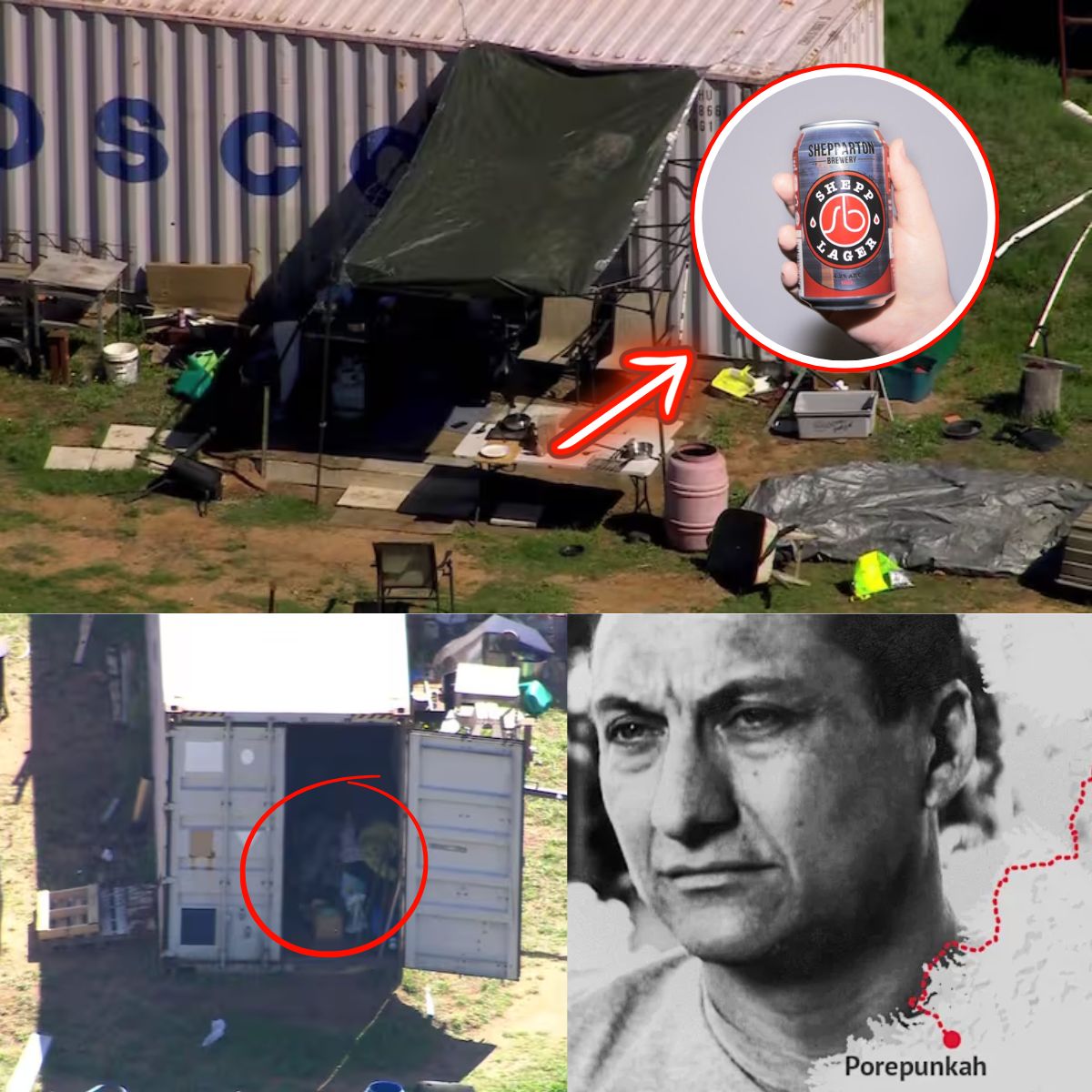
EXCLUSIVE: Inside the intense final chapter of Australia’s most wanted cop killer — Dezi Freeman. Concealed in a filthy shipping container deep in the wilderness, he was convinced he had disappeared without a trace. But in the end, it was the simplest clues — scattered camp chairs, empty beer cans, and even those once loyal to him — that unraveled everything.
It was supposed to be the perfect hideout – a remote patch of Australian bushland so isolated that even the most seasoned trackers might never find it.
But for Dezi Freeman, the 56-year-old self-styled sovereign citizen and conspiracy theorist who gunned down two police officers in cold blood last August before vanishing into the rugged Victorian high country, his final refuge would prove anything but safe.
Instead, the double killer’s last stand ended in a hail of police bullets on a sleepy Monday morning in late March 2026, after a tense three-hour standoff at a ramshackle property near Thologolong, close to the New South Wales border.
Now, piecing together the dramatic final chapter in one of Australia’s biggest manhunts, police insiders have revealed how Freeman – a man once thought to have perished by his own hand in the unforgiving wilderness – was only recently holed up at the site where he met his end.
And damning clues left behind at the scene tell a story of external support that kept the fugitive alive for seven long months: three well-worn camp chairs arranged casually around a fire pit, and an open box of beer, its contents partially consumed, sitting in plain view like a casual invitation to visitors.
“Those camp chairs and that beer weren’t there for one man living alone in the scrub,” one senior police source told us, speaking on condition of anonymity. “It was visual proof that Freeman had help. Someone – or several someones – was coming and going, bringing supplies, keeping him alive. He didn’t survive out there on bushcraft skills alone.”
Freeman’s death brings to a close a saga that began on the foggy morning of August 26, 2025, in the quiet alpine town of Porepunkah, nestled in Victoria’s northeast high country.
On that fateful day, a team of police officers arrived at Freeman’s property to execute a search warrant as part of an investigation into alleged sex offences. What should have been a routine operation turned into carnage in seconds.
Detective Leading Senior Constable Neal Thompson, 59, a respected veteran officer and devoted family man known for his love of AFL and adventure, was shot dead alongside Senior Constable Vadim De Waart-Hottart, 35, a Belgian-born cop with a promising career ahead of him. A third officer was wounded in the ambush and required surgery.
Freeman, armed and unrepentant, fled on foot into the dense bushland of Mount Buffalo National Park, taking the slain officers’ service handguns with him. He was last seen disappearing into the mountain fog, a figure straight out of a thriller – a man with extensive bush survival knowledge who had hiked the area since he was a teenager. His own son once described the rugged terrain as his father’s “second home.”
For the next seven months, Freeman became Australia’s most wanted man. A massive manhunt involving hundreds of officers from Victoria Police, supported by interstate forces, the Australian Security Intelligence Organisation and even elements of the Australian Defence Force, scoured the steep, rocky landscape riddled with caves, mineshafts and unforgiving wilderness.
A A$1 million reward was offered for information leading to his capture. Travel warnings were issued. The operation was described as one of the largest tactical policing efforts in Australian history.
Yet week after week, month after month, there was no sign of the fugitive. No confirmed sightings. No credible tips that panned out.
By early 2026, senior investigators were privately conceding that Freeman may well have taken his own life in the bush, his body perhaps lost forever in one of the many treacherous gullies or abandoned mine shafts that dot the high country.
“Until less than two weeks before the operation that ended it all, the working theory for many was suicide,” another police source revealed. “He had the skills to survive initially, but seven months? In that terrain? It seemed impossible without help. We started scaling back resources, focusing on cold-case angles and possible remains recovery.”
But behind the scenes, a small team of dedicated investigators refused to let the case go cold. Using a combination of electronic intelligence, long-cultivated human sources within Freeman’s circles, and old-fashioned dogged police work, they began piecing together a different picture.
Freeman hadn’t simply melted into the mountains to die. He had been moving – carefully, sporadically – with the assistance of a tight-knit group of supporters, many drawn from the fringes of the sovereign citizen movement he championed.
The breakthrough came in the days leading up to March 30, 2026. Intelligence pointed to a remote family property on Murray River Road at Thologolong, an isolated farming community about 130km north of Porepunkah and less than a kilometre from the NSW border.
The site featured three ageing shipping containers, some crudely converted into makeshift living quarters. Freshly installed spinning air ducts on the roofs suggested recent efforts to make the metal boxes habitable during the scorching summer heat.
It was no luxury bolthole. Photos and descriptions from the scene paint a picture of squalor: basic camping gear, scattered supplies, the detritus of a man on the run trying to stay hidden.
But the giveaway? Those three camp chairs and the open box of beer.
“Freeman had only recently relocated there,” a third police insider confirmed. “The setup wasn’t long-established. It looked like a temporary camp that had seen visitors. The chairs were arranged for conversation, not solitary use. The beer was fresh enough to indicate recent social activity. This wasn’t a lone wolf in the wilderness. He had an inner circle keeping him going.”
Police believe a member of that very inner circle – perhaps growing weary, fearful of the mounting pressure, or tempted by the reward – finally tipped off authorities.
More than 24 hours before the final confrontation, members of Victoria Police’s elite Special Operations Group (SOG) moved into position around the property, establishing a 360-degree containment. They lay in wait, observing, planning.
Specialist negotiators and tactical officers spent time trying to coax Freeman out peacefully. They knew he was armed – likely with one of the police service pistols stolen from the slain officers in Porepunkah.
On the morning of Monday, March 30, the operation reached its climax shortly after 8.30am.
Freeman emerged from his shipping container hideout, wrapped in a blanket or doona against the chill. For hours, officers had been urging him to surrender.
According to police accounts, he confirmed his identity during the standoff. In one dramatic moment, he is said to have admitted to the murders as he faced down the specialist team.
Then, he dropped the covering to reveal a weapon.
Multiple officers opened fire. Around 20 shots were exchanged in total, though it remains unclear if Freeman managed to discharge his gun. No police were injured.
Freeman was pronounced dead at the scene. His body was later removed as forensic teams swarmed the property, combing every inch for evidence – including clues that could lead them to those who harboured him.
Victoria Police Chief Commissioner Mike Bush later confirmed the shooting had ended the seven-month hunt, though formal identification via the coroner was pending at the time.
For the families of the slain officers, Neal Thompson and Vadim De Waart-Hottart, it brought a measure of closure – though the pain of their loss remains raw.
Thompson’s partner, herself a police officer, described him as “the best husband she’d never had” in tributes that moved many across the force.
De Waart-Hottart, a younger officer with his life ahead of him, left behind colleagues and friends stunned by the brutality of the attack.
In Porepunkah, the small close-knit community that found itself thrust into the global spotlight, reactions were mixed: shock, sadness, relief.
Locals who knew Freeman as a freelance photographer and outspoken conspiracy theorist expressed disbelief that he had been hiding so close by for parts of his time on the run. One neighbour at Thologolong told reporters they had no idea the fugitive was on the adjacent property until the gunshots rang out.
“I was surprised he was here,” the resident said, capturing the sentiment of many in the quiet farming area.
Freeman’s own family – including his wife Mali and their three children – had spent the seven months believing he was likely dead, according to reports. His death came as a profound shock.
Questions now swirl around exactly how Freeman evaded capture for so long. How did a 56-year-old man, albeit one with deep knowledge of the bush, survive in such harsh conditions without detection?
The camp chairs and beer provide part of the answer: external support from a network of sympathisers, possibly fellow sovereign citizens or acquaintances drawn into his web of anti-government rhetoric.
Police are now turning their attention to tracing those helpers. Electronic records, phone intercepts, and physical evidence from the site are being scrutinised. One source hinted at an intercepted call and other intelligence that narrowed the net in the final weeks.
Freeman’s ideology played a central role in his life and, ultimately, his downfall. As a vocal sovereign citizen, he rejected the authority of the state, courts and police – a worldview that allegedly led him to open fire when officers arrived with a lawful warrant.
His Facebook posts and online activity had long raised red flags, including commentary on other incidents involving police.
Yet for all his bluster about freedom and resistance, his end was solitary and violent, cornered in a converted shipping container far from the ideological battles he once waged online.
The property at Thologolong, with its cobbled-together campsite and basic amenities, stands in stark contrast to the vast wilderness he once roamed freely.
Investigators noted that the location was almost ideal for police – surrounded, with limited escape routes, and far enough from dense population to allow a controlled operation.
“If we could have chosen any place to corner a dangerous offender like Freeman, this was close to it,” one tactical officer reportedly said.
As forensic teams continue their work, the full story of Freeman’s seven months on the run is slowly emerging.
He is believed to have moved between locations, relying on pre-positioned supplies, occasional resupplies from supporters, and his own survival skills honed over decades of hiking Mount Buffalo.
There were periods where police came tantalisingly close – intensified searches in specific gullies, drone surveillance, dog teams – but he slipped away each time.
Until the inner circle fractured.
The open box of beer and trio of camp chairs may seem like small details in a saga of murder and manhunt, but to investigators they were the smoking gun of complicity.
“Someone sat there with him, sharing a drink, talking about the ’cause’ or just keeping him company,” a source said. “That support network kept him alive – and ultimately helped lead us right to him.”
In the days following the shooting, the remote property buzzed with activity: crime scene investigators in white suits, police vehicles lining the dirt track, helicopters overhead.
A gun believed to be one of the stolen service pistols was reportedly seen near the container.
Questions remain: Did Freeman fire back in his final moments? What exactly did he say when he identified himself and confessed? How deep does the support network run?
Victoria Police have released limited bodycam or video footage details, but insiders say recordings exist of the dramatic confrontation.
For the broader community, especially in regional Victoria, the case has reignited debates about sovereign citizen extremism, police safety, and the challenges of tracking fugitives in Australia’s vast bushlands.
Porepunkah, once a peaceful tourist spot known for its scenic beauty, now carries the scars of that August morning.
Residents hope for a return to normalcy, but the memory of the two fallen officers – and the massive operation that followed – will linger.
Freeman’s death also raises uncomfortable questions for his family and associates. His wife and children, who maintained they believed him dead, now face a new reality.
Police have been careful not to speculate publicly on accomplices, but the investigation into harbouring a fugitive is very much active.
One senior detective summed it up: “You can hide, but you can’t run forever. Especially not when your own people start to turn.”
As Australia processes the end of this extraordinary chapter, the focus shifts from the manhunt to justice for the victims’ families and accountability for anyone who aided Freeman’s evasion.
The shipping containers at Thologolong will be dismantled, the camp chairs removed as evidence, the beer box catalogued.
But the images of that remote bush site – and the simple items that betrayed the double killer’s support network – will remain etched in the minds of those who hunted him.
Dezi Freeman’s final days were not those of a lone martyr in the wilderness, but of a man sustained by others until his luck, and his hiding place, ran out.
In the end, the bush that once sheltered him delivered him straight into the hands of the law he so despised.