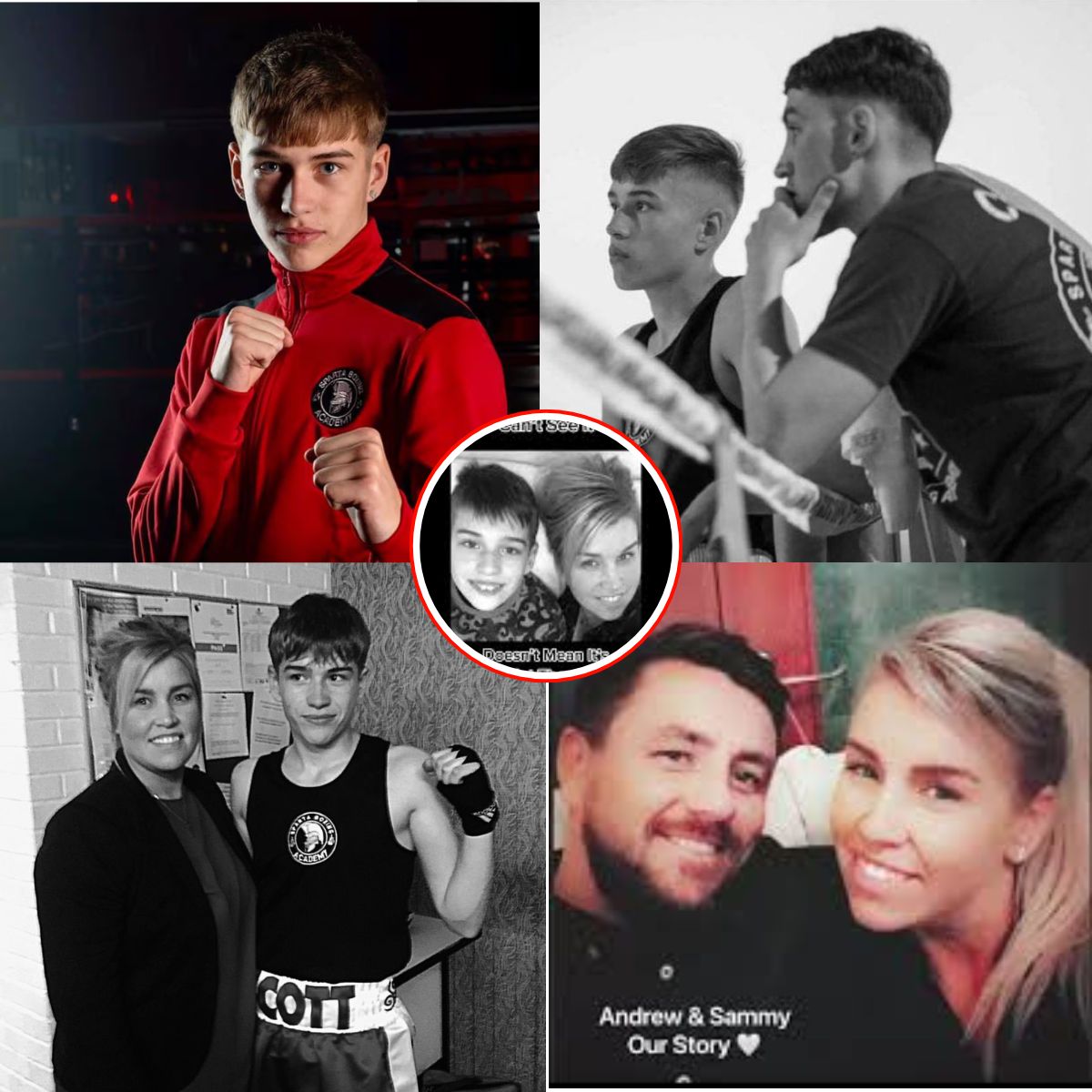
“BARBARIC” BACKLASH — a mother’s last effort to save her teenage son before his suicide has ignited nationwide anger.
“BARBARIC” OUTRAGE — A mother’s desperate fight to save her teenage son before his suicide has sparked national fury as heartbreaking details reveal a devastating system failure
In a tragedy that has left the nation shaken and furious, a brave Scottish mother’s desperate attempts to save her talented teenage son from suicide have exposed what many are calling a “barbaric” and “inhuman” collapse in child mental health services.
Samantha Merrilees begged for urgent help as her son Scott Martin spiralled into paranoia and despair. She rushed him to hospital after suicide attempts, pleaded with doctors to keep him safe, and fought tirelessly against long waiting lists and dismissive assessments. Yet despite her pleas, the system repeatedly failed the 16-year-old former boxing champion — until it was too late.
What should have been a moment of urgent, life-saving intervention turned into a heartbreaking catalogue of delays, dismissals and missed opportunities. Scott died by suicide on December 30, 2020, just days after a CAMHS appointment that downplayed his severe symptoms. Five years on, his mother’s courage in speaking out has ignited widespread outrage, with politicians labelling the treatment “barbaric” and campaigners demanding immediate reform.
The details are truly devastating — and they raise the most serious questions about whether Britain’s child and adolescent mental health services (CAMHS) are fit for purpose in a post-pandemic world where young people are crying out for help like never before.
Scott Martin: A Talented Young Sportsman Whose Light Was Dimmed
Scott Martin was the kind of boy any parent would be proud of. Growing up in Falkirk, he was a gifted athlete who played youth football for clubs including Falkirk FC, Hearts, Rangers and Partick Thistle. In 2018 he switched to boxing and, within a year, became the Scottish Amateur Boxing Champion — a remarkable achievement that spoke of his discipline, determination and natural talent.
He left St Mungo’s High School in 2020 and began working as an apprentice joiner alongside his father, David. On the surface, Scott seemed like a typical teenager building a future. But behind the smiles and sporting success lay a battle with mental health that began far earlier than most realised.
At just 12 years old, Scott faced a terrifying cancer scare when a tumour was removed from his bladder. The trauma of that experience marked the start of his struggles. By age 15, he was showing signs of paranoia and self-harm. His concerned family took him to their GP, only for symptoms to be brushed off as nothing more than “teenage hormones”.
It was a fateful misjudgement that set in motion a chain of events ending in unimaginable loss.
The First Cry for Help — and the First Failure
When Scott confided in a family member that he had been self-harming and had even walked out in front of a car in a suicide attempt, Samantha Merrilees sprang into action. She phoned the NHS immediately and rushed her son to hospital.
“I phoned the NHS straight away and took Scott to hospital,” Samantha later recalled with raw emotion. “I asked them to keep him in, to keep him safe. I didn’t know what else to do.”
Her desperate plea for admission — for a place where her boy could be protected and properly assessed — was denied. Instead, Scott was discharged and sent back to his GP surgery. There, he was prescribed medication and referred to Child and Adolescent Mental Health Services (CAMHS). It was the beginning of a long, agonising wait that would prove fatal.
A few months later, the situation deteriorated further. Scott was spotted trying to buy materials linked to suicide in a local shop. Alert staff refused the sale out of concern and contacted the family. That same night, a terrified Scott slept in his mother’s bed for comfort.
The GP changed his medication once more and upgraded the CAMHS referral to “urgent”. But even then, the family was warned it could still take up to 18 weeks just to receive an initial letter acknowledging the referral.
Eleven Months of Agony on the Waiting List
For the next 11 months, Scott languished on the CAMHS waiting list. Support was minimal — occasional brief telephone calls every couple of weeks that offered little real help. Samantha repeatedly reported that her son’s condition was worsening dramatically. She believed he was developing psychosis, with terrifying delusions that he was being filmed 24/7 and that people could read his thoughts simply by making eye contact with him.
Despite her repeated warnings, CAMHS attempted to discharge Scott from the waiting list not once, but twice. Officials claimed he was “not ill enough” for immediate support — a staggering assessment given his history of suicide attempts and escalating paranoia.
Samantha fought back every time, refusing to let her son slip through the cracks. But the system seemed deaf to her cries.
Finally, on December 21, 2020, Scott was given his first proper CAMHS appointment. During the assessment, he openly told the clinician about his belief that people could read his thoughts. Yet the notes from that session painted a different picture, describing him as appearing well with “good eye contact”. He was advised to return in four weeks.
Nine days later, on December 30, 2020 — just six days before what would have been his 17th birthday — Scott took his own life.
The loss devastated the family. Samantha has since spoken movingly about her desperate final efforts to save her son: fighting to keep him safe at home, begging professionals for meaningful intervention, and feeling utterly unheard as his mental health collapsed.
“If Scott had been properly assessed, I honestly believe he would still be here today,” she has said. “We begged for help for so long and weren’t heard.”
“Barbaric”, “Inhuman” and “Scandalous” — The Outrage Erupts
When Samantha bravely shared her story in detail, the reaction across Scotland — and beyond — was one of shock, grief and explosive anger.
Scottish Liberal Democrat leader Alex Cole-Hamilton did not mince his words, branding the failures “inhuman, barbaric and wrong”.
“This is a tragedy that should never have happened,” he said. “Scott’s experience illustrates that we are dealing with a broken system in urgent need of repair. It is impossible to fathom how Scott could have been neglected like this.”
Scottish Labour health spokesperson Jackie Baillie called it “scandalous”, highlighting that far too many young people are facing painfully long waits for CAMHS treatment, with thousands being turned away entirely.
Samantha herself has channelled her pain into action, pointing out that five years after Scott’s death, the latest figures remain “disgusting”. Young people in Scotland have collectively waited more than 4.5 million days for CAMHS treatment since 2019, according to recent reports. Thousands are still being turned away or left without timely support.
“It’s a disgrace that kids are still being turned away and that they aren’t being heard, taken seriously or supported,” she said.
The case has become a rallying point for the Daily Record’s Save Young Lives campaign, which is demanding shorter waiting times for children’s mental health services and the introduction of suicide prevention education in schools.
A Mother’s Courage: Turning Grief into the Scott Martin Foundation
In the darkest days after losing Scott, Samantha and her family refused to let his death be in vain. They established The Scott Martin Foundation, a charity dedicated to providing immediate mental health support for young people in the Falkirk area and beyond.
Unlike the slow-moving NHS system, the foundation allows parents or children to self-refer and receive funded counselling and therapy sessions straight away. It has already helped over 200 children through community donations and fundraising.
“Parents or children can refer themselves and get help straight away,” Samantha explained. “If someone asks for help, they will get it.”
Her determination to create the rapid-response support that Scott so desperately needed has inspired many — but it also serves as a damning indictment of the official services that failed him.
The Wider Crisis: Millions of Days Lost and Thousands Turned Away
Scott’s story is tragically far from unique. Across the UK, child and adolescent mental health services have been under immense strain for years, exacerbated by the COVID-19 pandemic, social media pressures, academic stress and family breakdowns.
Waiting lists have ballooned, with some young people waiting months or even years for assessment and treatment. In many cases, those with serious issues — including suicide attempts and emerging psychosis — are told they are “not ill enough” for urgent care, only to deteriorate further while waiting.
Experts warn that the consequences are deadly. Suicide remains a leading cause of death among young people, and every delay in support can have catastrophic results.
Politicians from all sides have called for urgent investment, more staff, better training for GPs and frontline workers, and a complete overhaul of referral and assessment processes. Some have demanded mandatory suicide prevention training in schools and greater integration between education, health and social services.
Yet campaigners argue that warm words have not been matched by meaningful action. While some pilot schemes and extra funding have been announced, the reality on the ground for desperate families like the Merrilees-Martins remains one of frustration, exhaustion and, too often, irreversible loss.
What Needs to Change — and Why Scott’s Story Must Not Be Forgotten
The outrage surrounding Samantha’s account has highlighted several critical failures that must be addressed:
- Long waiting times that allow conditions to worsen dramatically.
- Inadequate initial assessments that dismiss serious symptoms as “hormones” or “not ill enough”.
- Poor communication between GPs, hospitals and specialist services.
- Lack of rapid-response options for young people in crisis.
- Insufficient resources for CAMHS teams, leading to high caseloads and burnout.
Samantha’s call for drastic changes is echoed by countless other families who have lost loved ones while trapped in the same broken system.
“If Scott had been properly assessed,” she believes, “he would still be here today.”
Her foundation offers a small beacon of hope — a model of what immediate, accessible support could look like. But charities cannot and should not be expected to plug the gaping holes left by underfunded public services.
As the nation grapples with this latest heartbreaking case, the questions keep coming: How many more Scotts must we lose before real reform happens? How many more mothers must fight alone in those desperate final moments?
The fury is real. The pain is raw. And the demand for change has never been louder.
Scott Martin was a talented, loved young man with his whole life ahead of him. His mother did everything in her power to save him. The system did not.
In her bravery speaking out, Samantha Merrilees has ensured her son’s story will not be buried in silence. Now it is up to those in power — and all of us — to make sure no other family has to endure the same “barbaric” ordeal.
The fight for better mental health support for our young people is more urgent than ever. Scott’s memory, and the love of a mother who refused to give up, demand nothing less.