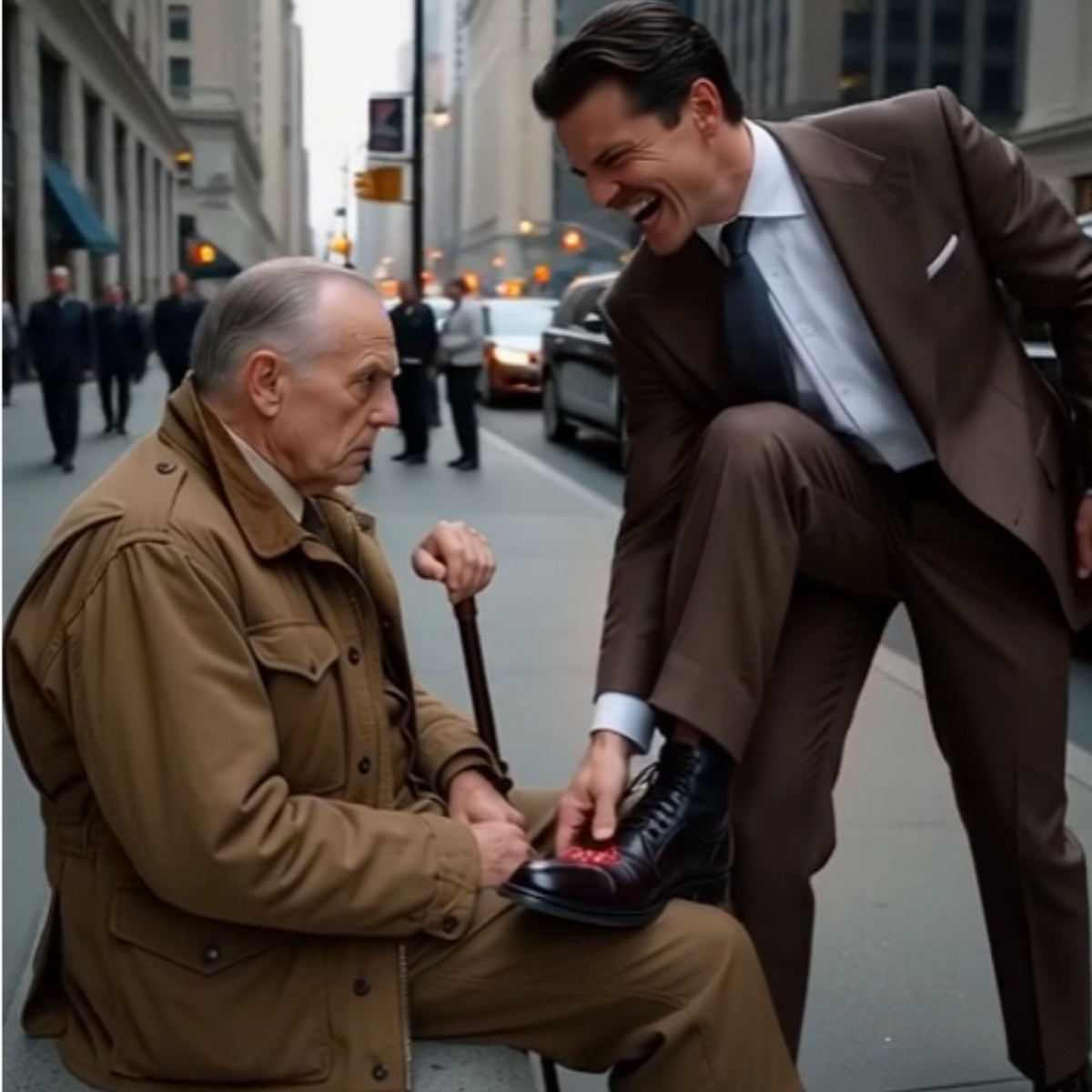
He Spat on My Boots and Ordered Me to Clean Them. He Had No Idea Who Was About to Arrive.
Chapter 1: The Stain on the Leather
New York City in November cuts right through you, especially when you’re sitting still. I sat on the cold concrete bench just outside the golden rotating doors of the Plaza Hotel, feeling the damp wind bite into my joints. My name is James Sterling, though most people just call me “The Colonel” or “Old Man” these days. I’m seventy-two, and my right knee still has a piece of shrapnel in it from a botched patrol in the Mekong Delta, a little souvenir that screams whenever the barometric pressure drops.
I wasn’t a guest at the Plaza. I couldn’t afford a cup of coffee in the lobby, let alone a room. I was just waiting. My daughter, Eleanor, told me to wait here. “Five o’clock, Dad. Don’t move,” she had said. So, I sat. I wore my old M-65 field jacket—olive drab, patches removed, cuffs fraying. It was warm, and it was mine.

The only thing on me that looked new were my boots. Standard issue black combat boots. I polish them every morning. Spit shine. Small circles. Cotton balls and water. It’s a discipline. When everything else in your life falls apart or fades away, you keep your boots clean. It tells the world you’re still here. You’re still holding the line.
The sidewalk was crowded with tourists and business types, a river of grey coats and umbrellas. That’s when the boy stepped out of the hotel bar.
I call him a boy, though he must have been twenty-five. He was wearing a navy pinstripe suit that looked like it had been tailored within an inch of its life. His hair was slicked back with enough product to waterproof a tent. He was loud. He was drunk. And he was holding court with two other guys who looked like clones of him, just slightly less expensive versions.
“I told the SEC to shove it,” the boy shouted, laughing a little too hard. “My dad knows the commissioner. It’s all a game, boys! It’s all a game!”
He swung his arms wide, gesturing at his own greatness, and stumbled. His Italian loafer caught the rubber tip of my cane, which was resting against my leg.
He didn’t fall, but he lurched. His martini glass—which he had illegally carried out of the bar—sloshed onto his sleeve.
The laughter stopped. The air around us seemed to freeze.
He looked at his wet sleeve. Then he looked at the cane. Then he looked at me.
His face twisted. It wasn’t just anger; it was offense. He was offended that I existed in his space. He looked at my old jacket, my grey stubble, the way I sat hunched against the cold. To him, I wasn’t a person. I was urban decay. I was a pothole in the road of his perfect life.
“You stupid old heavy,” he sneered. “Look what you did.”
“I didn’t move, son,” I said. My voice was raspy. I hadn’t spoken to anyone since breakfast.
“Don’t call me son,” he snapped. “Do you have any idea how much this suit costs? It costs more than your life.”
The people passing by slowed down. New Yorkers are good at ignoring things, but they love a train wreck. They watched, phones half-raised, waiting for the punchline.
“I’m sorry about your suit,” I said, keeping my eyes forward. “But you tripped.”
“I tripped? I tripped because you have your garbage sprawled out all over the sidewalk,” he shouted. He kicked my cane. It clattered to the ground, rolling into the gutter.
I didn’t reach for it. I just looked up at him. I’ve stared down men with AK-47s who wanted to kill me. A drunk child in a suit didn’t scare me. But it did make me sad.
“Pick it up,” I said calmly.
He laughed. A bark of disbelief. “Pick it up? You think I’m your maid?”
He looked down at me, searching for a way to hurt me. He couldn’t hit me; too many witnesses. He needed to humiliate me. His eyes drifted down to my boots. My polished, perfect boots. They caught the reflection of the streetlights.
He smiled. It was a nasty, wet smile.
“You like things shiny, huh? A little spit and polish?”
He cleared his throat. A deep, guttural sound that made the woman standing nearby gasp.
And then, he spat.
It was a large, frothy glob. It landed squarely on the toe of my left boot. It sat there, shivering slightly, ruining the mirror finish I had spent an hour perfecting that morning.
“Whoops,” he said, his voice dripping with mock sympathy. “Looks like you missed a spot, old man.”
Chapter 2: The Iron Silence
The world seemed to go silent. I could hear the taxis honking on 5th Avenue, but they sounded miles away. All I could see was the spit on the black leather.
My hands curled into fists inside my jacket pockets. The muscle memory was still there. The training. The instinct to strike, to incapacitate, to neutralize the threat. I knew seventeen ways to break this boy’s arm before he could blink. I could sweep his leg and put his face into the concrete in under two seconds.
But I didn’t moving.
Discipline. That was the word. The General had drilled it into us at Parris Island. Discipline is what separates us from the animals.
If I hit him, I’m just a crazy old vet attacking a civilian. I’m the problem. I’m the violence.
So, I breathed. In through the nose, out through the mouth. I looked at the spit. I looked at him.
“Clean that,” he said. He was emboldened by my silence. He thought I was afraid. “Clean it up, servant. Go on. Use your sleeve. That jacket is garbage anyway.”
“I am not a servant,” I said. My voice was low, like grinding stones.
“You are to me,” he laughed, turning to his friends. “Look at him. Probably lives in a shelter. Probably sucking up my tax dollars. Hey!” He snapped his fingers in my face. “I pay for your food stamps, grandpa. So when I say clean my mess, you clean it.”
A crowd had fully formed now. A ring of spectators. Some looked angry, shaking their heads. Others were filming, holding their iPhones up like shields. But nobody stepped in. Nobody said a word. The bystander effect in full force. They were waiting to see if the old dog would bite.
“You have no honor,” I told him. It was the only insult that mattered to me.
“Honor don’t buy tailored suits,” he scoffed. “Money buys honor. And I have all the money.”
He raised his foot, hovering his expensive loafer over my boot, threatening to stomp on it. “I should scuff these up just to give you something to do tomorrow.”
And then, the light changed.
It wasn’t a traffic light. It was a shift in the atmosphere. The air grew heavy.
A low rumble vibrated through the soles of my boots. It wasn’t the subway. It was a convoy.
Around the corner of 59th Street, they came. Six Chevrolet Suburbans, blacked out, massive, armored. They moved in a phalanx, pushing the yellow taxis out of the way like sharks moving through a school of minnows.
And in the center of them, a stretched Mercedes-Maybach limousine. Pitch black. Flags on the fender.
The doorman at the Plaza dropped his clipboard. He knew that car.
The convoy didn’t pull into the valet loop. It stopped right on the street, blocking two lanes of traffic. Red and blue lights flashed discreetly behind the grilles of the SUVs.
“What is this?” the bully muttered, distracted. He lowered his foot.
The doors of the SUVs burst open. Twelve men stepped out. They weren’t police. They were private security, but the kind that gets hired by heads of state. Earpieces. Bulges under their jackets. Eyes that scanned everything.
They formed a corridor. A wall of human steel between the limousine and the hotel entrance.
The bully took a step back, his arrogance faltering. “Is this… is the President here?”
The rear door of the Maybach opened. A chauffeur in a peaked cap held it wide.
First, a pair of red-bottomed heels hit the pavement. Then, she stood up.
Eleanor.
My little girl. Except she wasn’t little anymore. She was thirty-eight, and she was the most powerful woman in the city. She wore a white cashmere coat over a power suit that probably cost more than the bully’s entire wardrobe. Her hair was pulled back in a severe, elegant bun.
She radiated a kind of cold power that made the street go quiet.
She didn’t look at the hotel manager who was rushing out to greet her. She didn’t look at the paparazzi who had appeared out of nowhere, flashes popping.
She scanned the crowd. Her eyes—my eyes—swept over the faces until they landed on the bench.
She saw me. The tension in her jaw relaxed. She smiled, a genuine, warm smile that the business world rarely saw.
“Dad!” she called out.
She walked past the security line. She walked right past the stunned bully. She came to the bench and knelt down—kneeling in her white pants on the dirty sidewalk—and wrapped her arms around me.
“I’m so sorry I’m late,” she whispered into my ear. “The board meeting ran over. Are you okay? You’re freezing.”
“I’m fine, Elly,” I patted her back. “Just people watching.”
She pulled back to look at me, checking for damage like she always did. She adjusted my collar. Then, her eyes traveled down.
She saw the cane in the gutter.
She froze.
Then, she saw the boot.
She saw the frothy, white spit sliding down the black leather.
The smile vanished. The warmth evaporated from her face instantly. It was replaced by a look so terrifyingly cold that I felt a shiver go down my spine. She stared at the spit for a long second, processing what it meant.
Slowly, gracefully, she stood up.
She turned around. The crowd parted, leaving the bully standing there alone, exposed. He was holding his empty martini glass, his mouth slightly open.
Eleanor walked toward him. The security detail shifted, flanking her, their hands ready.
She stopped two feet from him. She was tall, and in her heels, she looked him right in the eye.
“Did you do this?” she asked. Her voice wasn’t loud. It was deadly quiet.
The bully swallowed hard. He looked at the cars. He looked at the guards. He looked at her.
“I… we were just… having a discussion,” he stammered, his bravado melting like snow on a grate. “He… he tripped me.”
“I asked you a question,” Eleanor said, stepping closer. “Did. You. Spit. On. My. Father?”
Chapter 3: The Weight of a Name
The silence on Fifth Avenue was unnatural. Usually, this city screams. It honks, it yells, it grinds gears and jackhammers concrete. But in that moment, under the darkening November sky, the only sound was the wind whistling through the gap between the Plaza Hotel and the glass tower across the street.
Eleanor Sterling stood there, a vision of white wool and unyielding steel. She didn’t blink. She didn’t breathe heavily. She was a statue carved from ice and fury.
Brad Kensington, the boy who had felt like a god ten seconds ago, was now shrinking. Physically shrinking. His shoulders hunched, his neck retracted into his expensive collar. He was trying to solve a math equation in his head that didn’t have an answer: How does the homeless bum have the backing of the Sterling empire?
He licked his lips. They were dry. The alcohol that had given him liquid courage was now turning into sour bile in his stomach.
“I… look, lady,” Brad started, his voice cracking. He tried to put on his ‘Wall Street shark’ mask, the one he wore in boardrooms to bully junior analysts. “You don’t understand the situation here. This guy… he was aggressive. He was blocking the public right of way. I was just—”
“I asked you a question,” Eleanor interrupted. She didn’t raise her voice. She lowered it. It was a whisper that carried more weight than a scream. “Did. You. Spit. On. Him?”
She took a step forward. The heel of her shoe clicked against the pavement like a gavel striking a judge’s bench.
Brad looked around for his friends, but they had vanished. evaporated into the crowd. Rats fleeing a sinking ship. He was alone.
“It was an accident,” Brad lied. A pathetic, transparent lie. “I was clearing my throat. He was in the way. If he wasn’t sitting there like a pile of trash, it wouldn’t have happened.”
Eleanor closed her eyes for a brief second. When she opened them, the fire inside was terrifying.
She turned to me. “Dad, give me the boot.”
“Elly, it’s fine,” I said, reaching for my cane in the gutter. My hand shook slightly—not from fear, but from the adrenaline of the situation. “Let’s just go. I don’t want a scene.”
“No,” she said softly. “The scene is already here. Give me the boot.”
I hesitated, then lifted my left leg slightly. She didn’t care about the dirt. She didn’t care about the germs. She pulled a silk handkerchief from her pocket—Hermès, probably worth three hundred dollars—and she wiped the spit off the leather.
She wiped it with a tenderness that broke my heart. She treated that old combat boot like it was a holy relic. She folded the handkerchief, now soiled, and held it in her hand.
Then she turned back to Brad.
“Do you know what these are?” she asked, gesturing to my feet.
Brad scoffed, trying to regain some ground. “Army surplus garbage? Fashion from 1970? What do I care?”
“These are jungle boots,” Eleanor said, her voice clinical, precise. “My father was issued a pair like this in 1968. He wore them when he walked point in the A Shau Valley. He wore them when he stepped on a landmine that didn’t detonate, standing still for fourteen hours until a tech could clear it.”
She took another step closer to him. Brad stepped back, hitting the bumper of one of the black SUVs. He was trapped.
“He wore boots like these when he came home to a country that spat on him then, too,” Eleanor continued. “He worked double shifts at a steel mill in Pennsylvania for thirty years in boots like these. He melted the steel that built the building your office is in.”
Brad rolled his eyes, though his hands were trembling. “Great. Touching story. Can I go now? I have a reservation at Le Bernardin.”
“You have a reservation nowhere,” Eleanor said.
She looked him up and down, dissecting him.
“You’re wearing a Brioni suit,” she observed. “Bespoke. About eight thousand dollars. Your watch is a Patek Philippe Nautilus, rose gold. Currently trading around one-hundred-fifty thousand on the secondary market. You have a lapel pin from the Alpha Sigma Phi fraternity at UPenn.”
Brad looked surprised. “Yeah? So I have taste. Sue me.”
“You don’t have taste,” she corrected him. “You have money. And judging by the fact that you’re day-drinking at the Plaza on a Tuesday, it’s not money you worked very hard for. You work at Kensington & Partners, don’t you? Your father’s hedge fund.”
Brad stiffened. “My father built that firm. I’m a Managing Director.”
“You’re a nepotism hire,” Eleanor said, cutting him to the bone. “I know your father. Robert Kensington. A man who cheats on his taxes as often as he cheats on his golf score. And you… you’re Brad. The ‘wild card.’ The liability.”
Brad’s face flushed a deep, ugly red. “You don’t know me! You don’t know who you’re messing with! I can buy and sell this old man a thousand times over!”
“You think this is about money?” Eleanor laughed, a dry, humorless sound. “You think you’re better than him because you have a credit card?”
She pointed at me. I was still sitting there, feeling the weight of the years.
“That man,” Eleanor said, her voice trembling with emotion now, “is the reason I am standing here. When my mother died, he didn’t fall apart. He worked nights. He cleaned floors. He polished those boots every single day to show me that dignity isn’t about what you own, it’s about how you carry yourself. He spent his life savings to send me to Wharton so I wouldn’t have to clean floors.”
She held up the soiled silk handkerchief.
“He taught me that you never, ever look down on someone unless you are helping them up. And you…” She looked at Brad with pure disgust. “You looked down on him. You spat on him. You treated him like he was beneath you because he didn’t have a shiny suit.”
Brad sneered. “He is beneath me. Look at him. He’s a loser.”
The air shifted. The security guards tensed. I saw the muscles in Eleanor’s jaw work.
“A loser,” she repeated.
She reached into her purse. She didn’t pull out a weapon. She pulled out a black iPhone.
“Let’s see who the real loser is, Brad.”
She unlocked the phone. The screen glowed against the twilight.
“You mentioned your father’s firm. Kensington & Partners. They specialize in leveraged buyouts of mid-cap manufacturing companies, correct? They strip the assets, fire the workers, and sell the husk for profit.”
“It’s called business,” Brad spat. “Something a woman like you wouldn’t understand.”
The crowd gasped. The misogyny was the final nail in his coffin, but he was too stupid to see it.
“I understand business very well,” Eleanor said calmly. “I understand it so well that I know your firm is currently over-leveraged on the Omni-Tech deal. You borrowed heavily to acquire it. And who holds that debt?”
Brad froze. His eyes widened.
“Who holds the debt, Brad?” she pressed.
He didn’t answer.
“Sterling Global Holdings,” she answered for him. “My company.”
She tapped the screen.
“And I also know that your firm has a morality clause in its lending agreement. specifically regarding the conduct of its executive officers. ‘Behavior that brings disrepute to the firm or its partners.’”
She held up the phone.
“I have twelve cameras on me right now, Brad. This entire interaction is being livestreamed by three teenagers behind you. You are currently trending on Twitter. ‘Rich brat spits on veteran.’ It has fifty thousand views in four minutes.”
Brad whipped his head around. Sure enough, people were holding up phones. The red recording dots were like sniper scopes.
“No…” he whispered. “No, you can’t… my dad will kill me.”
“Your dad won’t have time to kill you,” Eleanor said. “He’s going to be too busy trying to save his house.”
She pressed the call button. She put the phone to her ear on speaker.
The ringing sound echoed through the silent street.
Ring… Ring… Ring…
“Eleanor?” A voice answered. A deep, powerful voice. It was the Head of Risk Management at Sterling Global. “What do you need?”
“Execute the default clause on the Kensington debt,” Eleanor said. Her eyes never left Brad’s face.
” The whole tranche?” the voice asked, sounding surprised. “That’s four hundred million dollars. It will bankrupt them by morning.”
“Do it,” she said. “And call the Compliance Officer at their bank. Send them the video link I’m about to text you. Tell them I am formally filing a complaint regarding the conduct of their Senior Managing Director, Bradley Kensington. I want his personal assets frozen pending an investigation into hate crimes and assault on a senior citizen.”
“Understood. Executing now.”
The call ended.
Brad fell to his knees.
Chapter 4: The Dismantling
The physical collapse of a man is a strange thing to watch. Brad didn’t faint. He just lost the structural integrity of his arrogance. His knees hit the pavement hard, ruining the wool of his trousers.
“You can’t do this,” he wheezed. “It was just spit! It was a joke! I was joking!”
“A joke is when everyone laughs,” I said. It was the first time I had spoken in minutes. I stood up, using my cane to push myself upright. The pain in my knee was sharp, but I ignored it. I walked over to where he was kneeling.
I looked down at him. The dynamic had flipped completely. The ‘servant’ was standing; the ‘king’ was kneeling.
“You think humiliating people is funny?” I asked.
“I’m sorry!” he screamed, tears mixing with the snot running down his face. “I’m sorry, okay? Look! I’m sorry! Don’t ruin my life! Please!”
He reached out to grab the hem of Eleanor’s coat.
Before he could touch her, a massive hand intercepted his wrist. The lead security agent, a man who looked like he chewed rocks for breakfast, twisted Brad’s arm behind his back with practiced ease.
“Do not touch Ms. Sterling,” the agent growled.
“Let him go,” Eleanor said. “He’s not a threat. He’s a child.”
The agent released him. Brad slumped forward, putting his hands on the dirty sidewalk—the same sidewalk he had mocked me for sitting on.
His phone started to buzz.
Then it buzzed again.
Then it started ringing. A relentless, shrill ringtone.
He looked at the screen. It was ‘DAD’.
He didn’t answer. He couldn’t.
Then a notification popped up. Then another. He stared at the screen in horror.
Alert: American Express Platinum – Card Suspended. Alert: Chase Private Client – Account Access Restricted. Alert: Email from HR – Subject: IMMEDIATE SUSPENSION.
The speed of modern finance is terrifying. Eleanor hadn’t just made a threat; she had triggered a digital avalanche. In the world of high finance, perception is reality. When the CEO of Sterling Global pulls the plug, everyone else pulls the plug too, just to be safe.
“My cards…” Brad whimpered. “They turned off my cards.”
“You have no credit,” Eleanor explained, her voice devoid of pity. “You have no liquidity. And by tomorrow morning, when the video of you spitting on a disabled veteran hits the morning news cycles, you will have no friends.”
She crouched down, bringing her face level with his.
“You told my father to clean your mess because you thought money made you a master. But money is just paper, Brad. Character is currency. And you are bankrupt.”
She stood up and turned to the crowd.
“This show is over,” she announced.
She turned to me. The hardness in her eyes melted away instantly. She was my Elly again.
“Come on, Dad. The car is warm.”
“You didn’t have to do all that, honey,” I said quietly as we walked toward the limo. “He’s just a fool.”
“He’s a bully,” she corrected me. “And bullies only understand one language. Besides…”
She stopped at the open door of the Maybach. She looked down at my boots. They were old, scuffed, and now, thanks to her handkerchief, clean again.
“Nobody disrespects the uniform,” she said. “Not while I’m breathing.”
She helped me into the car. The leather seats were soft, smelling of vanilla and success. The chauffeur closed the door, sealing out the noise of the city.
Through the tinted window, I watched Brad. He was still kneeling on the sidewalk. Passersby were stepping around him, avoiding him like he was the garbage now. A police cruiser was pulling up, lights flashing. The hotel security was pointing at him.
“What’s going to happen to him?” I asked.
Eleanor opened a bottle of sparkling water and poured me a glass.
“He’ll learn,” she said. “He’s going to have to learn how to start over. He’s going to learn what it’s like to have nothing. It might be the best thing that ever happened to him. Or it might destroy him. That’s his choice.”
She took my hand. Her hand was soft, but her grip was strong.
“But we aren’t talking about him anymore,” she smiled. “I made a reservation at Peter Luger’s. I know it’s a trek to Brooklyn, but I know how much you love their steak.”
I smiled back. “You remembered.”
“I remember everything, Dad. I remember the double shifts. I remember the boots. I remember you reading to me when you were so tired you could barely keep your eyes open.”
The car began to move, gliding smoothly away from the curb.
As we merged into traffic, I looked back one last time. The image of the boy in the expensive suit, broken and weeping on the concrete, faded into the distance.
I looked at my boots. They were still shiny.
But the story wasn’t over. I didn’t know it yet, but that video wasn’t just going to ruin Brad. It was going to start a movement. And sometimes, movements bring out enemies far more dangerous than a spoiled brat in a suit.
“Ms. Sterling,” the security lead spoke from the front seat. “We have a situation.”
Eleanor looked up, her brow furrowing. “What is it?”
“The video isn’t just trending,” the agent said, checking his tactical tablet. “It’s being shared by the ‘Patriots Front’. And… we just got a ping on the dark web. Someone just put a bounty on the ‘Veteran’s identity’.”
Eleanor’s hand tightened on mine.
“What kind of bounty?” she asked.
“A doxxing bounty. They want to find where he lives. But it’s worse. The user who posted it… the digital signature matches the Kensington private server. But it’s not the son.”
Eleanor went rigid.
“Robert,” she whispered. “The father.”
“He’s not taking the bankruptcy lying down,” the agent said. “He’s coming after the Colonel.”
I looked at Eleanor. The peace of the moment shattered.
“Dad,” she said, her voice shifting back to that steel commander tone. “We aren’t going to the steakhouse.”
“Where are we going?” I asked.
” The Safe House,” she said. “If Robert Kensington wants a war, I’m going to give him one. But I need to make sure you’re safe first.”
She tapped on the partition window.
“Change of plans. Route Delta. Go.”
The heavy limousine surged forward, the engine roaring. We weren’t a family going to dinner anymore. We were targets.
And the boots… the boots were ready for one last battle.
Chapter 5: The Viper in the Receiver
The Mercedes-Maybach was no longer a luxury vehicle; it was a mobile command center tearing through the arteries of Manhattan. The partition between the driver and the passenger cabin was opaque, but the tension seeped through the leather-wrapped walls.
I watched the city blur past the rain-streaked windows. New York at night usually looked like a jewelry box spilled onto black velvet, but tonight, the lights looked like tracer fire.
“Status,” Eleanor commanded. She wasn’t looking at me. She had a tablet balanced on her knee, her fingers flying across the glass surface with the speed of a concert pianist. Her face was illuminated by the blue glow of the screen, highlighting the sharp angle of her jaw. She didn’t look like my little girl in that moment. She looked like a general plotting a nuclear strike.
Marcus, the lead security agent in the front seat, spoke through the intercom. His voice was clipped, professional, devoid of fear but heavy with urgency. “We have two bogeys. Black SUVs, no plates, following three cars back. They picked us up at Columbus Circle. I’ve alerted the extraction team at the safe house. ETA twenty minutes if traffic holds.”
“Lose them,” Eleanor said, her voice flat. “I don’t want them knowing where we land.”
“Copy that. Hold on.”
The heavy limousine swerved violently. I grabbed the handle above the door, my old knuckles turning white. My bad knee protested the G-force, a sharp spike of pain that reminded me I wasn’t twenty anymore. We took a hard right, the tires squealing against the wet asphalt, diving into a service tunnel that most people didn’t know existed.
“Dad,” Eleanor said, finally looking up. Her eyes were wide, the adrenaline dilating her pupils. “I need you to listen to me. This isn’t just a lawsuit anymore.”
“I gathered that,” I said, trying to keep my voice steady. “Robert Kensington. I saw him on the news a few times. Always smiling. donating to charities. The type of guy who shakes your hand while stealing your watch.”
“He’s worse,” Eleanor said. She tapped the tablet and turned it toward me.
The screen displayed a dossier. It wasn’t a public Wikipedia page. This was intelligence data—the kind you pay ex-Mossad agents to dig up.
“Robert Kensington isn’t just a hedge fund manager,” she explained, her finger tracing the lines of text. “He’s a cleaner. He washes money for the Russian oligarchy and Mexican cartels. He uses his son’s ‘losses’ to write off dirty money. That bank I just crippled? It wasn’t just his piggy bank. It was a laundromat for billions of dollars of black market capital.”
I stared at the screen. Photos of Kensington meeting with men in shadowy marinas in Montenegro. Bank transfers that routed through the Cayman Islands to shell companies in war zones.
“So,” I said, the realization settling in my gut like a stone. “You didn’t just bankrupt a bully. You shut down a criminal pipeline.”
“I poked the bear,” Eleanor admitted. “And the bear is hungry.”
Suddenly, the cabin was filled with a sound that made my skin crawl. It wasn’t a siren. It was the phone. Not Eleanor’s cell phone, but the satellite phone embedded in the armrest of the limousine. A secure line.
Only five people on earth had that number.
Eleanor stared at the blinking red light. Incoming Call: Unknown.
“It’s him,” she whispered.
She looked at me. I nodded. “Answer it. Never let the enemy think you’re afraid to talk.”
She pressed the button and put it on speaker.
“Eleanor,” the voice filled the cabin. It was smooth, cultured, wrapped in the velvet texture of old money. But underneath, there was a jagged edge of pure psychosis. “I must say, I’m impressed. I didn’t think you had the stomach for a public execution.”
“Robert,” Eleanor replied, her voice steady. “If you wanted to talk, you could have called my office. But since you’re chasing me through Midtown, I assume this isn’t a social call.”
“Chasing? Oh, no, my dear. I’m not chasing you,” Robert Kensington chuckled. It was a dry, rasping sound. “My men are just… escorting you. Making sure you get to your destination safely. I’d hate for anything to happen to the woman who just cost me four hundred million dollars.”
“Your son spat on a veteran,” Eleanor said coldly. “He assaulted a decorated officer. I responded with appropriate market force.”
“My son is an idiot,” Robert said dismissively. “He’s a soft, spoiled child. Honestly, you did me a favor. He needed a lesson in humility. But Eleanor… you touched the family money. You touched the structure. That is a violation of the unspoken rules.”
“There are no rules when you insult my blood,” Eleanor snapped.
“Blood,” Robert mused. “Yes. Let’s talk about blood. You see, Eleanor, money can be replaced. Reputation can be rebuilt. But blood? Once you spill it, you can’t put it back in the bottle.”
The line crackled with static.
“I have a specific set of skills, Eleanor. I have resources that go beyond lawyers and PR firms. You embarrassed the Kensingtons. Now, I have to balance the ledger. An eye for an eye. A father for a father.”
My hand instinctively went to my boot. I didn’t have a weapon, but the threat was clear.
“If you come near him,” Eleanor hissed, “I will release the full unredacted files on the Cyprus accounts. I know about the tungsten deal, Robert. I know about the arms shipments.”
There was a silence on the other end. A long, heavy pause.
“You have the files?” Robert asked, his voice losing its playful tone.
“I have everything,” Eleanor lied. I knew she didn’t have everything, but she was bluffing with the confidence of a poker pro. “Dead man’s switch. If anything happens to me or my father, it goes to the FBI, Interpol, and the New York Times simultaneously.”
Robert sighed. “Well played. Mutually assured destruction. Very Cold War. Your father would appreciate that.”
“Back off, Robert,” she warned.
“I’ll call off the dogs,” he said. “For now. But Eleanor… sleep with one eye open. The market is volatile. Crashes happen when you least expect them.”
The line went dead.
“He bought it,” Eleanor exhaled, slumping back against the seat. Her hands were shaking now. “He thinks I have the Cyprus files.”
“Do you?” I asked.
“No,” she said, looking out the window as we emerged from the tunnel. “I have rumors. Suspicions. If he finds out I’m bluffing, he won’t just kill us. He’ll torture us.”
“Then we need to get real ammunition,” I said, the old soldier in me waking up. “If we’re in a war, we don’t wait for the enemy to attack. We find his weakness and we strike.”
“First, we survive the night,” Eleanor said.
The limo slowed down. We had left the city center. We were in an industrial district near the Navy Yard. Warehouses, shipping containers, shadows.
“We’re here,” Marcus announced.
The car turned into an old, nondescript brick building. A massive steel garage door rattled open, swallowing us into the darkness.
Chapter 6: The Kill Box
The Safe House wasn’t a house. It was a fortress disguised as a derelict loft.
As we stepped out of the limousine, the air smelled of stale oil and dust, but as soon as we passed through the inner airlock, the atmosphere changed. It was sterile, climate-controlled, and silent.
The interior was a sprawling open-concept space with exposed brick walls, but the windows were reinforced with ballistic polycarbonate. A server bank hummed in the corner, cooling fans whirring like distant helicopters.
“Welcome to the Bolt Hole,” Eleanor said, tossing her coat onto a Kevlar-lined sofa. “I bought this place three years ago when the hostile takeover of Omni-Corp got nasty. It’s off the grid. Independent power, filtered water, satellite uplink.”
I looked around. It was impressive. It was expensive. But to my eyes, it was a trap.
“One exit?” I asked, scanning the room.
“Two,” Eleanor corrected. “Main elevator and the fire escape. Both are monitored by biometrics.”
“Too few,” I grunted, walking over to the window. I peered through the thick glass at the dark alley below. “If they breach the perimeter, we’re cornered. This isn’t a fortress, Elly. It’s a kill box.”
“Dad, please,” she sighed, rubbing her temples. “This place is state-of-the-art. Marcus and his team are outside. Nobody gets in without me knowing.”
I didn’t argue. I knew she trusted technology. She trusted systems. I trusted instincts. And my instincts were screaming that Robert Kensington wasn’t the type of man to be stopped by a biometric lock.
I sat down on a steel chair and began to unlace my boots.
“What are you doing?” Eleanor asked, pouring herself a glass of whiskey from a crystal decanter. Her hand was steady now, but her eyes were haunted.
“Maintenance,” I said. “Always take care of your gear.”
I pulled the boot off. My foot ached. The spit stain was gone, thanks to her, but the leather was dry from the heat of the day. I took a small tin of polish from my jacket pocket—I always carried it—and an old rag.
I started to work. Small circles. Wax on, wax off. The smell of the polish filled the room, a sharp, chemical scent that reminded me of the barracks.
Eleanor watched me. She took a sip of whiskey and walked over, sitting on the floor beside my chair. She rested her head on my knee.
“I’m scared, Dad,” she whispered. It was the first time she had admitted it. “I pushed too hard. I thought… I thought I could just buy justice. Like everything else.”
I stopped polishing. I rested my hand on her hair.
“You did the right thing, Elly. He dishonored us. You stood up for me. There’s no price tag on that.”
“But now he wants you dead,” she said, her voice breaking. “I put a target on your back.”
“The target has been there since 1968, sweetheart,” I smiled sadly. “I’ve been living on borrowed time for fifty years. Every day is a bonus.”
Suddenly, the lights flickered.
Not a brownout. A hard pulse.
Then, total darkness.
The hum of the server banks died. The electronic locks on the doors clicked—a sound that shouldn’t happen. They should default to locked. They clicked open.
“What happened?” Eleanor gasped, standing up in the pitch black. “The backup generator should have kicked in.”
“Cyber attack,” I said, my voice low. “He didn’t send soldiers. He sent hackers. He killed the brain of the house.”
“Marcus!” Eleanor screamed into the darkness. “Marcus, report!”
Silence.
No response from the intercom.
“Phone,” I commanded.
She pulled out her cell. “No signal. It’s jammed. He has a jammer nearby.”
I stood up. I didn’t need eyes to see in the dark. I had spent nights in the jungle where you couldn’t see your hand in front of your face. You listened. You felt.
I heard it.
The faint crunch of glass in the alley. The soft thud of suppressed footsteps on the fire escape.
“They’re here,” I said.
“Who?”
“The cleaners.”
I grabbed Eleanor’s arm. “Listen to me. The high-tech stuff is dead. The cameras, the locks, the phones. They’re useless. You are blind.”
“What do we do?” she panicked.
“We stop being a CEO,” I said, slipping my boot back on. I didn’t tie the laces tight; I needed circulation. “And we start being a soldier.”
I grabbed my cane. It was heavy hickory wood with a brass head. Not a rifle, but in close quarters, it was a mace.
“Stay behind me,” I whispered. “Don’t make a sound. Step where I step.”
We moved away from the center of the room, hugging the shadows of the brick wall.
The door to the fire escape creaked open.
A red laser beam cut through the dust-filled air. Then another. Night vision goggles.
Two shapes moved into the room. They were professional. They moved in silence, sweeping their weapons—compact submachine guns—left and right. They were looking for heat signatures, but the room was still cooling down, confusing their sensors.
“Clear left,” a muffled voice said.
“Check the bedroom,” another whispered.
They were moving toward the hallway where Eleanor slept.
I looked at Eleanor. She was trembling, pressing her hand over her mouth.
I looked at the men. They were wearing body armor. My cane wouldn’t do much against Kevlar. I needed an advantage.
I looked at the table near the door. The whiskey decanter. High alcohol content.
I looked at my pocket. The lighter I used to melt the polish into the boots.
“Elly,” I breathed into her ear. “When I move, you run for the main elevator shaft. The car is dead, but the ladder is there. Go down.”
“I’m not leaving you,” she whispered fiercely.
“This isn’t a negotiation, soldier,” I said, my voice hardening. “Move.”
I didn’t wait for her to argue.
I grabbed the heavy crystal decanter. I flicked the lighter.
“Hey!” I shouted, my voice booming like a drill sergeant.
The two lasers snapped toward me.
“Over here, you cowards!”
I threw the decanter. It smashed against the chest of the lead gunman, soaking him in high-proof amber liquid.
In the same second, I threw the lighter.
Whoosh.
A ball of blue and orange flame erupted in the center of the room. The gunman screamed, thrashing as the fire caught his tactical vest.
“Go!” I shoved Eleanor toward the door.
The second gunman panicked, turning to help his partner. That was his mistake. You never take your eyes off the threat.
I lunged. I wasn’t seventy-two anymore. I was twenty-two, and I was the reaper.
I swung the heavy brass head of my cane. It connected with the second gunman’s wrist with a sickening crack. He dropped his weapon.
He spun around, pulling a knife.
I stood there, backlit by the flames of his burning partner. I held the cane like a bayonet.
“You want the old man?” I growled, baring my teeth. “Come and get him.”
The gunman hesitated. He looked at the fire. He looked at the shadow of the girl escaping. He looked at the demon in the field jacket.
And in that hesitation, I knew I had him.
But then, a third laser dot appeared. Not from the door. From the window across the room.
A sniper.
“Dad!” Eleanor screamed from the hallway.
I dove.
The glass shattered where my head had been a microsecond before. A high-caliber round punched through the brick wall, sending dust exploding into the air.
I hit the floor, rolling behind the heavy steel kitchen island.
“Pinned down!” I yelled. “Elly, get out!”
“I can’t open the elevator doors!” she cried. “They’re mag-locked!”
We were trapped. The fire was spreading. The gunman I had hit was recovering his weapon. The sniper was dialed in.
And all I had was a cane and a pair of shiny boots.
“Okay,” I muttered to myself, wiping blood from a cut on my cheek. “Plan B.”
I looked at the gas line running to the industrial stove next to me.
“This is going to hurt,” I said.
Chapter 7: The Ghost of the Mekong
The world was a kaleidoscope of fire and shadow. My heart hammered against my ribs—not with the panicked fluttering of an old man, but with the steady, heavy beat of a soldier who had found his rhythm. I was behind the steel kitchen island, the cold metal pressed against my back.
The first gunman was still a human torch, his screams turning into wet gurgles as the fire consumed the oxygen in his lungs. The second one, the one with the broken wrist, was scrambling for his dropped submachine gun. And somewhere out in the dark, across the street, a sniper was waiting for one inch of my scalp to show.
“Eleanor!” I roared over the crackle of the flames. “The utility closet! Behind the kitchen! There’s a manual override lever!”
“I can’t see, Dad!” her voice came back, high-pitched and trembling.
“Count the tiles!” I yelled. “Ten paces from the fridge! Use your hands!”
I couldn’t wait for her to find it. The gunman with the broken wrist had his fingers on the grip of his weapon. He was snarling, his face distorted by the flickering orange light. He didn’t care about the mission anymore; he wanted me dead for the pain in his arm.
I looked at the gas line. It was a flexible stainless steel hose leading to the massive professional-grade range. I didn’t have a wrench. I didn’t have time.
I used the brass head of my cane. I hooked it behind the pipe and pulled with every ounce of strength I had left in my back. My muscles screamed. My bad knee buckled.
Snap.
The hiss of escaping natural gas filled the air, a high-pitched whistle that competed with the roar of the fire.
“Dad, what are you doing?” Eleanor cried out. She had found the closet. I heard the heavy clunk of the manual lever. The magnetic locks on the elevator doors released with a loud thwack.
“Get in the shaft, Elly! Don’t look back!”
The gunman had his gun up now. He leveled it at the kitchen island.
Rat-tat-tat-tat!
The bullets shredded the stainless steel, sending sparks flying inches from my face. One slug grazed my shoulder, tearing through the olive drab fabric of my field jacket. I didn’t feel the pain. I felt the heat.
The gas was pooling now, heavy and invisible. The fire from the first gunman was drifting closer to the stove.
I looked at my boots. The leather was hot. I remembered a bridge in ’69. We had to blow it to stop the NVA advance. I had been the one to set the charges. I was the one who had to run.
“Hey, son!” I yelled at the gunman.
He stopped firing for a second, confused.
“You should have stayed in school!”
I kicked the heavy industrial stove with my right boot, shoving it toward the open gas line and the crawling fire. Then, I didn’t run—I threw myself toward the hallway, sliding on the polished floor like I was sliding into home plate.
BOOM.
The explosion wasn’t like the movies. It wasn’t a slow-motion fireball. It was a physical wall of pressure that slammed into me, throwing me down the hallway and into the open elevator doors. The sound was a deafening crump that blew out the remaining windows of the loft.
I felt Eleanor’s hands grabbing my jacket. She pulled me into the dark square of the elevator car just as a backdraft of flame licked the air where my legs had been.
“Dad! Dad!” she was sobbing, pulling me into the corner of the small, dark box.
I coughed, my lungs burning. The loft was a furnace. The sniper wouldn’t be able to see through the smoke and heat haze. The gunmen were gone.
“I’m… I’m okay,” I wheezed. “Did you… did you hit the emergency brake?”
“We’re moving,” she said, her voice shaking. “The manual release triggered a gravity drop. We’re going down.”
We sat in the dark, the elevator descending slowly, shaking in its tracks. Above us, the sounds of sirens began to wail, a chorus of emergency vehicles descending on the Navy Yard.
Eleanor pulled me close. She was covered in soot, her white suit ruined, her hair matted with sweat and dust. She looked at me, her eyes searching mine in the dim emergency light.
“You saved me,” she whispered. “Again.”
“That’s the job, Elly,” I said, leaning my head against the vibrating wall. “That’s the only job that ever mattered.”
Chapter 8: The Final Polish
The aftermath was a whirlwind of blue lights, black suits, and questions. But this time, the suits didn’t belong to Kensington. They belonged to the FBI.
The explosion had been a beacon. When the feds arrived, they didn’t just find a fire; they found the remains of two professional mercenaries. And when Eleanor handed over the “Cyprus Files”—which she had actually managed to download from Kensington’s server during the brief moments the power was on—the game was over.
It turned out Robert Kensington wasn’t as untouchable as he thought. The files contained a digital map of every bribe, every laundered dollar, and every politician in his pocket.
Three days later, I was back on my bench.
Not the one at the Plaza. This was a quiet park in Brooklyn, overlooking the East River. The air was crisp, the sky a brilliant, mocking blue.
I was sitting there, finishing the polish on my left boot. The leather was scarred now—a deep scuff from where I’d kicked the stove—but I worked the wax into the wound until it shone anyway. A scar is just a story you survived.
The morning headlines were draped across my lap.
KENSINGTON EMPIRE COLLAPSES: ROBERT KENSINGTON ARRESTED IN PRIVATE JET. BRADLEY KENSINGTON SIGHTED AT GREYHOUND STATION, ASSETS SEIZED.
I took a deep breath of the cold air.
A black car pulled up to the curb. Just one this time. A simple, elegant sedan.
Eleanor stepped out. She wasn’t wearing a power suit. She was wearing jeans and an old sweater. She looked younger. She looked like she had finally slept.
She walked over and sat down next to me. She didn’t say anything for a long time. We just watched the tugboats push barges through the grey water.
“He tried to call me from the holding cell,” she said eventually. “Robert.”
“Did you answer?”
“No,” she said. “I blocked the number. He’s a ghost now, Dad. He’s going to spend the rest of his life in a federal prison in Colorado. And Brad… Brad is gone. Someone saw him trying to sell his Patek watch at a pawn shop in Jersey for five hundred dollars.”
She looked at my boots.
“You’re still polishing them.”
“Every day, Elly. It’s the discipline.”
She reached into her pocket and pulled out a small velvet box. She handed it to me.
“I found this in the wreckage of the safe house,” she said. “The fire didn’t touch it. It was in the floor safe.”
I opened the box. Inside was my Silver Star. The ribbon was a bit faded, but the silver shone.
“I thought it was lost,” I whispered.
“Nothing is lost, Dad. Not the things that matter.”
She stood up and offered me her hand. Not to help a “servant,” but to walk with a hero.
“Come on,” she said. “I found a little diner around the corner. They make the best pancakes in Brooklyn. And this time, I’m paying—with a debit card that actually works.”
I stood up, my knee clicking in protest, but my spirit felt lighter than it had in decades. I looked down at my boots one last time. They were clean. They were ready.
As we walked away from the bench, a young man jogged past us. He tripped slightly on a crack in the sidewalk, nearly bumping into me.
He stopped, turned around, and looked at me. He saw the old jacket. He saw the cane. And then, he saw the boots.
“Sorry about that, sir,” the young man said, reaching out to steady my arm. “Are you okay?”
I looked at him. He didn’t have a pinstripe suit. He had a backpack and a tired smile.
“I’m fine, son,” I said. “Thank you for asking.”
He nodded, smiled at Eleanor, and went on his way.
I looked at Eleanor. She was smiling, too.
“See?” I said. “There’s hope for the world yet.”
We walked into the diner, the smell of bacon and coffee welcoming us home. The war was over. The boots were staying on the ground. And for the first time in a long time, the reflection in the leather showed a man who was finally at peace.