At 15, I Was Thrown Out in a Storm Because of a Lie My Sister Told — Then My Father Arrived, and Everything Changed
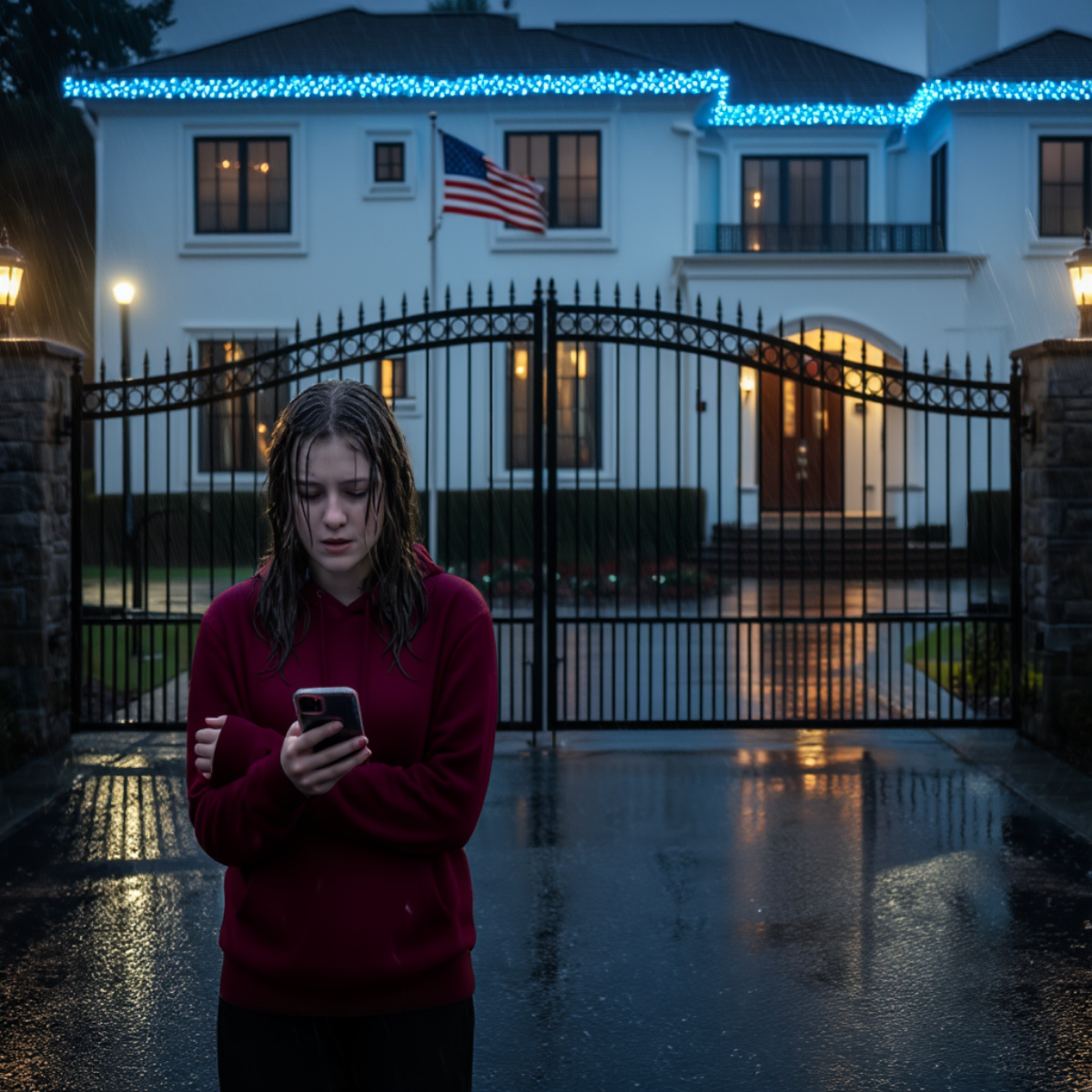
The rain wasn’t falling down, it was coming sideways. They call it an atmospheric river here in Seattle. But that night, it felt like an ocean trying to drown me. I stood outside the heavy iron gate of my family’s estate, shivering in just a thin hoodie. Through the glowing window, I saw them. My mother, Patricia, was pouring tea for my sister, Tiffany. They looked warm.
They My mother had locked the electronic gate, trapping me on the public road. My phone sat at 12%. I didn’t cry. I didn’t beg. I dialed my father.
The cold wasn’t just on my skin. It was inside my bones. My jaw was shaking so violently that my teeth clicked together like dice in a cup. I tried to tuck my hands into the sleeves of my hoodie, but the fabric was already soaked through heavy and useless against the biting wind coming off the Puget Sound.
My fingers felt like foreign objects, numb and clumsy, clutching my phone like a lifeline. 20 minutes. That was all it took to go from sitting at the dinner table to standing in a hypothermic nightmare. I closed my eyes and the memory of the warmth hit me harder than the rain. 20 minutes ago, the living room had been smelling of roasted garlic and rosemary. I was setting the table.
Then came the scream. Tiffany ran down the stairs. Her face a perfect mask of devastated innocence. She was sobbing, holding her phone out like a weapon. She said $12,500 was gone. Transferred out of her account. Stolen. That money was her inheritance from our grandmother. the fund specifically set aside for her summer camp in Europe.
She pointed a manicured finger at me and said I must have used her Face ID while she was napping. I didn’t even get a chance to deny it. I didn’t get to ask for proof. My mother, Patricia, didn’t look at the phone. She didn’t check the bank app. She just looked at me. The disgust in her eyes was immediate, absolute, and familiar.
She crossed the room in two strides, and the slap echoed louder than the thunder outside. It wasn’t a slap of discipline. It was a slap of pure, unadulterated hatred. She grabbed my arm, her nails digging into my skin and dragged me to the door. She threw me out like I was garbage she’d forgotten to take to the curb.
Standing there in the dark, watching the rain slant through the security lights, I realized why I wasn’t banging on the gate. Any normal teenager locked out in a storm would be screaming. They would be pressing the intercom button, begging their mother to have mercy, apologizing for things they didn’t do just to get back into the warmth. But I stayed silent.
I realized something in that freezing darkness, something that psychiatrists call the trap of normalized cruelty. My mother wasn’t trying to teach me a lesson. He wasn’t misguided. She was enjoying this. I could feel her gaze from behind the curtains. She was waiting for me to break. She wanted me to fall to my knees and plead so she could feel benevolent when she finally decided to let the wet dog back in.
She had spent 15 years normalizing this dynamic, making me the villain so Tiffany could shine as the golden victim. If I begged, I was validating her world. If I screamed, I was giving her the emotional reaction she craved. The realization killed the fear instantly. It replaced the shivering panic with something cold and hard and sharp.
I wasn’t a daughter to her. I was a prop in her power fantasy. And I was done playing my part. I wiped the water from my eyes. I didn’t look at the window again. I looked at the road watching for headlights. I wasn’t waiting for a parent. I was waiting for a witness. I was waiting for my father. Then I saw them.

Two beams of white light cutting through the downpour like lasers. My father’s SUV didn’t slow down as it approached the estate entrance. He knew the gate code. He knew the remote frequency, but he didn’t use either of them. He saw his teenage daughter standing in the freezing rain, and he saw the iron bars locking her out, and he made a choice that told me everything I needed to know about whose side he was on. He swerved hard to the right.
The engine roared, a deep mechanical growl that drowned out the thunder. He jumped the curb, his tires tearing through the pristine sod my mother spent thousands maintaining. There was a sickening, satisfying crunch as the heavy vehicle plowed straight through Patricia’s prize-winning hydrangeanger bushes, flattening the landscaping and bypassing the locked gate entirely.
He didn’t stop until his bumper was inches from the front porch steps. He was out of the car before the engine died. He didn’t run. He stalked. He pulled off his heavy coat and wrapped it around me in one fluid motion. The warmth was shocking, but the look on his face was colder than the ice storm. He didn’t ask what happened. Hedidn’t ask for my side of the story.
He looked at the locked front door, then at me, and his eyes went dark. “Stay behind me,” he said. His voice was low, terrifyingly calm. He walked up the steps and didn’t bother with his key. He kicked the front door right below the lock. It was a solid mahogany door built to withstand intruders, but it wasn’t built to withstand a father who had just seen his child treated like a stray animal.
The wood splintered with a crack like a gunshot, and the door swung inward, bouncing off the interior wall. The transition was instant and jarring. One second, I was in a chaotic, freezing hurricane. The next I was standing in a silent golden lit foyer that smelled of lavender and expensive tea. The contrast made me dizzy.
Patricia was standing in the middle of the living room, a porcelain teacup frozen halfway to her mouth. She didn’t look guilty. She didn’t look horrified that her husband had just driven across the lawn and kicked in the door. She looked annoyed. She looked like a hostess whose dinner party had been interrupted by a rude guest.
“Have you lost your mind, Robert?” she snapped, setting the cup down with a sharp clink. “You ruined the flower beds. I told you I was handling her discipline. She needs to learn that actions have consequences. My father didn’t even look at her. He didn’t validate her with an argument. He didn’t scream about the cold or the cruelty or the fact that I could have died of hypothermia.
He walked right past her, his wet boots leaving dark, muddy streaks on the cream colored Persian rug. He walked straight to the sofa where Tiffany was curled up under a Kashmir blanket, looking wideeyed and fragile, clutching her iPad to her chest like a shield. “Robert, don’t you dare ignore me!” my mother yelled, her voice rising in octave.
“Your daughter is a thief. She stole $12,000. My father stopped in front of Tiffany. He towered over her, dripping water onto the upholstery. Tiffany tried to shrink back, tried to summon those crocodile tears that had worked on everyone else for 17 years. She opened her mouth to whimper to play the victim, but my father held out his hand.
“Give it to me,” he said. “It’s private.” Tiffany squeaked, looking at mom for help. I said, “Give it to me.” He didn’t wait. He reached down and ripped the iPad out of her hands. That’s my property. Tiffany shrieked. It wasn’t a scared sound anymore. It was the entitled screech of someone who had never been told no in her entire life.
She lunged for the device, her manicured nails clawing at dad’s arm, but he held it high out of her reach like he was keeping a dangerous toy away from a toddler. Give it back to her, Robert. Mom shouted, stepping between them. You are violating her privacy. You have no right to treat your daughter like a criminal in her own home.
I pay the bill, he said, his voice cutting through their noise like a blade. I own the account. I have every right. He didn’t waste time guessing her passcode. He didn’t argue about ethics. He walked over to the 80-in OLED screen mounted above the fireplace, the one mom usually kept on a loop of serene landscape paintings to impress guests, and tapped a single icon on the iPad.
The screen flickered. The peaceful mountain meadow vanished. In its place, Tiffany’s home screen appeared, magnified to a terrifying 4t wide. Robert stopped this immediately. Mom yelled, moving to block the TV. “Move,” he said. He didn’t shout it. He didn’t have to. The sheer weight of his authority pushed her aside.
He opened the Venmo app. There was no hacking involved. No technical wizardry. It was just there right at the top of the transaction history. Sent to Lux Life Resale. $12,500. Memo investment piece. The silence that fell over the room was heavy, suffocating. Mom stared at the number on the giant screen.
She blinked, her mouth opening and closing like a fish on dry land. That that proves nothing. She stammered, desperate to keep her worldview from collapsing. Sierra could have done that. She could have stolen the iPad while Tiffany was sleeping and made the transfer. Is that right? Dad asked. He swiped up. He opened the mail app.
The latest email was timestamped 3 hours ago. Subject: Your order has shipped. Sender: Chanel official. The tracking number was live. The delivery address wasn’t my room. It wasn’t a locker. It was addressed to Tiffany St. James. Care of her best friend’s house two streets over. Did Sierra order a $5,000 handbag to your friend’s house, Tiffany? Dad asked, turning to look at her.
Did she forge the confirmation email, too? Tiffany was shaking her head, tears streaming down her face. But they weren’t the cute, sympathetic tears she used on mom. These were the ugly, splotchy tears of a cornered animal. I needed it, she sobbed. Everyone has one. You don’t understand the pressure. But that’s not the worst part, Dad said.
He wasn’t done. He swiped again. He opened her messages. He didn’t have to scrollfar. The group chat pinned at the top was active. The last message had been sent 5 minutes ago. Right while I was freezing at the gate, right while mom was pouring tea on the screen in high definition, everyone read Tiffany’s words.
OMG, you guys, it actually worked. The loser is literally freezing outside the gate right now. Mom is totally buying it. She’s pouring me tea. I’m a genius. Bye-bye, Sierra. Attached to the message was a photo. A blurry zoomed-in picture taken from the living room window. A picture of me standing in the rain shaking.
The golden child narrative didn’t just crack. It shattered into a million irreparable pieces. Dad stared at the message, reading it once, twice, three times. Then he slowly turned to look at mom. “You said you were protecting the family,” he whispered. “Look at that screen, Patricia. Look at what you were protecting.” “She’s 16, Robert.
” Mom’s voice was shrill, “Desperate.” She stepped in front of the TV, trying to block the damning image of the group chat with her own body. “It’s just a mistake. She was acting out. Girls her age do stupid things when they feel threatened. We can return the bag. We can get the money back. It’s just money. Just money. My father repeated.
His voice wasn’t loud. It was dead. He didn’t look at her. He didn’t look at Tiffany, who was now sobbing into her hands, making sounds that might have been apologies if anyone was listening. He looked at the iPad in his hand. He wasn’t done. He had seen something else in the mail app, something that had caught his eye before he switched to the messages. Move, Patricia,” he said.
“No, you’ve made your point. You’ve humiliated her enough.” He didn’t argue. He just stepped around her, tapped the screen, and the TV shifted again. He wasn’t looking at the inbox anymore. He had opened the trash folder. “What are you doing?” Mom demanded, grabbing at his arm. “Stop digging. You’re just trying to find reasons to hate her.
” “I’m trying to find the truth,” he said. He opened a deleted email on the large screen so no one could miss it. It was an acceptance letter sent yesterday for a full scholarship to the summer STEM initiative. I had waited weeks for it, convinced I hadn’t gotten in, but I had. Dad whispered stunned, “She got in yesterday.
” Then we saw the reply sent 20 minutes later from my account while I was at practice. It declined the offer and was immediately deleted. The silence shifted. This wasn’t theft. It was sabotage. Dad turned to Tiffany, his voice breaking. You didn’t just steal from her. You found her acceptance, declined it, and erased it so she’d never know. She froze.
Mom had no defense this time. I stepped forward, no longer cold. You didn’t want the money. You wanted to destroy my way out because you’re afraid I might actually be better than you. For the first time, Mom didn’t protect her. Then her expression hardened into entitlement. She stood, smiled thinly, and ordered us out of her house. Dad didn’t argue.
He called the sheriff. When Sheriff Miller arrived, Dad handed him a legal document. The house was held in trust. For me, mom’s right to live there depended on keeping me safe. By locking me out in the storm, she violated the trust and evicted herself. The ruling was immediate. 10 minutes to leave. I watched them escorted into the storm.
No longer powerful, no longer protected. When the door closed, the house felt quiet and safe for the first time. Later, my dad made hot cocoa like he used to when I was little. The scholarship was reinstated. I accepted it. They thought ownership meant control, but real ownership is accountability.