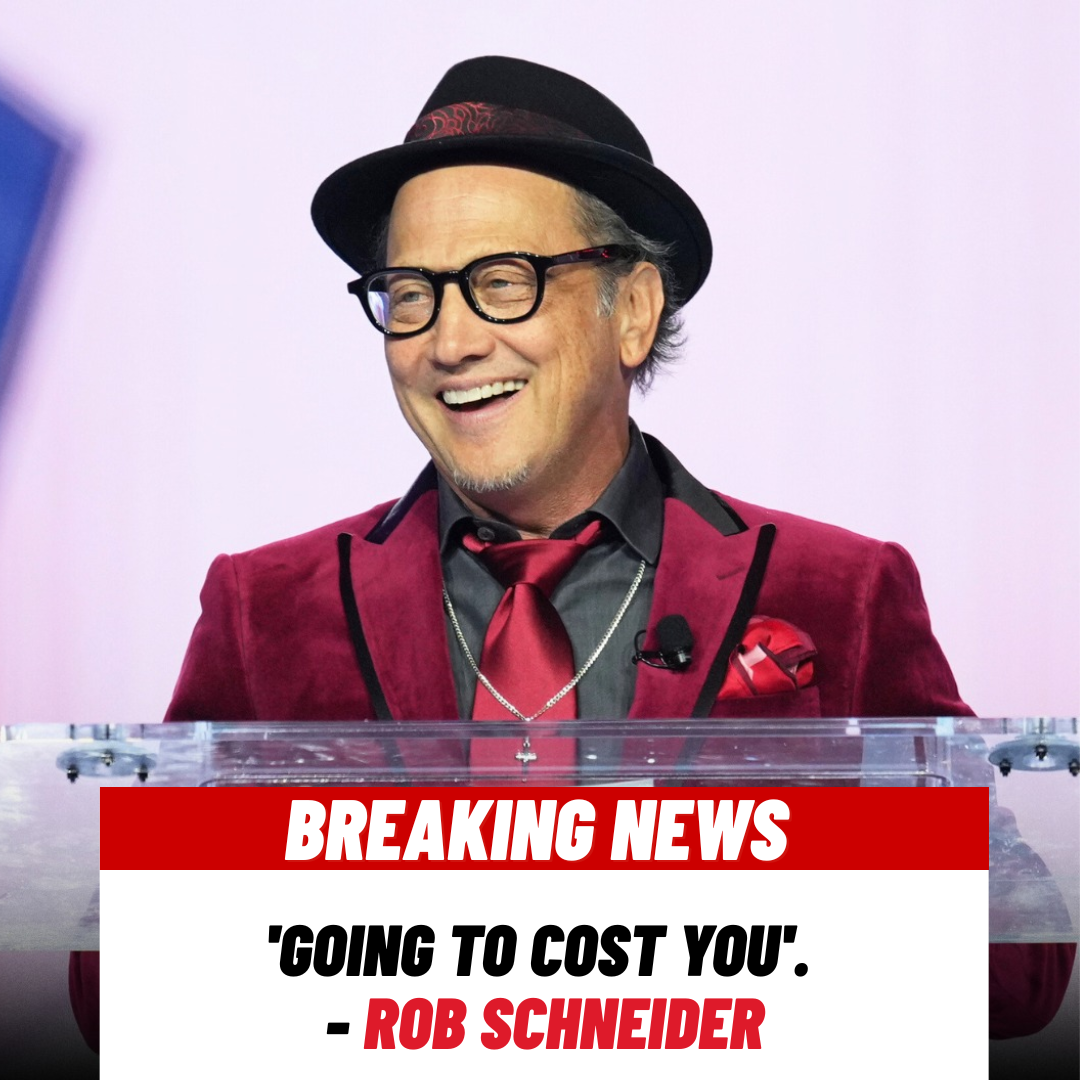
‘GOING TO COST YOU’ — Rob Schneider Breaks the Silence on Hollywood’s Hidden Blacklist
Rob Schneider has never been known for holding his tongue. But now, the former Saturday Night Live star says speaking his mind came with a price far steeper than he ever imagined — the quiet end of his Hollywood movie career.
In a blunt new interview, Schneider accused the entertainment industry of suffering from what he calls a “rot in the soul,” claiming conservative actors are being silently blacklisted while studios publicly preach tolerance and diversity. According to Schneider, once he began expressing right-leaning political views, the phone stopped ringing, leading roles disappeared, and an unspoken message settled in: fall in line or fade out.
The 61-year-old comedian, best known for films like Deuce Bigalow: Male Gigolo and The Hot Chick, said the shift was swift and unmistakable. “That was it for me starring in movies,” he said, recalling the moment he realized his political beliefs had become career poison.
Schneider insists there was no dramatic confrontation, no formal notice from studio executives, and no explicit ban. Instead, he describes something more insidious — a silent freeze-out that leaves performers professionally stranded while allowing Hollywood to deny any wrongdoing.
“Show business doesn’t want controversy,” Schneider explained. “They don’t want you being mouthy. And I understand that. But at a certain point, if we want to remain a free society, someone has to be willing to step up and speak, even if it costs them.”
And cost him, it did.
For decades, Schneider enjoyed a steady run of mainstream success, boosted by his years at SNL and a string of broad comedies that defined late-1990s and early-2000s Hollywood. But he says that era came to an abrupt halt once he stopped keeping his political opinions private.
“The act of telling the truth in an age of authoritarianism and lies is a courageous act,” he said, quickly adding that he doesn’t consider himself heroic. He contrasted his personal career losses with what he described as “real courage” — the sacrifices made by soldiers who gave “the last full measure of their devotion” to the country.
Then, with a self-aware laugh, he acknowledged the gulf between the two. “The fact that I’ll never make Deuce Bigalow 4, 5, and 6 — I think I’ll survive,” he joked. Still, he admitted the reality stings. “It’s a bummer.”
Schneider’s comments tap into a growing debate over political conformity in Hollywood, where progressive values dominate both on-screen storytelling and off-screen culture. While studios and award shows frequently celebrate inclusion and free expression, critics argue those ideals apply selectively — welcoming diversity of race, gender, and identity, but not of ideology.
Schneider believes conservative voices are tolerated only as long as they remain quiet.
“It’s going to cost you,” he said bluntly. “Freedom of speech doesn’t mean freedom from consequences.”
He even cracked a dark joke referencing late-night host Jimmy Kimmel, who briefly faced professional fallout after controversial remarks in 2025. “You can ask Jimmy Kimmel,” Schneider quipped, underscoring his belief that no one is truly immune once they cross Hollywood’s invisible lines.
To illustrate his point, Schneider pointed to legendary actor Charlton Heston — once celebrated as a civil rights supporter and Hollywood icon, later scorned by liberal elites after becoming an outspoken conservative and president of the NRA.
“That’s shameful,” Schneider said. “He didn’t change his talent. He didn’t change his legacy. He just happened to be a conservative.”
According to Schneider, the same pattern is playing out again, only more quietly. Instead of public denouncements or official blacklists, actors are simply left out of casting conversations, passed over for roles, and deemed ‘too risky’ by studios eager to avoid backlash.
“I think today’s blacklisting of conservatives is the same thing,” he said. “At its core, it’s contributing to Hollywood’s destruction.”
Schneider’s critique goes beyond personal grievance. He believes the industry is actively dismantling itself — culturally, creatively, and financially — by alienating huge portions of the audience.
“People feel talked down to,” he said. “They feel preached at. And eventually, they stop buying tickets.”
In his view, that rejection is already underway. Box office numbers remain shaky, major franchises struggle to recapture former glory, and studios increasingly rely on reboots rather than original storytelling. Meanwhile, audiences are drifting elsewhere.
“In five years, a lot of these studios are just going to be real estate,” Schneider predicted. “People are already getting their entertainment from podcasts, YouTube, and social media instead of movies.”
He sees platforms outside traditional Hollywood as both an escape valve and a warning sign — proof that creators no longer need studio approval, and that audiences are eager for voices that don’t conform to a single ideological script.
Schneider himself has embraced alternative paths, focusing on stand-up comedy, independent projects, and direct engagement with fans. While the budgets are smaller, he says the creative freedom is greater — and the audiences more honest.
“There’s something refreshing about it,” he said. “You know exactly where you stand.”
Still, Schneider doesn’t pretend the shift has been painless. He admitted that watching former peers continue to land major studio roles while his own opportunities dried up has been difficult.
“You work your whole life to get into those rooms,” he said. “And then suddenly, you’re not invited anymore.”
Despite his harsh assessment, Schneider insists he hasn’t lost his love for filmmaking — only his faith in Hollywood’s moral consistency.
“They talk about inclusion nonstop,” he said. “But inclusion doesn’t mean anything if it only applies to people who agree with you.”
As political divisions continue to harden across the country, Schneider believes Hollywood faces a choice: embrace genuine diversity of thought or continue narrowing its cultural lens.
“I think we’re watching an implosion,” he said. “And unless something changes, it’s only going to get worse.”
For now, Schneider seems resigned to his outsider status — defiant, realistic, and unapologetic.
“If telling the truth costs me a few movies,” he said, “so be it.”