Brand Pulled Overnight: Crane Moves In After Hotel Video Sparks Fallout
Crane Removes Hilton Branding From Minnesota Hotel After Video Sparks ICE Service Dispute
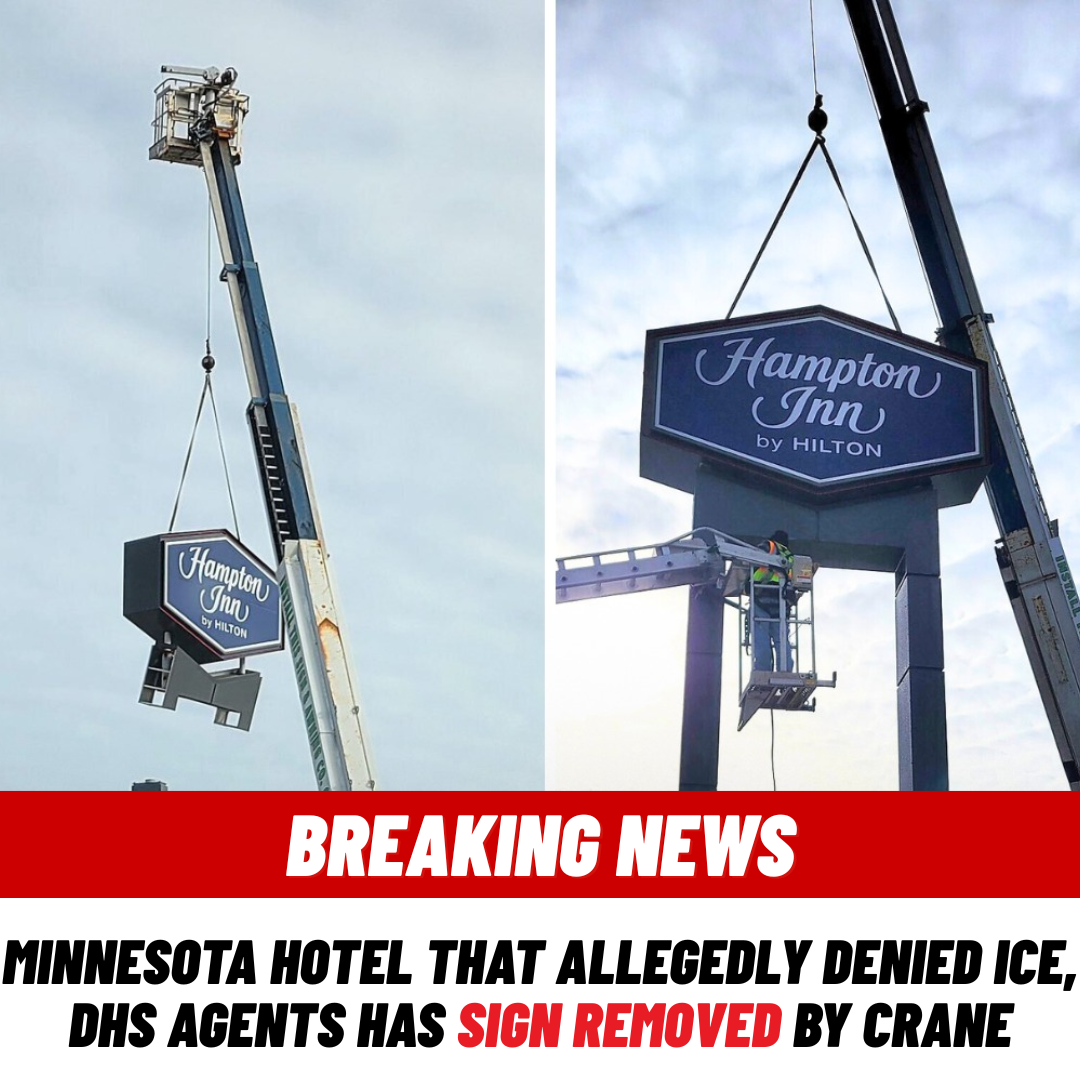
A dramatic early-morning scene unfolded outside a Minnesota hotel this week as a towering crane was brought in to remove the familiar Hampton Inn signage — marking a swift and highly visible response after a video circulated online allegedly showing federal immigration officers being denied service.
The hotel, located in Lakeville, south of Minneapolis, was stripped of its Hilton-affiliated branding after the footage triggered intense scrutiny and political backlash. The move came amid claims that Department of Homeland Security (DHS) and Immigration and Customs Enforcement (ICE) agents were refused accommodation while on duty.
Photographs and video shared across social media captured workers hoisting the large sign away from the building, an unmistakable signal that the parent company had taken decisive action.
A Video That Set Off a Firestorm
The controversy began after a short clip surfaced online appearing to show ICE agents at the hotel’s front desk being turned away. In the footage, an employee can be heard explaining that the property could not accommodate the agents, citing internal policy.
The video quickly spread, drawing sharp reactions from lawmakers, commentators and law enforcement supporters who accused the hotel of discrimination against federal officers.
DHS officials later confirmed that agents were involved in the incident, though the precise circumstances — including whether rooms were available at the time — remain disputed.
Hilton Moves Quickly
Hilton, which franchises the Hampton Inn brand to independently owned properties, confirmed that it had removed its branding from the Lakeville hotel following a review of the incident.
In a statement, the company stressed that it does not tolerate discrimination of any kind and expects franchisees to comply with brand standards and applicable laws.
The decision to physically remove signage — rather than quietly terminate a contract — sent a powerful message, industry observers noted.
“This is the corporate equivalent of a public severing,” one hospitality analyst said. “It’s not subtle.”
What Hilton Said — And Didn’t Say
Hilton stopped short of detailing the specific contractual violations involved, but emphasised that the hotel is independently owned and operated.
The company reiterated that denying service to law enforcement solely based on their occupation would be inconsistent with brand expectations.
However, Hilton did not publicly address whether the hotel had cited safety concerns, staffing issues, or other operational reasons — factors that sometimes complicate such encounters.
The Hotel’s Position
The Lakeville property has not released a detailed public explanation beyond brief statements acknowledging the incident. Sources familiar with hotel operations say staff may have been uncertain about company policy regarding housing federal agents, particularly amid heightened tensions surrounding immigration enforcement.
Supporters of the hotel argue that frontline employees are often left navigating politically charged situations without clear guidance, especially in late-night or high-pressure circumstances.
Critics counter that federal officers on duty should not be treated differently from other guests.
Political Reaction Escalates
The incident quickly became a flashpoint in the broader national debate over immigration enforcement.
Several Republican lawmakers condemned the alleged refusal, calling it an example of “anti-law enforcement bias.” Some urged consumers to boycott the property, while others praised Hilton for acting swiftly.
On social media, the images of the crane removing the sign became symbolic — shared widely as evidence of corporate accountability.
“This is what consequences look like,” one post read.
A Franchise System Under Pressure
The episode has also highlighted the complexities of the franchise model that dominates the hotel industry.
While properties operate independently, brand reputation remains centralized. When controversy strikes one location, the fallout can ripple across the entire chain.
Hospitality experts say companies like Hilton must balance contractual fairness with reputational risk — especially in an era where viral video can force decisions within hours.
“Once that video went viral, the clock was ticking,” an industry insider noted. “Doing nothing was not an option.”
Law Enforcement Response
DHS officials have defended the agents involved, stating they were seeking routine accommodation while carrying out official duties.
They stressed that agents did not request special treatment and expected to be treated as any other guests.
The department also confirmed it is reviewing the incident internally, though it has not indicated whether any formal action against the hotel is planned.
Community Reaction
Locally, the reaction has been mixed.
Some residents expressed concern that the situation had drawn national attention to their town, while others defended the hotel staff, arguing that businesses should have the right to set policies they believe protect employees and guests.
Others welcomed Hilton’s move, saying it reaffirmed respect for law enforcement.
The Image That Lingers
What may endure longest is the visual itself: a crane lifting away a corporate logo in broad daylight, as onlookers filmed from the street.
In the age of instant outrage and corporate accountability, the image became a powerful shorthand — representing how quickly a brand can distance itself when controversy erupts.
“It was a statement without words,” said one branding expert. “Everyone understood what it meant.”
What Happens Next
The future of the Lakeville hotel remains uncertain. Without Hilton branding, the property may rebrand independently or seek affiliation with another chain.
For Hilton, the swift action appears aimed at containing reputational damage and reaffirming its stance amid a highly polarised issue.
For the broader hospitality industry, the incident serves as a cautionary tale about staff training, clear policies and the speed at which local decisions can become national controversies.
As investigations and internal reviews continue, one thing is already clear: the removal of that sign has turned a single front-desk interaction into a moment watched far beyond Minnesota — and into a symbol of how corporate, political and cultural fault lines now intersect in real time.