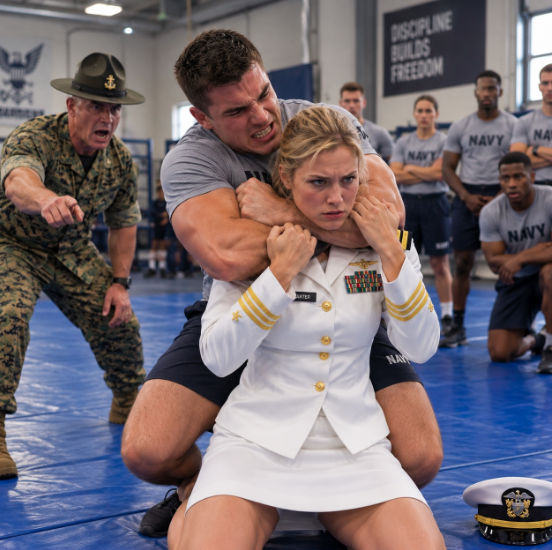
👇 PART 2 — HE THOUGHT HE BROKE THE QUIET TRANSFER, BUT THE ENTIRE TRAINING ROOM LEARNED WHO SHE REALLY WAS
Bradley Jenkins sat on the edge of the mat for almost thirty seconds without saying anything.
That was unusual.
People like Bradley always had something to say.
A joke.
An excuse.
A comment designed to make sure the room remembered him.
But after hitting the floor in front of forty-seven trainees, he had nothing.
Because for the first time since arriving at Little Creek, Bradley had encountered someone who did not care about his reputation.
And that confused him more than losing.
Commander Donovan Price dismissed the class five minutes later.
Nobody moved immediately.
The trainees looked between me and Bradley like they were trying to understand what they had just witnessed.
The quiet transfer who had eaten lunch alone.
The woman nobody bothered to introduce themselves to.
The person Bradley had decided was harmless.
Had just ended a restraint drill with almost no effort.
Bradley finally stood.
His face was red.
Not from pain.
From embarrassment.
“You think that proves something?”
I picked up my water bottle.
“It proves you ignored a safety signal.”
“That’s not what I meant.”
“I know.”
That made him angrier.
Because I did know.
I knew exactly what he meant.
He wanted the room to believe he had lost because of luck.
Because of a trick.
Because of anything except the obvious.
He had lost because he stopped thinking.
—

That evening, Commander Price called me into his office.
He closed the door.
“You made him angry.”
“Yes.”
“You did that intentionally?”
“No.”
Price raised an eyebrow.
I corrected myself.
“Not completely.”
A small smile appeared.
“Bradley Jenkins has been one of the strongest candidates in this rotation.”
“I know.”
“He is also one of the biggest risks.”
“I know.”
Price leaned back.
“That’s why you are here.”
I looked at him.
“Not because of Bradley.”
“No.”
He opened a folder.
Inside were months of evaluations.
Complaints.
Training reports.
Incident notes.
A pattern.
“Several instructors have noticed the same thing,” Price said. “He performs well when things are controlled.”
“And when they aren’t?”
“He compensates with aggression.”
I nodded.
“That becomes dangerous.”
“Exactly.”
The problem was not that Bradley was strong.
The problem was that he believed strength solved everything.
Real operations punished people who thought that way.
—
The next week changed the atmosphere.
Bradley stopped making jokes around me.
But he started watching.
That was actually worse.
People who underestimate you are easy to predict.
People who realize they misjudged you become curious.
And curiosity creates mistakes.
I noticed him asking questions.
Not about me.
About my evaluations.
About why Commander Price listened to my recommendations.
About why instructors suddenly changed certain drills.
He was looking for answers.
He just did not know where to look.
Because the answer was sitting in front of him every day.
—
Three days later, the advanced leadership exercise began.
The trainees were divided into teams.
The scenario was designed to test decision-making under pressure.
Limited communication.
Changing objectives.
Multiple failures.
Exactly the kind of situation where confidence could become a weakness.
Bradley was assigned team leader.
I was assigned observer.
That bothered him.
“Observer?”
“Yes.”
“You’re not participating?”
“No.”
He smiled.
“Convenient.”
I looked at him.
“You have a problem with the assignment?”
“No.”
His tone said yes.
That was another note.
—
The exercise started at 0600.
For the first hour, Bradley performed well.
Clear commands.
Good physical ability.
Strong presence.
His team followed him.
Then the situation changed.
The simulated objective moved.
One team member was removed.
A supply issue appeared.
The timeline shortened.
Pressure.
That was the point.
Not whether he could succeed when everything worked.
Whether he could lead when nothing did.
Bradley made the first mistake.
He ignored a quieter team member’s suggestion.
Then the second.
He rushed.
Then the third.
He blamed.
By hour three, his team was no longer following him.
They were surviving him.
I watched silently.
Commander Price stood beside me.
“What do you see?”
I answered honestly.
“He wants to win.”
“That’s bad?”
“No.”
I watched Bradley argue with one of his teammates.
“He wants to prove he’s the winner.”
Price nodded.
There was the difference.
—
At the final checkpoint, Bradley’s team failed.
Not because they lacked ability.
Because they lacked trust.
The trainees removed their gear.
Nobody spoke.
Bradley walked toward me.
“You knew this would happen.”
“No.”
“You did.”
“I knew it was possible.”
He looked angry.
“Same thing.”
“No.”
I stepped closer.
“The difference matters.”
He waited.
“You keep thinking leadership is making people follow you.”
I pointed toward his team.
“It’s making them trust you.”
For once, Bradley had no answer.
—
That night, something happened I did not expect.
Bradley came to my office door.
No audience.
No Wyatt.
No performance.
Just him.
“I owe you an apology.”
I looked up.
“For what?”
He hesitated.
Everything about him wanted to avoid saying it.
That was the hardest part.
Not admitting he was wrong.
Admitting he had been wrong for the right reasons.
“I judged you before I knew you.”
I closed the folder.
“Yes.”
He nodded.
“I thought because you were quiet, you were weak.”
“And now?”
He looked down.
“Now I think I was loud because I was afraid nobody would notice me.”
That was the first honest thing Bradley Jenkins had said to me.
And honesty was where improvement started.
But before I could respond, my phone vibrated.
A secure message.
FROM: COMMANDER PRICE.
SUBJECT: IMMEDIATE.
I opened it.
One sentence.
THE EVALUATION WAS COMPROMISED.
I looked at Bradley.
Then back at the message.
Someone had accessed restricted training data.
Someone had altered scores.
Someone had been watching the evaluation from inside the command structure.
And suddenly, Bradley Jenkins was no longer the biggest problem at Little Creek.
Because the person we were supposed to be investigating…
was investigating us.
RETURN TO THE COMMENTS TO READ PART 3. THANK YOU!