🚨 NSW TRAGEDY: Mother Charged After Blue Mountains Attack Involving Three Young Children — As Investigation Turns to What Happened Before the Horror
A quiet community in New South Wales has been left reeling after a mother was charged over an alleged attack involving her three young children — aged just five, three and one — in a case that has prompted shock and grief far beyond the Blue Mountains.
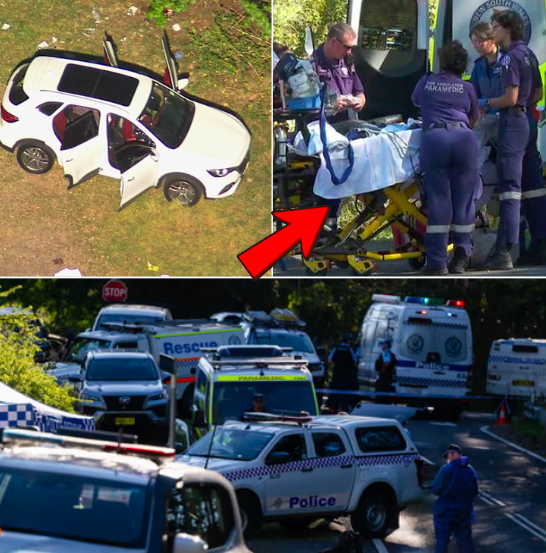
The 42-year-old woman was charged after emergency services descended on Valley Heights, west of Sydney, following reports of a horrifying incident involving the mother and her three children.
One of the children, a five-year-old boy, could not be saved.
The two younger children — aged three and one — were rushed to hospital in critical condition, while their mother was also taken for medical treatment.
In the days that followed, the tragedy deepened further when authorities confirmed that the one-year-old child had also died in hospital.
What began as an emergency response on a suburban road had become a devastating criminal investigation involving the deaths of two very young children and serious injuries to a third.
And as detectives began piecing together the hours and circumstances surrounding the incident, one question inevitably came to dominate public attention:
What could possibly have led to such a tragedy?
A HORRIFYING DISCOVERY IN VALLEY HEIGHTS
The incident unfolded in Valley Heights, a community in the lower Blue Mountains, on September 20.
Emergency services were called to Waratah Road shortly before 1pm following reports concerning a woman and three children.
The scene confronting first responders was devastating.
According to NSW Police, the three children had suffered stab wounds.
The five-year-old boy died at the scene despite efforts to save him.
His younger siblings, aged three and one, were transported to The Children’s Hospital at Westmead in critical condition.
Their 42-year-old mother was also taken to hospital under police guard after suffering injuries.
Police subsequently alleged that the woman’s injuries were self-inflicted.
The investigation quickly became a major operation.
Detectives established Strike Force Karelo to investigate the circumstances surrounding what had happened.
For a community accustomed to the relative calm of the Blue Mountains, the sudden presence of police vehicles, forensic investigators and emergency crews marked the beginning of a nightmare few could have imagined.
A MOTHER BECOMES THE ACCUSED
After receiving medical treatment, the woman was charged.
Police initially laid one count of murder and two counts of causing grievous bodily harm with intent to murder in connection with the alleged attack.
The charges were classified as domestic-violence related.
It is important to stress that the allegations against the woman have not yet been tested at trial. She is entitled to the presumption of innocence unless and until proven guilty.
But the case became even more devastating days later.
On September 24, police announced that the one-year-old child had died in hospital.
Authorities said an additional murder charge would be laid following the child’s death.
That development fundamentally changed the scale of the case.
Two children — just five years old and one year old — were now dead.
A third child, only three, had survived serious injuries.
The sheer ages of the children intensified the public response.
They were at stages of life normally associated with first words, preschool, toys, bedtime stories and the earliest memories of childhood.
Instead, their family became the focus of one of the most disturbing criminal investigations in NSW that month.
THE SURVIVING CHILD
Amid the horror, attention also turned to the three-year-old child who survived.
Initial reports described the child as being in critical condition following the incident.
The child’s survival added another deeply painful dimension to the investigation.
Detectives would need to reconstruct events carefully using physical evidence, forensic examination, witness accounts and any available digital or surveillance material.
At the same time, medical teams were focused on treating the surviving child.
Authorities have understandably released limited information about the child’s identity and medical circumstances.
Protecting the privacy of a young surviving victim is particularly important in a case of this nature.
The father of the children was contacted by police and was reported to have been at the hospital with his children following the incident.
Police did not publicly identify him as a suspect.
THE QUESTION AUSTRALIA WANTS ANSWERED
As news of the case spread, speculation inevitably began about a possible motive.
Yet this is precisely where the known facts end and unanswered questions begin.
Authorities have not publicly established a definitive motive explaining why the alleged attack occurred.
Nor have police released evidence establishing a specific chain of events that caused the tragedy.
That distinction matters.
In cases involving parents and children, public discussion can quickly turn toward assumptions about mental health, relationship difficulties, financial pressures or domestic conflict.
But without evidence, those explanations remain speculation.
What investigators can do — and what Strike Force Karelo is tasked with doing — is reconstruct the period leading up to the incident.
Detectives can examine communications, movements, witness accounts and other evidence that may reveal whether there were warning signs or significant events before emergency services were called.
That process could eventually provide answers.
For now, however, the central question remains unresolved.
POLICE SAY THE FAMILY WAS NOT PREVIOUSLY KNOWN TO THEM
One of the most significant early details to emerge was that police said the mother had not previously been known to them.
That fact became particularly important because authorities were treating the alleged attack as domestic-violence related.
The absence of a known police history raises difficult questions that extend beyond this individual case.
How can authorities identify families at risk when there have been no previous police reports?
What warning signs exist outside the criminal justice system?
And how much can friends, relatives, health professionals, schools or community services realistically detect before an emergency occurs?
Those questions have no simple answers.
Domestic and family violence can take many forms, and not every dangerous situation generates a previous police report.
The Blue Mountains case therefore became part of a broader discussion taking place in NSW after a particularly grim period involving several deaths investigated in a domestic-violence context.
For authorities, prevention becomes especially difficult when there has been little or no previous contact with police.
A COMMUNITY IN SHOCK
Valley Heights sits in the lower Blue Mountains, roughly 70 kilometres west of Sydney’s central business district.
It is the kind of community where an incident involving multiple police and emergency vehicles immediately attracts attention.
News that three extremely young children were involved transformed that concern into horror.
The tragedy was felt not simply because of the alleged circumstances, but because of the ages of those involved.
Five.
Three.
One.
Numbers that, when placed beside the words “murder investigation,” seem almost impossible to comprehend.
For residents, the road where the emergency response unfolded was no longer simply an ordinary part of their neighbourhood.
It had become the centre of an investigation that would draw attention from across Australia.
THE PEOPLE WHO STOPPED TO HELP
Another important aspect of the case involves the members of the public who encountered the emergency and attempted to help.
Before detectives could begin gathering evidence and before courts could consider criminal charges, ordinary people were confronted with an extraordinary situation.
Emergency calls were made.
Assistance was attempted.
Paramedics and police then arrived and took control of the scene.
Those first moments matter in any major emergency, particularly when victims have suffered life-threatening injuries.
For the witnesses involved, however, the psychological impact can persist long after police tape disappears.
Cases involving injured children can be particularly traumatic for bystanders and first responders.
The events therefore affected not only the immediate family but also the people who found themselves unexpectedly drawn into the tragedy.
FORENSIC INVESTIGATION BEGINS
Strike Force Karelo now carries the responsibility of establishing precisely what happened.
Investigations of this seriousness can involve numerous forms of evidence.
Detectives may examine the physical scene, forensic evidence and relevant communications while taking statements from witnesses and people familiar with the family.
A detailed timeline is often crucial.
Investigators need to determine where those involved were before the incident, when particular events occurred and whether there were communications or interactions relevant to understanding what happened.
But investigators must also separate evidence from assumption.
A criminal case ultimately depends on what can be established and presented in court, not what appears plausible in public discussion.
That process can take months.
Sometimes it takes years.
THE LEGAL CASE AHEAD
The mother’s case is now before the courts.
The allegations are among the most serious available under criminal law.
But charges are not convictions.
Prosecutors will eventually need to establish their case through admissible evidence, while the defence will have the opportunity to challenge that evidence and present its own case.
Questions about the accused woman’s state of mind may also become legally significant depending on the evidence and arguments ultimately presented.
However, no conclusion about those issues should be drawn before the relevant evidence is heard.
This is particularly important because public reaction to cases involving the deaths of children can be intense.
The criminal justice system operates under a different standard.
It requires evidence.
It requires procedure.
And it requires the allegations to be tested.
TWO YOUNG LIVES LOST
Behind the criminal charges and forensic investigation lies the most painful fact of all.
Two very young children are dead.
The five-year-old died before he could be taken from the scene.
The one-year-old initially survived long enough to reach hospital but later succumbed.
The loss of the youngest child several days after the incident meant the family endured a second devastating development while investigators were already working to understand the first death.
Meanwhile, another child survived.
The three-year-old’s presence at the centre of the case serves as a reminder that the consequences of the incident extend far beyond the courtroom.
There will be medical, emotional and family consequences that may continue for years.
WHY THE CASE HAS RESONATED
There are crimes that shock because of their scale.
Others shock because they occur somewhere unexpected.
This case has resonated for another reason: the extreme vulnerability of the children involved.
A one-year-old is entirely dependent on adults.
A three-year-old is barely beginning to understand the world.
A five-year-old should be thinking about school, friends and play.
That contrast between ordinary childhood and the allegations at the centre of the investigation is what has made the Valley Heights tragedy particularly difficult for many people to process.
It also explains why speculation surrounding the alleged motive has been so intense.
People naturally search for an explanation when confronted with an event that appears inexplicable.
But the responsible answer at this stage is also the most frustrating one:
Investigators have not publicly provided a definitive explanation.
WHAT HAPPENED BEFORE THAT AFTERNOON?
This is likely to become one of the most important areas of the investigation.
The events immediately preceding the emergency call may help detectives understand whether the alleged attack was preceded by a specific incident or whether other circumstances played a role.
Investigators may examine the family’s recent movements and communications and speak with people who had contact with them.
They may also investigate whether anything changed in the days or hours before the incident.
But unless authorities release those findings or they emerge through court proceedings, claims about a hidden trigger or secret motive should be treated cautiously.
The investigation is ongoing.
There is still a substantial difference between something detectives are examining and something they have proved.
A BROADER DOMESTIC-VIOLENCE CONVERSATION
The tragedy also occurred against the backdrop of continuing concern about domestic and family violence in Australia.
NSW authorities have repeatedly faced the challenge of identifying high-risk situations before they become fatal.
The Valley Heights investigation demonstrates one of the most difficult aspects of that problem: authorities cannot intervene in circumstances they do not know exist.
If a person has no significant history with police, conventional risk-monitoring mechanisms may have little information to work with.
That does not mean there were necessarily warning signs in this particular case.
It means investigators will need to determine whether any existed and, if so, whether anyone could reasonably have recognised them.
Those findings may ultimately matter beyond the courtroom.
A CASE FAR FROM OVER
For now, the Blue Mountains tragedy remains an active criminal case.
A 42-year-old mother stands accused of extraordinarily serious crimes.
Two children are dead.
Another survived.
A father and extended family are confronting unimaginable loss.
A community is trying to understand how an ordinary September afternoon became the scene of a major homicide investigation.
And detectives are still working through the evidence.
The investigation may eventually establish a clearer picture of what happened before emergency services arrived on Waratah Road.
Court proceedings may reveal evidence that has not yet been made public.
Witness testimony, forensic findings and other material may help answer the question hanging over Valley Heights since the first emergency call:
Why?
Until that evidence emerges, there is no verified public finding establishing a definitive motive.
That unanswered question now sits at the centre of the case.
For Australians following the tragedy, however, one fact needs no further investigation.
Three children — aged only five, three and one — were caught in an appalling incident.
Two of them never came home.
And as Strike Force Karelo continues its work, the search for an explanation behind what happened in the Blue Mountains is only beginning.