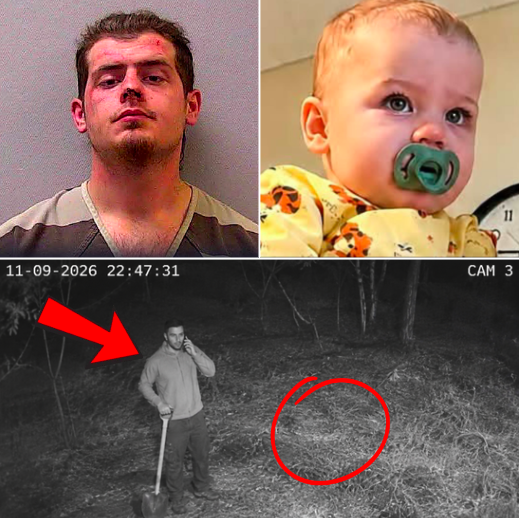
🔥 SHOCKING UPDATE: FARM SECURITY CAMERA CATCHES WHO MICHAEL COMER CALLED SECONDS AFTER BURYING HIS 11-MONTH-OLD SON!
LEXINGTON COUNTY, S.C. — For forty-eight agonizing hours, the quiet, pine-covered stretch of rural South Carolina near Batesburg-Leesville was the center of an unthinkable nightmare. When 11-month-old Koah Sharp vanished into thin air while under the care of his own father, nearly one hundred law enforcement officers, K-9 units, state troopers, and federal agents descended upon the dense woodlands, bracing themselves for the worst possible outcome.
When rescuers finally heard a faint, desperate whimper rising from beneath a fresh patch of pine needles—and pulled the helpless infant alive from a towel-wrapped metal dog crate buried under a foot of cold earth—the nation breathed a collective sigh of relief. It was hailed as nothing short of a miracle.
But behind the closed doors of the Lexington County Sheriff’s Department, seasoned homicide and special victims detectives were already staring at a far darker, far more sinister puzzle. Because the question that haunted investigators from the very first moment wasn’t just how the baby survived twenty-four hours underground. It was why Michael Comer had buried him there in the first place—and why he had taken such bizarre, calculated steps to keep the child alive inside that makeshift tomb.
Now, newly uncovered surveillance footage from a neighboring agricultural property has blown the investigation wide open, revealing that Michael Comer did not act alone—and exposing the chilling identity of the person on the other end of a phone call made seconds after the dirt was packed over his son’s head.
A Routine Afternoon Turns into a Nightmare
To understand the sheer depravity captured on that grain-silo security camera, investigators had to reconstruct the final hours leading up to Monday afternoon.
By all accounts, November 9 began like any other crisp autumn day in Lexington County. Koah Sharp, an energetic eleven-month-old with bright eyes and a tuft of sandy hair, was being watched by his paternal grandmother at a family residence tucked away near the tree line. Having an urgent errand to run, the grandmother made a decision that would haunt her for the rest of her life: she left Koah temporarily in the care of her son, Michael Comer, while waiting for a scheduled caregiver to arrive.
On paper, Comer was already a ticking time bomb. Court records obtained after his arrest revealed a troubling history of volatility. He had recently been placed on probation following a guilty plea stemming from a domestic violence incident involving Koah’s mother. Even more alarming, in a frantic 911 call released earlier this week, Comer’s own mother admitted to dispatchers that her son had been spiraling—making erratic, terrifying statements about disappearing to New York with the baby and even threatening to take his own life.
Yet when the caregiver arrived at the house that Monday afternoon, the front door stood unlocked, the living room was dead silent, and both Michael Comer and little Koah had vanished without a trace.
The Manhunt and the Miracle Beneath the Pine Needles
Within hours, the disappearance triggered an all-hands-on-deck emergency response. Helicopters swept the tree canopy with thermal imaging while teams of deputies combed through thickets, creeks, and abandoned outbuildings.
Late Monday night, police caught their first major break. Acting on a tip about suspicious movement near a rural property in Batesburg-Leesville, officers surrounded a locked storage shed and arrested Michael Comer on a preliminary trespassing charge. He was dirty, disheveled, and reeked of alcohol—but he was completely alone.
When detectives pressed him on the whereabouts of his eleven-month-old son, Comer retreated behind a wall of icy, impenetrable silence. According to Sheriff’s Department officials, the father showed zero panic, zero grief, and zero remorse—even as the temperatures dropped overnight into the low forties, threatening the life of an infant exposed to the elements.
For twenty-four hours, rescuers raced against a ticking clock. Then, on Tuesday afternoon, roughly fifty yards from a relative’s property line, an investigator’s boot sank into a patch of soil that looked suspiciously loose beneath a layer of freshly scattered pine needles.
The team froze. In the dead quiet of the woods, someone heard it: a weak, muffled cry coming from directly beneath their feet.
Bodycam footage from the rescue captured the frantic, heart-stopping seconds as deputies dropped to their knees, clawing away the dirt with their bare hands and entrenching tools. Twelve inches down, their fingers struck cold steel. Inside a standard metal wire dog crate—carefully wrapped in a heavy bath towel that had created a microscopic pocket of breathable air and insulated the child from the freezing mud—lay Koah Sharp.
Miraculously, aside from mild dehydration and hypothermia, the boy was unharmed. He was rushed to a local hospital and discharged into the arms of relieved relatives later that very night.
The Unanswered Question That Bothered Detectives
To the public, the story seemed tragically simple: a mentally unstable, abusive father had snapped, tried to murder his own child in a fit of rage or suicidal despair, and failed only because of dumb luck and a bath towel.
Veteran investigators, however, weren’t buying it.
“When someone wants to kill an infant and hide the body, they don’t spend ten minutes meticulously wrapping a wire crate in a thick cotton towel so dirt doesn’t fall through the bars into the baby’s face,” one law enforcement source close to the investigation explained. “And they certainly don’t bury the crate only twelve inches deep, fifty yards from a family member’s back porch, where search dogs are guaranteed to walk within the first day.”
The crime scene didn’t look like a murder attempt. It looked like a staging ground. It looked like someone was trying to hide a child temporarily—or create a bargaining chip in a much larger, far more twisted game.
For three days, detectives scoured Comer’s burner phone records, bank statements, and recent movements, searching for the missing piece of the puzzle. They found it on Friday morning, mounted twenty feet up on the side of an equipment barn belonging to an adjacent 40-acre timber and cattle farm.
What the Farm Camera Captured
The farm’s owner, an elderly retiree who rarely checked his automated perimeter cameras, turned over the hard drive after deputies canvassed neighboring properties extending beyond the initial search grid. Because the camera’s infrared sensor was angled toward a broken fence line bordering the woods, it had inadvertently captured a crystal-clear, unobstructed view of the exact clearing where Koah was buried.
When detectives queued up the timestamp from Monday afternoon—roughly forty minutes after Comer vanished from the grandmother’s house—the room went dead silent.
In the grainy, high-definition black-and-white footage, Michael Comer emerges from the brush carrying a long-handled spade in his right hand and the metal dog crate in his left. Contrary to what his family believed, Comer does not appear intoxicated, frantic, or out of control. His movements are brisk, deliberate, and eerily methodical.
The video shows Comer dropping to his knees behind a cluster of scrub pines. Over the next seven minutes, he digs a shallow rectangular trench, wraps the crate tightly in a folded towel pulled from his backpack, and lowers the infant inside. He pauses briefly to test the stability of the dirt over the top of the cage, ensuring the weight won’t crush the wire frame, before kicking a thick blanket of pine needles over the fresh soil.
Then, at 4:18 PM, just as he picks up the shovel to leave, Comer stops dead in his tracks.
Standing directly over the buried child, he reaches into his front pocket, pulls out a prepaid cell phone, and dials a single number. Thanks to the farm camera’s sensitive directional microphone—installed to detect trespassing poachers—the audio picked up Comer’s voice cutting clearly through the autumn breeze.
“It’s done,” Comer says into the receiver, his tone flat and businesslike. “He’s under the pines. Nobody’s going to find him until the wire hits the account. Make sure she knows the clock is ticking.”
Unmasking the Mastermind Behind the Curtain
That single, chilling sentence shattered every assumption investigators had made about the case.
Comer hadn’t buried his son out of madness or suicidal despair. He was executing a cold-blooded, calculated extortion plot—and someone else was pulling the strings from the shadows.
Within two hours of enhancing the audio and subpoenaing the emergency tower pings from the prepaid phone, federal agents traced the recipient of the 4:18 PM call to a rundown motel room just across the state line in Augusta, Georgia.
When U.S. Marshals kicked down the door late Friday night, they didn’t find a cartel boss or a stranger from the dark web. Sitting on the edge of the bed, surrounded by printed bank routing documents and a packed suitcase, was 42-year-old Victor Vance—the estranged, debt-ridden uncle of Koah’s mother, and a career con artist with a rap sheet stretching across three states.
According to arrest affidavits unsealed over the weekend, Vance had spent the past six months drowning in over $180,000 of illegal gambling debts owed to loan sharks in Atlanta. Desperate for cash, Vance knew a secret that few outside the immediate family were aware of: Koah’s maternal grandfather had recently passed away, leaving behind a substantial $250,000 life insurance trust fund—a fund that Koah’s mother had sole emergency access to in the event of a family crisis.
Knowing that Michael Comer was desperate for money, facing probation violations, and harboring deep resentment toward Koah’s mother, Vance allegedly approached Comer two weeks before the disappearance with a sickening proposition.
A Twisted Scheme Built on Pure Cruelty
Investigators say Vance masterminded the entire abduction as a fake kidnapping-for-ransom scam, recruiting Comer to do the dirty work in exchange for a 40% cut of the payout.
The plan, as laid out in encrypted text messages recovered from Vance’s burner phone, was as grotesque as it was reckless. Vance allegedly convinced Comer that if the child simply “disappeared” while in Comer’s care, police would immediately arrest Comer as the prime suspect—leaving Vance free to contact Koah’s mother anonymously, posing as a ruthless kidnapper demanding $200,000 in untraceable wire transfers for the boy’s safe return.
To ensure the baby wouldn’t cry out and alert search parties before the ransom was paid—and to make sure Comer wasn’t caught with the child when police inevitably tracked him down—Vance instructed Comer to create an “underground hiding spot” near the property line. The towel-wrapped crate was never meant to be a coffin; in the twisted minds of the two men, it was supposed to be a temporary holding cell for twelve to eighteen hours until the money cleared and Vance could “anonymously” tip off police to the location.
“They treated an eleven-month-old human being like a stolen briefcase stashed in a locker,” a senior prosecutor stated during Saturday’s emergency bond hearing. “They didn’t care about the freezing temperatures. They didn’t care about oxygen deprivation. They buried a helpless baby in the dirt to squeeze money out of a grieving mother.”
What Vance and Comer hadn’t accounted for was how fast the Lexington County Sheriff’s Department would lock down the area—and how quickly Comer would be arrested on an unrelated trespassing charge before Vance could even send the ransom demand. Terrified of being linked to the crime once Comer was in custody, Vance fled toward the Georgia border, leaving little Koah buried alive underground with no one coming back to dig him up.
Had deputies not spotted that disturbed patch of pine needles on Tuesday afternoon, the makeshift holding cell would have become a permanent grave.
Facing Justice
Today, little Koah Sharp is back home, surrounded by family members who are still struggling to comprehend the sheer betrayal of the crime. Pediatricians report that the boy is eating, sleeping, and smiling again, miraculously showing no signs of lasting physical trauma from his twenty-four-hour ordeal beneath the earth.
For Michael Comer and Victor Vance, however, the nightmare is only beginning.
Comer, who remains held without bond at the Lexington County Detention Center, now faces upgraded charges including attempted murder, kidnapping, criminal conspiracy, and unlawful conduct toward a child. Victor Vance is currently awaiting extradition from Georgia to face identical conspiracy and kidnapping charges—with prosecutors signaling they intend to seek the maximum penalty under South Carolina law.
As for the farm security camera that broke the case wide open, investigators say it stands as a grim reminder of how close this tragedy came to ending in unthinkable loss—and how a single phone call exposed the monsters hiding in plain sight.