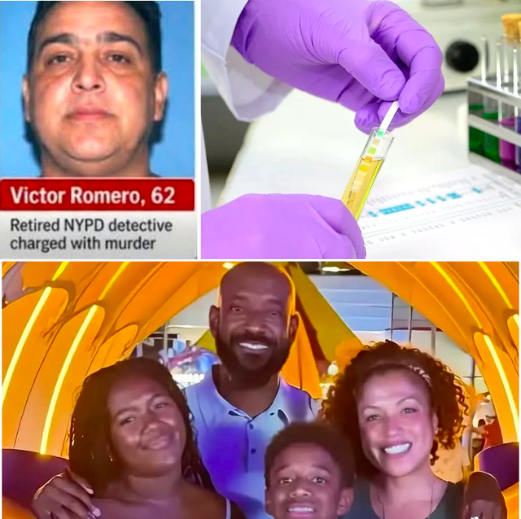
🔥 THE SECRET IN THE EX-DETECTIVE’S BLOOD: LEAKED MEDICAL REPORT CHANGES EVERYTHING!
🔥 LEAKED MEDICAL REPORT! HARDLY HAVING HAD TIME TO REJOICE SINCE POSTING BAIL, VICTOR ROMERO (62)—WHO LEFT 46-YEAR-OLD FATHER OF TWO KORAN IRVINE DEAD FOLLOWING A DISPUTE ON THE GEORGE WASHINGTON BRIDGE—HAS ONCE AGAIN BEEN SUMMONED FOR EMERGENCY INTERROGATION AFTER MEDICAL REPORTS CONFIRMED THAT AT THE TIME OF THE CRIME, HE TESTED POSITIVE FOR… 👇
CHAPTER I: THE SUNSET SHOOTING ON THE GWB
On a congested October evening in 2026, the lower level of the George Washington Bridge became the setting for a horrific tragedy that stopped New York City traffic in its tracks. Thousands of commuters were heading home toward New Jersey when two vehicles—a late-model SUV and a sedan—began an aggressive game of bumper-to-bumper position wrestling in the middle lanes.
Behind the wheel of the sedan was Koran Irvine, a 46-year-old dedicated Con Edison technician and father of two who was returning home from a long shift. Behind the wheel of the SUV sat 62-year-old Victor Romero, a retired New York City Police Department detective with a storied history in the force, including a high-profile shootout in the early 2000s that had earned him commendations for bravery.
Witnesses would later describe a harrowing scene: flashing headlights, sudden braking, and frantic horn blasts echoing off the bridge’s steel girders. As both vehicles ground to a halt due to heavy gridlock near the Jersey-side anchorage, verbal insults erupted through open windows. Seconds later, Koran Irvine stepped out of his vehicle to confront the SUV driver.
He never made it past the hood.
A single gunshot shattered the evening air. Irvine collapsed onto the asphalt, clutching his chest as horrified drivers looked on. Romero remained seated inside his vehicle until Port Authority Police officers swarmed the scene with guns drawn. Despite emergency medical technicians fighting to save Irvine’s life on the way to Harlem Hospital, the 46-year-old father was pronounced dead shortly after arrival.
CHAPTER II: THE BAIL OUTRAGE AND PUBLIC FUROR
In the immediate aftermath of the shooting, prosecutors originally signaled that Victor Romero would face top-tier felony charges, including Second-Degree Murder. However, when the defendant appeared before a Manhattan magistrate for his arraignment, the legal landscape shifted dramatically.
Citing Romero’s twenty-plus years of distinguished service as an NYPD officer, his clean criminal record since retirement, and his deep roots in the community, the defense argued that Romero was acting out of fear and reasonable self-defense. To the outrage of the victim’s family and the broader public, prosecutors reduced the charges down to First-Degree Manslaughter.
Even more shocking was the court’s decision regarding pretrial release: the judge set bail at $1 million. Within forty-eight hours, Romero’s legal team, backed by law enforcement defense funds and personal assets, posted the required bond. Cameras captured Romero stepping out of the courthouse in a sharp suit, shielding his face with a navy-blue umbrella, and slipping into an awaiting sedan without offering a single word of apology to the grieving family.
For Koran Irvine’s widow and two teenage children, the image of the man who ended their loved one’s life walking free on bail felt like a second blow. Protests flared outside the courthouse, with civil rights groups and community members demanding an independent investigation into whether Romero was receiving preferential “blue wall” treatment due to his former status as a decorated detective.
Romero’s freedom, however, was destined to be fleeting.
CHAPTER III: THE LEAKED TOXICOLOGY SLIP
While Romero was settling back into his suburban residence under house arrest, investigators from the Manhattan District Attorney’s Forensic Sciences Bureau were working around the clock to analyze blood and urine samples collected from Romero immediately following his arrest on the bridge.
In cases involving fatal shootings, standard police protocol mandates a full toxicological screening to evaluate a suspect’s sobriety, chemical impairment, and cognitive state. Initial reports suggested that Romero had registered zero for alcohol on a breathalyzer test at the scene. But the comprehensive lab analysis—conducted at a state-certified toxicology facility—told an entirely different and terrifying story.
Late on a Friday afternoon, a sealed 14-page medical report was uploaded to the court database. Within hours, a leaked excerpt reached major news outlets and crime investigative portals:
EXTRACTED LABORATORY REPORT — FORENSIC TOXICOLOGY DIVISION
Subject: Romero, Victor M.
Date of Collection: October 2026
Status: CONFIDENTIAL / COURT SEALED
Findings: Blood specimen analysis confirms the presence of high-concentration Schedule II controlled substances, alongside unprescribed neurological inhibitors. Subject tested positive for elevated levels of amphetamine compounds consistent with illegal performance enhancers, combined with trace amounts of heavy prescription sedatives.
The chemical cocktail found in Romero’s system was far beyond a routine therapeutic dosage. Forensic toxicologists who reviewed the leaked documents noted that combining high-dose stimulants with central nervous system depressants creates a volatile physiological condition commonly referred to in legal science as “toxic agitation”—a state marked by severe paranoia, sudden bouts of uncontrollable rage, impaired depth perception, and extreme hypersensitivity to perceived threats.
CHAPTER IV: THE EMERGENCY SUMMONS
The moment the toxicology findings were verified by the District Attorney’s office, the prosecutor’s stance transformed from cautious negotiation to urgent action.
At 6:30 AM on Monday, state troopers and investigators executed an emergency arrest warrant at Romero’s home. The former detective, who thought he was sitting comfortably on bail awaiting a preliminary hearing months down the road, was taken into custody once again—this time in handcuffs and leg irons.
He was rushed directly to an undisclosed interrogation room at the Manhattan Criminal Court building for an emergency deposition.
The news spread through social media like wildfire. Reporters camped outside the courthouse as legal experts broke down the implications of the leaked toxicology report:
-
Destruction of the “Self-Defense” Claim: To prove self-defense under state law, a shooter must demonstrate an objective, reasonable fear of imminent deadly force. If the shooter’s perception was distorted by self-induced drug intoxication, the “reasonable person” standard no longer applies.
-
Upgrade of Charges: Introducing evidence of heavy chemical impairment directly supports charges of Depraved Indifference Murder or Aggravated Manslaughter, both of which carry potential sentences of 25 years to life in state prison.
-
Revocation of Bail: Operating a motor vehicle and wielding a concealed firearm while under the influence of illicit or non-prescribed controlled substances represents an immediate danger to the public, providing solid legal grounds to revoke his $1M bail entirely.
CHAPTER V: INSIDE ROOM 402 — THE INTERROGATION BREAKDOWN
Leaked transcripts from inside the interrogation room reveal a dramatic showdown between veteran homicide detectives and their former colleague.
When investigators pushed the medical report across the metal table, showing the stark red ink indicating positive tests for unprescribed stimulants and sedatives, Romero’s composed exterior reportedly shattered.
“You knew you were taking heavy medication that altered your mood, didn’t you, Victor?” the lead prosecutor asked, leaning over the table. “You drove onto that bridge with a loaded weapon in your holster and a cocktail of chemicals in your bloodstream.”
Romero, according to sources close to the investigation, sat in silence for over two minutes, his hands trembling as he stared at the lab results. His defense attorney attempted to intervene, claiming the substances were part of an ongoing prescription regimen for service-related post-traumatic stress disorder (PTSD).
However, prosecutors counter-punched immediately with pharmacy records revealing that the specific combination of drugs found in Romero’s system had never been authorized by any licensed physician associated with the NYPD health network or his private medical providers.
“He wasn’t following a doctor’s orders,” a law enforcement insider commented anonymously. “He was self-medicating with dangerous illegal cocktails while carrying a concealed weapon in public. He turned himself into a walking time bomb on one of the busiest bridges in the world.”
CHAPTER VI: THE MASTERMIND ANGLE — WHAT WAS IN THE TRUNK?
As detectives pulled on the thread of Romero’s chemical impairment, an even weirder detail emerged from the traffic camera footage recorded minutes before the fatal shooting.
Enhancement of high-definition toll plaza cameras on the Manhattan side of the bridge showed that Romero’s vehicle was not simply commuting home. Surveillance logs showed his SUV making three consecutive loops around the same block in Upper Manhattan before following Koran Irvine’s sedan onto the lower level of the bridge.
Why was a decorated retired detective tailing a Con Edison technician across state lines?
Investigators are now looking into whether the fatal encounter on the George Washington Bridge was truly a spontaneous act of road rage or if the drug-induced paranoia led Romero to mistake Irvine for someone else entirely. Unconfirmed reports suggest that a search of Romero’s vehicle following his second arrest yielded multiple unregistered electronic tracking devices and encrypted cell phones stored in a locked trunk compartment.
Did the former detective’s chemical cocktail fuel an irrational delusion that he was under surveillance, leading him to execute an innocent driver who just happened to merge into his lane?
CHAPTER VII: JUSTICE FOR KORAN IRVINE
Outside the courthouse, a growing crowd of supporters gathered around Koran Irvine’s widow, who held up framed photographs of her husband celebrating his daughter’s graduation just months prior.
“They tried to tell us my husband was the aggressor,” she said through tears, her voice amplified by loudspeakers. “They tried to tell us that a decorated cop only did what he had to do. But the truth always comes to the light. He wasn’t a protector—he was an impaired, dangerous man who took my children’s father away for nothing.”
With the leaked medical report now part of the official court record, the District Attorney’s office has formally filed a motion to revoke Victor Romero’s bail permanently and reinstate the top charge of Second-Degree Murder.
A judge is expected to rule on the motion by the end of the week. If the bail is revoked, Romero will spend the remainder of his trial behind bars at Rikers Island—a starkly different reality from the quiet suburban home he thought he had purchased with his $1 million bond.
As the legal proceedings unfold, the nation remains captivated by this tragic story on the George Washington Bridge—a case that started with a horn honk in traffic, escalated through drug-fueled rage, and revealed that no past badge or title can hide the truth when toxicology reports speak for the dead.