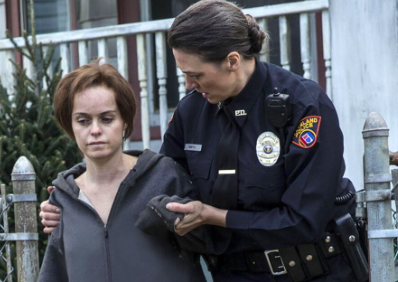
🚨 STREAMING NOW ON NETFLIX: “THE TERRIFYING SECRET BEHIND A MIRACULOUS RESCUE!” — KATIE SARIFE’S DARK TRUE-CRIME DRAMA REVEALS A NIGHTMARE HIDDEN FROM THE WORLD FOR YEARS!
CLEVELAND ABDUCTION: THE TERRIFYING TRUE STORY OF THREE WOMEN HELD CAPTIVE FOR YEARS — AND THE EXTRAORDINARY COURAGE THAT FINALLY BROUGHT THEM HOME
Film: Cleveland Abduction (2015)
Genre: True Crime, Biographical Drama, Psychological Thriller
Starring: Taryn Manning, Raymond Cruz, Katie Sarife, Samantha Droke, Joe Morton
Director: Alex Kalymnios
Runtime: Approximately 88 minutes
Original Network: Lifetime

A HOUSE OF HORRORS, ELEVEN YEARS OF SUFFERING, AND A SURVIVAL STORY THAT STILL SHOCKS THE WORLD
Some films are frightening because of the monsters they invent. Others create terror through elaborate mysteries, supernatural forces, or imaginary killers lurking in the shadows. But Cleveland Abduction is disturbing for a far more devastating reason: the nightmare at its center really happened.
Based on the horrifying experiences of Michelle Knight, one of three women abducted and imprisoned by Ariel Castro in Cleveland, Ohio, the 2015 Lifetime film transforms an almost unimaginable true-crime case into a deeply emotional story of suffering, resilience, and survival.
Taryn Manning delivers a harrowing performance as Knight, a young woman whose life changes forever when an apparently ordinary encounter becomes the beginning of years of captivity.
Raymond Cruz portrays Castro, the man responsible for imprisoning Knight, Amanda Berry, and Gina DeJesus inside his home.
Katie Sarife plays Gina DeJesus, while Samantha Droke portrays Amanda Berry.
Together, their performances recreate a story that horrified the world when the three women finally escaped in May 2013.
Yet Cleveland Abduction is not simply about the crimes committed against them.
It is about the extraordinary strength required to survive when freedom seems impossible, the emotional bonds formed under desperate circumstances, and the painful process of reclaiming a life after years of trauma.
The film is frequently uncomfortable to watch, and its subject matter demands sensitivity. Nevertheless, beneath the darkness lies a powerful reminder that survival itself can be an extraordinary act of courage.

1. THE TRUE STORY THAT SHOOK CLEVELAND
The real events behind Cleveland Abduction began in August 2002, when Michelle Knight disappeared in Cleveland.
Knight was 21 years old and facing significant personal difficulties, including a struggle to regain custody of her young son.
During this vulnerable period, she encountered Ariel Castro, a local school bus driver who offered her a ride.
What appeared to be an ordinary interaction became the beginning of an ordeal that would last more than a decade.
Castro took Knight to his house on Seymour Avenue, where he imprisoned her.
Over the following years, he abducted two more young women.
Amanda Berry disappeared in April 2003, shortly before her seventeenth birthday.
Gina DeJesus vanished in April 2004 at the age of fourteen.
For years, their families searched for answers, unaware that the missing women were being held inside a residential property in Cleveland.
The case became one of the most disturbing examples of prolonged captivity in modern American criminal history.
When Berry managed to escape and seek help in May 2013, the discovery of the three survivors stunned the public.
Castro was subsequently arrested, pleaded guilty to hundreds of criminal charges, and received a sentence of life imprisonment without parole plus 1,000 years. He died in prison in September 2013.
These events form the factual foundation of Cleveland Abduction, although the film necessarily dramatizes dialogue, interactions, and individual moments.
Understanding that distinction is important: the movie is an interpretation of survivors’ experiences, not a complete documentary record of everything that occurred.
2. TARYN MANNING DELIVERS A DEVASTATING PERFORMANCE AS MICHELLE KNIGHT

The emotional center of Cleveland Abduction is Taryn Manning’s portrayal of Michelle Knight.
Manning faces a difficult challenge.
She must communicate prolonged psychological suffering without allowing Knight to become defined exclusively by victimhood.
Her performance succeeds most powerfully when it emphasizes the character’s determination to preserve a sense of identity despite her circumstances.
At the beginning of the film, Michelle is presented as a young woman already struggling with instability and personal loss.
Her desire to reconnect with her son provides an emotional foundation that makes the subsequent captivity particularly devastating.
As the story progresses, Manning portrays Michelle’s changing emotional state through exhaustion, fear, anger, and moments of fragile hope.
The performance is often physically restrained.
A quiet expression can communicate despair.
A hesitant movement can reveal the character’s fear of punishment.
And a brief moment of connection with another captive can suggest how essential human companionship becomes in circumstances designed to destroy it.
What makes Manning’s portrayal memorable is the persistence of Michelle’s inner life.
She is not simply waiting to be rescued.
She remembers.
She hopes.
She forms relationships.
She struggles to maintain a connection to the person she was before her captivity.
Manning gives these moments genuine emotional weight, creating a portrait of resilience that remains compelling even when the film’s storytelling becomes conventional.
3. RAYMOND CRUZ CREATES A TERRIFYING PORTRAIT OF ARIEL CASTRO
Raymond Cruz faces an equally demanding responsibility as Ariel Castro.
His character is not a fictional villain invented to entertain an audience. He represents a real perpetrator whose actions caused immense suffering.
Cruz portrays Castro as controlling, unpredictable, and frighteningly capable of presenting different faces to different people.
Outside the rooms where the women are imprisoned, Castro can appear ordinary. Inside the house, his behavior becomes threatening and violent.
This contrast is one of the film’s most disturbing elements.
Cruz does not rely entirely on shouting or physical aggression to communicate danger. Sometimes his character’s apparent calmness is even more unsettling.
The performance emphasizes the uncertainty experienced by the captives, who cannot reliably predict what will provoke another episode of abuse.
However, the film occasionally gives Castro more screen time than necessary to establish his cruelty.
Repeated depictions of suffering risk overwhelming the emotional development of the women themselves.
The strongest moments are those that return attention to Michelle’s responses rather than dwelling on her captor’s actions.
Ultimately, Cruz succeeds in creating an intimidating presence, although the material raises difficult questions about how much violence a true-crime dramatization needs to show.
4. KATIE SARIFE AND SAMANTHA DROKE BRING HEARTBREAKING HUMANITY TO THE STORY
The arrival of Amanda Berry and Gina DeJesus changes the emotional direction of the film.
Samantha Droke portrays Amanda, while Katie Sarife plays Gina, the youngest of the three abducted women.
Their presence introduces new dimensions to Michelle’s struggle.
Until then, much of her experience has been defined by isolation.
Now she must confront the devastating realization that other young women are being subjected to the same captivity.
Yet their relationships gradually become sources of emotional support.
Sarife portrays Gina with vulnerability and quiet determination, capturing the fear of a teenager forced into circumstances beyond her understanding.
Droke gives Amanda a different emotional identity, emphasizing her character’s distress, resilience, and eventual determination to escape.
Together with Manning, the actresses communicate the importance of solidarity.
Their characters experience moments of disagreement, exhaustion, and despair, but their connection provides a measure of companionship within an otherwise terrifying environment.
These relationships become the film’s emotional foundation.
Rather than portraying survival as an entirely individual achievement, Cleveland Abduction acknowledges the importance of human connection.
The women’s ability to support one another becomes a form of resistance against the isolation imposed upon them.
5. THE MOST DISTURBING ELEMENT: HORROR HIDDEN INSIDE AN ORDINARY HOUSE
One of the film’s most unsettling qualities is its setting.
The house on Seymour Avenue does not resemble the elaborate locations usually associated with fictional horror.
It is an ordinary residential property.
That ordinariness makes the story more frightening.
The film repeatedly emphasizes the contrast between everyday life outside the building and the suffering concealed within it.
Neighbors continue their routines.
The surrounding community changes.
Years pass.
Yet the women remain imprisoned.
Director Alex Kalymnios uses confined interiors and restricted movement to create an atmosphere of claustrophobia.
The rooms feel oppressive, and the limited views of the outside world reinforce the captives’ isolation.
Unlike conventional thrillers, the film does not need an elaborate musical score or unexpected supernatural events to generate fear.
The knowledge that the story is rooted in reality provides much of the tension.
Every locked door becomes a reminder of lost freedom.
Every ordinary sound from outside suggests a world continuing without the women who have disappeared from it.
The house becomes a symbol of how terrible crimes can remain concealed within seemingly familiar surroundings.
6. ELEVEN YEARS COMPRESSED INTO JUST 88 MINUTES
The film’s most significant structural challenge is its running time.
The real ordeal lasted more than a decade.
Yet Cleveland Abduction attempts to portray that extraordinary period within approximately 88 minutes.
This inevitably requires difficult storytelling decisions.
The early sections devote considerable attention to Michelle’s abduction and the immediate consequences.
Later years pass much more quickly.
Major developments are presented through selected incidents rather than a continuous depiction of everyday life.
This compression creates an uneven rhythm.
The first half is particularly intense, while the second sometimes moves too rapidly through emotionally significant events.
The passage of time can feel abstract, even though the audience understands that years of suffering have occurred.
Executive producer Judith Verno discussed the challenge of condensing an eleven-year ordeal into a television film while attempting to remain authentic and avoid exploitation.
Bustle
That challenge is visible throughout the finished production.
The film succeeds in communicating the broad emotional reality of prolonged captivity, but its format cannot fully explore the psychological complexity of eleven years.
A longer miniseries might have provided more space for the women’s individual experiences and their lives after liberation.
Nevertheless, the condensed structure creates an undeniably intense viewing experience.
7. THE ESCAPE THAT CHANGED EVERYTHING
The story reaches its emotional turning point when Amanda Berry finds an opportunity to seek help.
On May 6, 2013, Berry managed to alert neighbors after discovering that Castro was away and an exit was not securely locked.
Her cries for assistance brought attention to the house.
Neighbors helped her get outside, and she contacted emergency services.
The subsequent rescue of Michelle Knight and Gina DeJesus ended years of captivity.
In the film, this moment offers an overwhelming release from the oppressive atmosphere established throughout the story.
But the significance of the rescue extends beyond the immediate excitement.
Freedom does not automatically erase trauma.
The women must begin confronting a world that has changed dramatically during their absence.
They have lost years of ordinary experiences, relationships, and personal independence.
The film acknowledges this difficult transition, although its limited running time restricts the depth of its exploration.
Importantly, the escape is presented not as a magical solution to suffering but as the beginning of another stage in the survivors’ lives.
The real-world details of the rescue are documented in accounts of the case and the film’s production history.
The Cinemaholic
8. THE AFTERMATH: FREEDOM DOES NOT ERASE THE PAST
One of the film’s strongest decisions is to continue beyond the rescue.
Many true-crime dramas end when victims are found or perpetrators are arrested.
Cleveland Abduction recognizes that survival involves more than leaving the place where captivity occurred.
Michelle must confront the emotional consequences of her lost years.
Her separation from her son remains particularly painful.
The film portrays her discovery that his life continued without her, creating a devastating contrast between the freedom she has regained and the experiences she can never recover.
Manning handles these scenes with considerable sensitivity.
Her performance becomes quieter and more reflective, allowing Michelle’s grief to emerge without the constant presence of physical danger.
The film also includes her confrontation with Castro during the sentencing proceedings.
This moment shifts the emotional focus away from the perpetrator’s control and toward Michelle’s determination to reclaim her identity.
It is among the production’s most meaningful sequences.
However, the ending also reveals the limitations of television-movie storytelling.
The transition from captivity to renewed independence happens quickly.
The complex, nonlinear nature of recovery receives less attention than it deserves.
Still, the film’s decision to acknowledge life after rescue gives its conclusion greater emotional substance.
9. THE CONTROVERSY: WHEN TRUE CRIME BECOMES ENTERTAINMENT
Cleveland Abduction raises an uncomfortable question about the ethics of dramatizing real suffering.
When filmmakers recreate traumatic events, they must balance historical accuracy, emotional impact, and respect for survivors.
This film does not always achieve that balance.
Some scenes are extremely difficult to watch.
Although the production avoids certain forms of graphic imagery, its repeated depictions of cruelty can feel excessive.
Critics were divided over whether the film’s emotional message justified its approach.
Variety criticized the production for emphasizing brutality without sufficiently demonstrating why viewers needed to witness so much of it.
Yahoo
The Hollywood Reporter also questioned the effectiveness of the film’s final emotional uplift, suggesting that its treatment of the subject lacked sufficient complexity.
Metacritic
Other reviewers responded more positively.
Hollywood Life praised Manning’s performance and emphasized the film’s message of perseverance.
Hollywood Life
These reactions reveal the central tension within the production.
Its strongest material focuses on the women’s humanity and resilience.
Its weakest moments risk allowing the brutality of the crimes to dominate the narrative.
For viewers interested in the case, Michelle Knight’s own memoir provides an important first-person perspective beyond the film’s dramatization.
10. WHY THE FILM REMAINS EMOTIONALLY POWERFUL
Despite its shortcomings, Cleveland Abduction remains a compelling example of survivor-centered true-crime storytelling.
Its impact comes primarily from Taryn Manning’s performance and the relationships between the three women.
The film reminds viewers that prolonged captivity involves more than physical confinement.
It can affect identity, trust, memory, personal relationships, and the ability to imagine a future.
The passage of time becomes especially significant.
While the outside world continues changing, the captives are denied opportunities that most people take for granted.
Birthdays pass.
Families grow older.
Children grow up.
The emotional consequences of these losses cannot be measured simply by the number of years spent imprisoned.
The film is most effective when it allows these realities to emerge through quiet scenes rather than dramatic confrontation.
Its depiction of companionship is particularly moving.
Michelle, Amanda, and Gina are portrayed as individuals whose shared experiences create an extraordinary bond.
Their connection does not eliminate suffering, but it helps them preserve a sense of humanity.
This emphasis on solidarity gives the story meaning beyond its most disturbing events.
11. CRITICAL RECEPTION AND AUDIENCE RESPONSE
The film received mixed reviews following its 2015 premiere.
Professional critics frequently questioned its handling of violence, pacing, and emotional complexity.
However, some audience members responded strongly to the performances and the underlying survival story.
IMDb
6.6/10
Approximately 11,000 user ratings.
IMDb
Rotten Tomatoes audience score
54%
Based on 250+ audience ratings; no published Tomatometer score.
Rotten Tomatoes
These figures suggest a divided reception rather than universal acclaim.
For some viewers, the film’s emotional intensity makes it memorable.
For others, its relentless depiction of abuse and abbreviated treatment of recovery limit its effectiveness.
Both responses are understandable.
The subject matter is exceptionally difficult, and viewers may differ substantially in what they expect from a dramatization of real trauma.
12. FINAL VERDICT: A DISTURBING TRUE-CRIME FILM ABOUT THE COURAGE TO SURVIVE
Cleveland Abduction is not a comfortable film, nor should it be approached as an ordinary suspense thriller.
Its subject is rooted in real suffering, and its emotional impact depends upon recognizing the humanity of the women whose experiences inspired it.
Taryn Manning delivers the strongest performance, portraying Michelle Knight with vulnerability, determination, and emotional depth.
Raymond Cruz creates a frightening antagonist, while Katie Sarife and Samantha Droke provide important emotional support through their portrayals of Gina DeJesus and Amanda Berry.
Director Alex Kalymnios establishes a claustrophobic atmosphere that effectively communicates the fear and isolation of captivity.
However, the film’s brief running time and repeated emphasis on violence prevent it from becoming a fully developed examination of the survivors’ experiences.
Its treatment of recovery is particularly compressed.
Nevertheless, the final scenes provide a meaningful reminder that the women are more than the crimes committed against them.
Their lives did not end with their abductions.
Nor were their identities permanently defined by their captor.
The real significance of the story lies in their survival, their courage, and their continuing right to determine their own futures.
For audiences interested in serious true-crime dramas, Cleveland Abduction offers a harrowing experience anchored by a compelling central performance.
But it is best watched with an understanding of its difficult subject matter and the limitations of dramatizing real events.
Final Rating: 3.5/5 — A deeply unsettling survival drama featuring a powerful performance from Taryn Manning, though its compressed storytelling and repeated depictions of cruelty weaken its emotional complexity.
Content advisory: Kidnapping, sexual violence, physical abuse, coercive control, and traumatic experiences.
The most important truth behind Cleveland Abduction is not the cruelty of the man who imprisoned three women. It is that Michelle Knight, Amanda Berry, and Gina DeJesus survived, regained their freedom, and continued lives that belong to them—not to the person who tried to take those lives away.