
🚨 STEPHEN GRAHAM’S MIND-BENDING NETFLIX THRILLER HAD ME HOOKED FOR 8 EPISODES — FOUR DETECTIVES, ONE DEAD BODY, AND A TWIST I NEVER SAW COMING!
STEPHEN GRAHAM’S MIND-BENDING NETFLIX CRIME THRILLER IS AN EIGHT-PART NIGHTMARE — FOUR DETECTIVES, FOUR DIFFERENT ERAS, ONE DEAD BODY, AND A TWIST THAT CHANGES EVERYTHING!
ENTERTAINMENT | NETFLIX REVIEW | BODIES (2023)
Four detectives. Four different timelines. One mysterious corpse. And a terrifying conspiracy stretching across more than 150 years. Netflix’s Bodies, starring Stephen Graham, is the kind of dark British crime thriller that turns an ordinary murder investigation into an extraordinary puzzle — leaving viewers questioning everything they thought they understood about time, fate, and the truth.
There are crime dramas that keep you guessing until the final episode. Then there are crime dramas that make you wonder whether the entire world you are watching can be trusted.
Netflix’s Bodies belongs firmly in the second category.
Adapted from the DC Vertigo graphic novel by Si Spencer, this ambitious eight-part British thriller combines murder mystery, science fiction, psychological suspense, and historical drama into one remarkably intricate story.
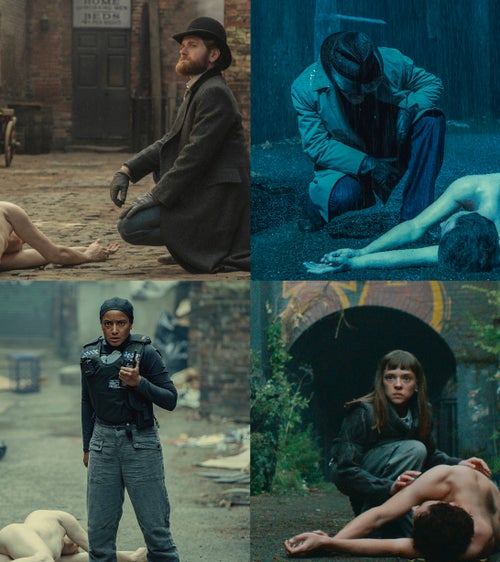
At its centre is a seemingly impossible discovery: the same unidentified naked man is found dead in exactly the same location in London, but across four different periods of history.
The detectives investigating the deaths have never met. They inhabit entirely different worlds. Yet their investigations are connected by something far more disturbing than coincidence.
And watching over the mystery is Stephen Graham, whose portrayal of the enigmatic Elias Mannix brings a chilling sense of inevitability to the unfolding nightmare.
For viewers who enjoy dark detective dramas, complicated conspiracies, and revelations that force them to reconsider everything they have already seen, Bodies offers an unusually addictive experience.
But its greatest achievement is not simply its extraordinary premise.
It is the way the series gradually transforms a murder investigation into a haunting examination of loneliness, power, manipulation, and the terrible consequences of believing that destiny cannot be changed.

FOUR DETECTIVES, ONE CORPSE — AND A MYSTERY THAT DEFIES EVERY EXPLANATION
The nightmare begins in Whitechapel, London, where a body is discovered in Longharvest Lane.
The victim is naked, bears a mysterious marking, and appears to have been shot. Yet the circumstances surrounding his death are immediately troubling.
What makes the discovery extraordinary is that the same corpse appears in four separate years: 1890, 1941, 2023, and 2053.
Each investigation begins independently, with the detective involved believing they are confronting a crime rooted in their own time.
In 1890, Detective Inspector Alfred Hillinghead, played by Kyle Soller, is navigating the rigid social hierarchy and moral expectations of Victorian London.
In 1941, Detective Sergeant Charles Whiteman, portrayed by Jacob Fortune-Lloyd, is operating in a city devastated by the Second World War.
In 2023, Detective Sergeant Shahara Hasan, played by Amaka Okafor, encounters the body while investigating a disturbing incident in contemporary London.
And in 2053, Detective Constable Iris Maplewood, played by Shira Haas, finds herself confronting a mystery in a technologically transformed society.
Each detective possesses different resources, experiences, and personal vulnerabilities.
Yet the questions confronting them are identical.
Who is the dead man?
Why does his body keep appearing in the same location?
And how can events separated by generations possibly be connected?
The genius of Bodies is that it does not immediately provide a convenient explanation.
Instead, it invites viewers to investigate alongside its characters, carefully distributing clues across different timelines.
A discovery in Victorian London may suddenly become relevant to an investigation in the present day.
A conversation during wartime Britain may acquire an entirely different meaning when the story jumps into the future.
Even seemingly minor details can become significant several episodes later.
The result is a thriller that demands attention — and rewards viewers who are willing to examine every suspicious conversation, recurring symbol, and unexpected connection.
STEPHEN GRAHAM DELIVERS ONE OF THE SERIES’ MOST UNSETTLING PERFORMANCES
For many viewers, the biggest attraction will be Stephen Graham.
The acclaimed British actor has built a formidable reputation through performances in This Is England, Line of Duty, The Irishman, Boiling Point, and numerous other dramas.
His ability to portray emotionally complicated characters has made him one of the most compelling performers in contemporary British television.
But Bodies gives him a particularly unusual challenge.
As Elias Mannix, Graham is not simply playing a conventional criminal mastermind.
He is portraying a figure whose identity, influence, and understanding of the world become increasingly disturbing as the story progresses.
Mannix is introduced as an important presence within the mystery, but the full significance of his role emerges gradually.
Graham understands that the character’s power lies partly in restraint.
Rather than relying on constant shouting or theatrical displays of menace, he often uses controlled expressions, deliberate speech, and unsettling composure.
There is something particularly frightening about a character who appears completely convinced that everything happening around him is unfolding exactly as it should.
Graham captures that conviction with remarkable precision.
His performance becomes even more fascinating as the series explores the emotional foundations of Mannix’s beliefs.
The character’s relationship with love, belonging, and personal destiny gives the story a psychological dimension that could easily have been lost beneath its elaborate science-fiction mechanics.
What initially resembles a sinister conspiracy gradually reveals itself as something far more complicated.
And Graham makes that complexity compelling.
His scenes are especially effective because he can suggest vulnerability and menace almost simultaneously.
A seemingly sincere expression may leave the viewer wondering whether Mannix is revealing genuine emotion or exercising another form of control.
The ambiguity becomes one of the show’s strongest dramatic weapons.
Crucially, Graham is not the sole focus of the series. The younger incarnation of Elias Mannix, played by Gabriel Howell, is also central to the narrative, allowing the drama to examine how circumstances, influence, and personal choices shape an individual’s future.
Together, these performances give Bodies an emotional foundation beneath its complicated mystery.
THE 1890 STORYLINE IS A DARK VICTORIAN DETECTIVE DRAMA IN ITS OWN RIGHT
One of the most impressive aspects of Bodies is how convincingly it recreates four distinct periods.
The Victorian storyline, centred on Alfred Hillinghead, could almost function as a standalone historical crime thriller.
Kyle Soller brings intelligence, restraint, and emotional sensitivity to a detective struggling with the expectations of his society.
Hillinghead is a respected investigator, but his personal life contains vulnerabilities that threaten his professional standing and family relationships.
As he pursues the mystery surrounding the unidentified corpse, he becomes entangled in circumstances that expose the prejudices and dangers of his era.
The series uses this storyline to explore secrecy, repression, and the devastating consequences of living in a society where certain truths cannot safely be acknowledged.
Visually, Victorian London is portrayed as a world of narrow streets, dim interiors, oppressive institutions, and deep social divisions.
The atmosphere is frequently claustrophobic.
Every investigation seems to lead into another shadowy corner of the city.
Every conversation carries the possibility of personal or professional ruin.
And the deeper Hillinghead investigates, the more apparent it becomes that the mysterious death is connected to forces operating far beyond his understanding.
Soller gives the character a quiet dignity that makes his predicament especially affecting.
Rather than simply functioning as a historical piece in a complicated puzzle, Hillinghead becomes a fully developed protagonist whose choices carry enormous emotional weight.
That emotional investment is essential to the success of the series.
Without it, the constant movement between different centuries might feel like an intellectual exercise.
Instead, the audience becomes genuinely concerned about the people caught inside the mystery.
WARTIME LONDON BRINGS BETRAYAL, CORRUPTION, AND A DANGEROUS DOUBLE LIFE
If the Victorian storyline is atmospheric and tragic, the 1941 investigation is considerably more morally ambiguous.
Jacob Fortune-Lloyd’s Charles Whiteman is a detective operating in a London under relentless wartime pressure.
Air raids, destruction, uncertainty, and widespread fear provide a dramatic backdrop to his investigation.
But Whiteman is hardly an uncomplicated hero.
He is a compromised figure whose personal dealings and hidden loyalties create dangerous conflicts.
His involvement with the mysterious corpse threatens to expose secrets that could destroy him.
Fortune-Lloyd brings sharp energy and dark humour to the role.
Whiteman is resourceful, unpredictable, and capable of making decisions that are difficult to defend.
Yet the actor gradually reveals the character’s humanity, allowing viewers to understand the pressures influencing his behaviour.
The wartime setting also gives Bodies opportunities for striking visual storytelling.
Bomb-damaged streets, shadowy offices, and the constant threat of sudden violence create an atmosphere of instability.
In this world, the distinction between survival and betrayal is frequently uncertain.
The investigation becomes a dangerous balancing act in which Whiteman must decide how much he is willing to sacrifice to uncover the truth.
As with the other timelines, the series carefully introduces information that only acquires its full significance much later.
A seemingly straightforward exchange may conceal a connection to events decades away.
A decision made under immediate pressure may have consequences that extend far beyond the character’s lifetime.
It is this sense of historical interconnectedness that gives Bodies much of its narrative power.
THE PRESENT-DAY INVESTIGATION MAKES THE IMPOSSIBLE FEEL TERRIFYINGLY REAL
For audiences looking for a more familiar contemporary crime thriller, the 2023 storyline provides the strongest initial point of entry.
Amaka Okafor plays Detective Sergeant Shahara Hasan, a determined investigator whose encounter with the mysterious corpse sets her on a path towards an increasingly alarming conspiracy.
Unlike the detectives operating in earlier periods, Hasan has access to modern investigative technology.
Yet those resources do little to explain the extraordinary circumstances surrounding the death.
The more she uncovers, the more conventional explanations begin to collapse.
Okafor gives an excellent performance, grounding the series in believable human reactions even when the narrative moves into extraordinary territory.
Her Hasan is intelligent, persistent, and deeply committed to understanding what happened.
But she is also emotionally vulnerable, particularly when the investigation begins to threaten people and principles that matter to her.
The contemporary storyline introduces questions about radicalisation, manipulation, institutional power, and the ways vulnerable individuals can become entangled in destructive belief systems.
These themes are particularly important because they prevent the mystery from becoming purely mechanical.
The show is not simply asking how the same body can appear in different centuries.
It is also examining why people become willing to participate in terrible events — and how apparently ordinary lives can be transformed by powerful ideas.
Hasan’s investigation becomes increasingly urgent as the scale of the threat becomes apparent.
The tension is heightened by the audience’s growing awareness that events unfolding in different timelines may be connected to her own future.
And because Bodies frequently reveals information to viewers before its characters understand its significance, the suspense becomes almost unbearable.
There are moments when the audience can recognise danger approaching long before the detective herself does.
That dramatic irony is used with considerable skill.
THE YEAR 2053 TRANSFORMS THE ENTIRE SERIES INTO SOMETHING EVEN MORE DISTURBING
Just when viewers think they understand the rules of Bodies, the futuristic storyline challenges their assumptions again.
Shira Haas portrays Iris Maplewood, a detective working in a radically altered London in 2053.
The city is technologically advanced, but its apparent progress conceals unsettling questions about freedom, control, and the price of stability.
Maplewood initially appears to occupy a world that has overcome many of the problems affecting earlier generations.
However, the reality is considerably more complicated.
Her investigation into the unidentified corpse begins to expose contradictions within the society she serves.
Haas delivers a tightly controlled performance that gradually reveals the emotional conflict beneath Maplewood’s professional confidence.
The character is particularly compelling because she has reasons to believe in the system surrounding her.
Her loyalties are not simply the result of ignorance.
They are connected to deeply personal experiences and the opportunities her society has provided.
This makes her eventual confrontation with uncomfortable truths more emotionally convincing.
The futuristic setting also gives the series a distinctive visual identity.
Where Victorian London is dark and oppressive, and wartime London is chaotic and damaged, the London of 2053 often appears cleaner, more controlled, and technologically sophisticated.
Yet the sense of unease remains.
The future is not presented as a simple utopia.
Instead, it becomes another environment in which individual freedom and institutional authority exist in an uneasy relationship.
As Maplewood’s investigation develops, the series begins bringing its seemingly separate mysteries into sharper alignment.
And it is here that the true ambition of Bodies becomes unmistakable.
EVERY CLUE MATTERS — AND THE SHOW’S BIGGEST TRICK IS HIDING THE TRUTH IN PLAIN SIGHT
One reason Bodies is so addictive is its careful use of recurring details.
Symbols, locations, phrases, and relationships appear across different periods, creating a network of connections that gradually becomes more significant.
The repeated discovery of the same corpse is only the beginning.
As the detectives pursue their investigations, they encounter evidence suggesting that their lives may be linked to a much larger sequence of events.
The show’s structure encourages viewers to compare scenes across timelines.
An apparently insignificant detail in one episode may provide essential context for a later revelation.
A character’s behaviour may seem inexplicable until the audience learns what happened in another century.
And information that initially appears contradictory may eventually become part of a coherent explanation.
This is where the writing becomes particularly impressive.
The series takes an inherently complicated premise and turns it into a dramatic mystery that remains largely accessible, provided viewers are willing to concentrate.
That does not mean every aspect works perfectly.
Some developments require a generous willingness to accept the show’s internal logic, and the final episodes occasionally prioritise explanations over the quieter character work that makes the earlier chapters so effective.
Certain revelations also arrive with such speed that viewers may want to revisit previous episodes to appreciate their significance.
Nevertheless, these weaknesses rarely undermine the central mystery.
The narrative maintains a powerful sense of momentum, and its strongest twists emerge from connections established much earlier.
Rather than simply introducing surprises for their own sake, Bodies frequently uses revelations to change the meaning of information viewers already possess.
That is a far more satisfying approach than relying entirely on last-minute shocks.
A TERRIFYING STORY ABOUT FATE, LONELINESS, AND THE NEED TO BE LOVED
Beneath the science fiction and elaborate plotting, Bodies is fundamentally interested in human behaviour.
Its characters are shaped by fear, ambition, shame, loyalty, and the desire to belong.
Those emotions transcend the historical settings.
A detective living in Victorian London may face very different social pressures from an investigator in 2053, but both must confront difficult choices about identity and personal responsibility.
Similarly, the series explores how people can become trapped by their beliefs about the future.
If someone becomes convinced that a particular event is inevitable, what happens to their willingness to resist it?
If an individual believes that suffering is necessary to achieve a better world, how far might they go to justify terrible actions?
And if the past can influence the future, does that mean the future is already decided?
These questions become central to the story.
Stephen Graham’s Elias Mannix embodies many of its most troubling contradictions.
He is a character whose understanding of destiny is inseparable from his emotional needs.
His conviction that events must unfold in a particular way creates a chilling tension between personal longing and collective consequences.
This gives the drama a more thoughtful dimension than its sensational premise might initially suggest.
The greatest threat in Bodies is not simply an impossible corpse or a mysterious connection between centuries.
It is the possibility that people can become so attached to a promised future that they lose sight of the human cost of creating it.
IS BODIES WORTH WATCHING? AN ADDICTIVE BRITISH THRILLER THAT REWARDS PATIENCE
For viewers who enjoy straightforward detective stories, Bodies may initially feel unusually demanding.
The narrative moves rapidly between four periods, introducing multiple characters, investigations, and historical settings.
It requires concentration.
Looking away from the screen during an apparently minor conversation may mean missing information that becomes important later.
But that complexity is also what makes the series rewarding.
Unlike many crime thrillers that depend on one central detective uncovering a sequence of clues, Bodies creates suspense through the gradual convergence of four separate investigations.
Each storyline contributes something distinctive.
The Victorian chapters provide emotional tragedy and social tension.
The wartime investigation offers danger, moral compromise, and dark humour.
The contemporary storyline supplies urgency and recognisable investigative drama.
And the futuristic chapters introduce philosophical questions that transform the meaning of everything that came before.
The performances are consistently strong, with Amaka Okafor, Kyle Soller, Jacob Fortune-Lloyd, and Shira Haas providing the emotional foundations of the series.
Stephen Graham, meanwhile, gives the mystery its most unsettling human presence.
His performance is a reminder that a convincing antagonist does not always need spectacular displays of cruelty.
Sometimes the most disturbing character is the person who believes, with absolute certainty, that their actions are justified.
Visually, the series is ambitious and atmospheric, using production design and cinematography to distinguish each period without sacrificing the overall sense of continuity.
The pacing is generally effective, although some of the later exposition could have benefited from greater restraint.
And while viewers seeking a completely uncomplicated resolution may find certain aspects of the finale debatable, the series deserves considerable credit for attempting something more challenging than a conventional murder mystery.
Its strongest achievement is making an elaborate time-spanning conspiracy feel deeply connected to the personal choices of its characters.
FINAL VERDICT: ONE BODY, FOUR CENTURIES, AND A MYSTERY THAT REFUSES TO LET GO
Netflix’s Bodies is one of those rare British crime thrillers whose central concept is genuinely as fascinating as its premise suggests.
The discovery of the same dead man in four different periods could easily have become an elaborate gimmick.
Instead, the series uses that extraordinary idea to construct a suspenseful story about power, identity, love, and the possibility of changing the future.
It is not flawless.
The final stretch occasionally becomes overly complicated, and the series sometimes expects viewers to accept difficult concepts with limited explanation.
But its ambition, atmosphere, and performances make it a compelling viewing experience.
Stephen Graham is particularly memorable as Elias Mannix, bringing emotional depth to a character whose influence extends far beyond any ordinary criminal investigation.
And the four central detectives give the story something even more important than clever plotting: human stakes.
By the time the investigations begin to converge, the audience is no longer simply interested in discovering the identity of a corpse.
They are invested in whether the characters can escape the consequences of events that appear to have been set in motion long before they were born.
For fans of Dark, Line of Duty, The Devil’s Hour, and other intricately constructed mysteries, Bodies offers an absorbing combination of familiar detective drama and ambitious speculative fiction.
It is the kind of series that encourages viewers to finish one episode and immediately start another, convinced that the next revelation will finally explain everything.
And just when the mystery appears to have reached its conclusion, the final moments leave viewers confronting one last unsettling possibility.
Because after four detectives, four different eras, and a conspiracy stretching across generations, the most disturbing question is whether the nightmare has truly ended — or whether the final clue means that everything is about to…
👇 WATCH BODIES ON NETFLIX AND DISCOVER THE MYSTERY 👇