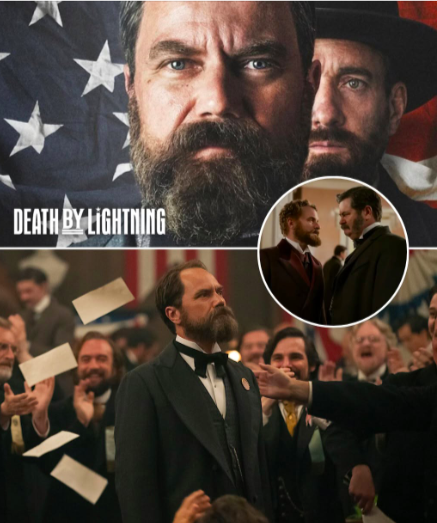
🚨 NETFLIX JUST TURNED ONE OF AMERICA’S DARKEST POLITICAL TRAGEDIES INTO AN ADDICTIVE HISTORICAL THRILLER…
⚡ WHEN HISTORY TURNS INTO A PSYCHOLOGICAL THRILLER
History is rarely polite. When viewed through the dull, sepia-toned lens of high school textbooks, the 19th-century American political landscape often feels like a collection of dusty portraits and forgotten dates. But every so often, a historical episode comes along that is so utterly wild, so laced with madness, political backstabbing, and grotesque medical irony, that it defies belief.
Enter Netflix’s breakout historical thriller, Death by Lightning.
Spanning four tense, cinematic episodes, this critically acclaimed limited series—created by Mike Makowsky, produced by the mastermind team behind Game of Thrones, and directed by Matt Ross—has captured the global imagination. Anchored by powerhouse performances from Michael Shannon as President James A. Garfield and Matthew Macfadyen as his unhinged assassin, Charles J. Guiteau, the show dives headfirst into the chaotic genesis and abrupt, bloody truncation of America’s 20th presidency.
It is a world where ruthless machine politics, a utopian “free-love commune,” a deeply delusional drifter, and a team of doctors who literally murdered a president with their bare hands collide in a symphony of historical absurdity.
Yet, as viewers sit glued to their screens, a nagging question echoes across social media: How much of this actually happened?
Based on Candice Millard’s brilliant bestselling book Destiny of the Republic, Death by Lightning walks a razor-thin tightrope between historical documentation and high-octane Netflix magic. Before you dive into the binge, let’s separate the absolute facts from the Hollywood embellishments by breaking down 9 things the show got startlingly right… and where it took creative liberties.
PART I: WHAT NETFLIX NAILED (THE UNBELIEVABLE TRUTH)
1. James A. Garfield Never Wanted the Job (The Accidental Nominee)
The Screenport: In the series, Michael Shannon portrays Garfield as an exhausted, reluctant statesman who attends the 1980 Republican National Convention merely to support a friend, only to have an electrifying speech accidentally launch him into the presidential spotlight.
The Historic Reality: Spot on. Garfield arrived in Chicago in 1880 as the campaign manager for Ohio Senator John Sherman. The convention quickly degenerated into a bitter, deadlocked war between political factions. As delegates screamed through 35 ballots without a winner, Garfield took the podium to give a procedural speech. His oratorical brilliance was so hypnotic that delegates began shifting their votes en masse. By the 36th ballot, a man who had explicitly begged his party not to draft him found himself holding the Republican nomination.
2. Charles Guiteau’s Bizarre Stint in a “Free-Love Commune”
The Screenport: Matthew Macfadyen’s portrayal of Charles Guiteau captures his unsettling, grandiose eccentricities—including a deeply disturbing background living inside a radical communal society.
The Historic Reality: It sounds like a fictional fever dream, but it is entirely true. Before he became an assassin, Guiteau spent years as a core member of the notorious Oneida Community in upstate New York—a religious, utopian socialist experiment that practiced “complex marriage” (meaning everyone was married to everyone) and communal property. Guiteau was deeply unpopular among the communards, who mockingly nicknamed him “Charles Gitout” due to his aggressive social ineptitude and poor hygiene. He eventually tried to sue the community’s founder, John Humphrey Noyes, and even threatened to assassinate him before the commune ultimately dissolved.
3. The Assassin Believed God Ordained the Murder
The Screenport: Guiteau is depicted as deeply unhinged, believing that a divine voice instructed him to remove the President to heal a fractured Republican Party.
The Historic Reality: Guiteau’s grandiosity knew no bounds. After writing a mediocre campaign speech for Ulysses S. Grant that was promptly rejected, Guiteau simply crossed out Grant’s name, wrote in Garfield’s, and convinced himself that his prose was single-handedly responsible for Garfield’s presidential victory. When he moved to Washington, D.C., with no money and tattered clothes, he haunted the corridors of the White House, demanding a high-level consulship in Paris as his rightful “reward”. When cabinet officials finally threw him out, Guiteau genuinely believed God commanded him to shoot the President so that Vice President Chester A. Arthur could take over and heal party rifts.
4. The Fatal Shots at the Train Station
The Screenport: July 2, 1881. A crowded Washington railway station. Guiteau approaches the President from behind and fires two point-blank shots from a British Bulldog revolver.
The Historic Reality: This sequence is meticulously recreated down to the historical record. As Garfield walked through the Baltimore and Potomac Railroad Station on his way to his alma mater’s reunion, Guiteau stepped out from the waiting room shadows. The first bullet grazed Garfield’s arm, but the second tore deep into his back, lodging behind his pancreas. As chaos erupted, a policeman named Patrick Kearney tackled Guiteau, who cheerfully shouted out, “I did it! Arthur is president now! The Stalwarts will rule!”
5. The Doctors Actually Killed Him (Medical Malpractice of the Highest Order)
The Screenport: The series portrays Garfield’s post-shooting medical care as an unmitigated horror show, with physicians unknowingly introducing lethal infections into the President’s body.
The Historic Reality: This is the most shocking and infuriating aspect of the entire true story. Garfield survived the initial gunshot, but he did not survive his doctors. Led by Doctor Willard Bliss—a physician obsessed with ego and fame—a team of doctors repeatedly shoved unwashed, bare fingers and unsterilized instruments deep into Garfield’s open wound, desperately hunting for the bullet. Even though Joseph Lister had pioneered antiseptic surgical practices in Europe years earlier, stubborn American doctors refused to wash their hands or instruments. They practically liquefied the President’s internal organs, eventually piercing his liver. As medical historians note today: The bullet didn’t kill James Garfield; his doctors did.
PART II: WHERE NETFLIX TOOK CREATIVE LIBERTIES (THE MYTHS & TWISTS)
6. Alexander Graham Bell’s Metal Detector Drama
The Screenport: The series dramatically highlights the desperate race to save Garfield using experimental technology, featuring a high-stakes sequence where Alexander Graham Bell rushes to the White House with a newly invented electromagnetic metal detector.
The Historic Reality: While this did happen historically, the show ramps up the cinematic tension significantly. Bell did invent a primitive induction-balance metal detector to try and locate the bullet lodged in Garfield’s back. However, the scene plays out with more Hollywood thriller pacing than reality allowed. In truth, Bell’s device failed to find the bullet because the metal springs in Garfield’s mattress—unbeknownst to the inventors—threw off the magnetic field. The show frames this as an agonizing near-miss, leaning heavily into the tragic irony.
7. The Simplification of the “Stalwart vs. Half-Breed” Feud
The Screenport: The political warfare between Garfield’s faction (the Half-Breeds) and the machine-politics faction (the Stalwarts, led by Roscoe Conkling) is dramatized with rapid-fire dialogue and intense boardroom standoffs.
The Historic Reality: While the political animosity was fiercely real, the series naturally condenses complex 19th-century legislative horse-trading into digestible, high-drama television. In reality, the spoils system—where political appointments were handed out indiscriminately to loyal party hacks—was deeply entrenched. Garfield’s courageous stand against this corruption was genuinely revolutionary for its time, laying the groundwork for the Pendleton Civil Service Reform Act, but the intricate web of senatorial patronage is smoothed over to maintain narrative momentum.
8. Guiteau’s Courtroom Circus
The Screenport: Matthew Macfadyen plays Guiteau’s trial as an unhinged, darkly comedic courtroom spectacle where the defendant insults judges, recites poetry, and treats the proceedings like a theatrical play.
The Historic Reality: Believe it or not, this is barely an exaggeration. Guiteau’s actual trial in late 1881 was a national circus that predates modern media sensationalism. Guiteau turned his murder trial into a personal stage: he recited epic poems, flirted with female spectators, insulted his own defense attorneys, ate lunches delivered to the defendant’s table, and dictated his autobiography to reporters from the courtroom. He refused to plead insanity because he genuinely believed he was a political savior, capping off his life by reciting a self-composed poem titled “I am Going to the Lordy” right before the trapdoor opened.
9. The Emotional Weight and Pacing of Garfield’s Final 80 Days
The Screenport: The final episodes focus intensely on the agonizing, slow-motion decline of Garfield as he wastes away in a sweltering Washington bedroom, intercut with political maneuvering.
The Historic Reality: Here, the series exercises dramatic license to compress 80 days of excruciating suffering into a tight narrative arc. In reality, Garfield was moved from the stifling heat of Washington to a seaside cottage in Elberon, New Jersey, in hopes that the fresh ocean air might revive him. The public watched daily bulletins like modern sports scores as the beloved president withered down to a skeleton. The show captures the emotional devastation accurately, but condenses the exhaustive medical bulletins and political anxiety of that miserable summer.
📺 THE VERDICT: IS DEATH BY LIGHTNING WORTH YOUR TIME?
If you love prestige period dramas, dark historical ironies, and powerhouse acting masterclasses (Shannon and Macfadyen deliver career-best work), Death by Lightning is an absolute triumph.
It reminds us that American history is not a collection of marble statues, but a messy, bloody, and frequently bizarre human experiment. It proves that sometimes, reality is infinitely stranger—and much more terrifying—than anything a Hollywood writer’s room could possibly invent.
Grab your popcorn, prepare for frustration at 19th-century medical hygiene, and stream Death by Lightning on Netflix tonight.