
🚨 ITV JUST DROPPED A GOBSMACKING BRITISH CRIME DRAMA! — A 100%-RATED PSYCHOLOGICAL THRILLER WHERE A WOMAN DISAPPEARS AND HER HUSBAND’S TERRIFYING LACK OF EMOTION BECOMES THE BIGGEST MYSTERY OF ALL!
GONE (2026) REVIEW: DAVID MORRISSEY AND EVE MYLES DELIVER A SPELLBINDING ITV CRIME THRILLER WHERE A MISSING WIFE, A COLD-HEARTED HUSBAND AND A WEB OF DARK SECRETS TURN ONE FAMILY’S NIGHTMARE INTO PURE PSYCHOLOGICAL TERROR
TV REVIEW | GONE (2026) • ITV / ITVX • Crime, Mystery, Psychological Thriller • 6 Episodes
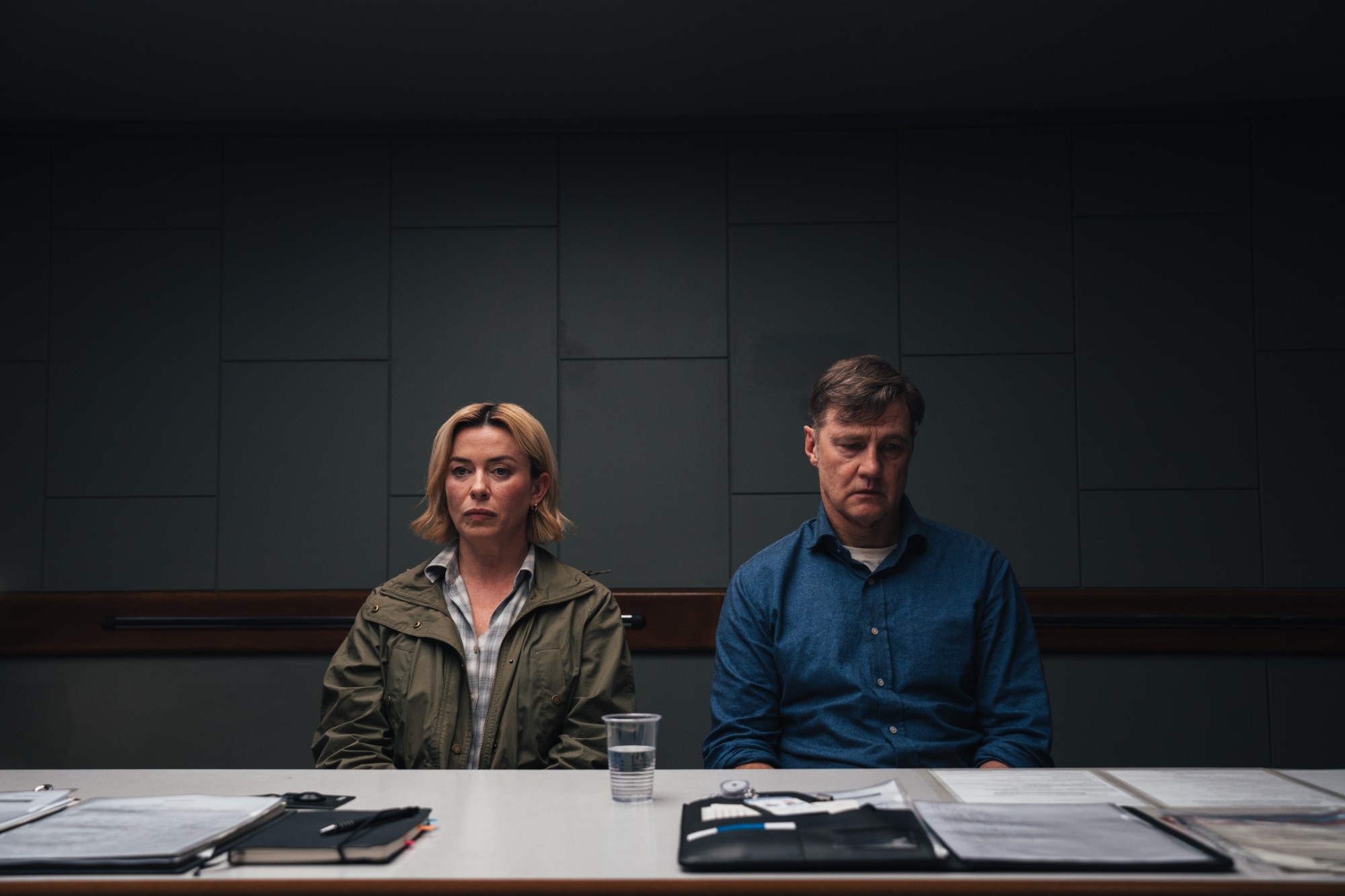
There is something profoundly unsettling about a man who appears incapable of grief.
When a wife mysteriously disappears from her comfortable family home, the natural expectation is panic, desperation, and an increasingly frantic search for answers. But what happens when her husband responds with an almost frightening absence of emotion? What if his greatest concern appears to be maintaining the routines of his prestigious school rather than confronting the possibility that the woman he married may never return?
That disturbing question forms the foundation of Gone, ITV’s gripping six-part psychological crime drama starring David Morrissey and Eve Myles.
Created by acclaimed screenwriter George Kay, whose previous credits include The Long Shadow, Hijack, and Lupin, the series transforms a seemingly familiar missing-person mystery into something far more psychologically complex. Beneath its investigation lies an examination of emotional repression, institutional privilege, fractured relationships, and the terrifying uncertainty of never truly knowing another person.
Morrissey delivers an extraordinarily controlled performance as Michael Polly, a respected headmaster whose wife Sarah vanishes without explanation. Opposite him, Myles is captivating as Detective Annie Cassidy, a determined investigator who becomes increasingly convinced that Michael’s unnerving composure conceals something sinister.
The result is a slow-burning, deeply atmospheric thriller that refuses to provide easy answers.
And with a 100% critics’ score on Rotten Tomatoes, based on 12 reviews, Gone has established itself as one of ITV’s most critically admired crime dramas of 2026.
Rotten Tomatoes+1
A DISAPPEARANCE THAT EXPOSES THE DARKNESS BEHIND A PERFECT FAMILY
At the center of Gone is Michael Polly, the headmaster of St Bartholomew’s, a prestigious private school in Bristol.
Michael is a man who values discipline, routine, achievement, and emotional restraint. His life appears carefully constructed around professional responsibility and a deeply ingrained belief that order must be maintained regardless of personal circumstances.
Then his wife Sarah disappears.
For most people, such an event would immediately shatter the illusion of normality. But Michael’s reaction is almost impossible to interpret.
Rather than displaying obvious panic, he continues behaving with an unnerving degree of composure. His attention remains fixed on school responsibilities, rugby fixtures, and the practical demands of his professional life.
His daughter Alana, played by Emma Appleton, reacts very differently. Her growing fear and confusion make her father’s emotional distance appear even more disturbing.
When Detective Annie Cassidy enters the investigation, she quickly notices the contradiction.
Michael is not behaving as she expects a frightened husband to behave.
But does unusual behavior indicate guilt?
Or is Michael simply a deeply repressed man whose inability to express emotion makes him appear suspicious?
This uncertainty becomes the series’ central psychological weapon.
Rather than immediately presenting Michael as either villain or victim, Gone invites viewers to examine their own assumptions about grief, masculinity, and the ways people respond to trauma.
The deeper Annie investigates, the more complicated the disappearance becomes.
And as troubling evidence emerges, the comfortable world surrounding Michael begins to fracture.
Press Centre+1
DAVID MORRISSEY DELIVERS A MASTERCLASS IN CONTROLLED PSYCHOLOGICAL TERROR
David Morrissey has built an impressive career portraying complicated men whose outward confidence conceals emotional instability.
In Gone, he takes that ability to another level.
His Michael Polly is not a conventional television suspect. He does not spend every scene nervously avoiding questions or displaying obvious signs of deception.
Instead, he is almost aggressively ordinary.
He speaks with authority, maintains professional boundaries, and seems genuinely irritated when the investigation disrupts his carefully organized existence.
That ordinary behavior becomes increasingly disturbing because of the extraordinary circumstances surrounding him.
Morrissey understands that psychological tension does not always require shouting, violence, or dramatic confrontation.
Sometimes the most frightening performance is the one that reveals almost nothing.
A prolonged silence, a carefully measured response, or a fleeting expression of irritation becomes loaded with possible meanings.
Michael’s emotional detachment is especially effective because Morrissey refuses to reduce him to a simple stereotype.
There are moments when his behavior seems almost cruel.
At other times, his rigid personality begins to resemble a form of emotional imprisonment.
He is a man who has spent so long controlling his feelings that he may no longer understand how to express them.
One particularly revealing sequence involves Michael reacting with anger over mud being brought into his home, even as the investigation surrounding his wife becomes increasingly serious.
The moment is deeply uncomfortable, yet it also exposes the peculiar priorities governing his existence.
Morrissey’s greatest achievement is keeping viewers uncertain about whether they are watching a calculating individual concealing a terrible secret or a profoundly damaged man incapable of responding normally to catastrophe.
That ambiguity makes his performance extraordinary.
EVE MYLES IS THE EMOTIONAL FORCE DRIVING THE ENTIRE INVESTIGATION

If Morrissey provides the mystery, Eve Myles supplies its relentless momentum.
As Detective Annie Cassidy, Myles creates a character whose intelligence, determination, and emotional instincts make her a compelling counterpart to Michael’s rigid personality.
Annie is observant, direct, and unwilling to accept convenient explanations.
She notices the details other people overlook.
More importantly, she understands that the truth behind a disappearance cannot always be discovered through physical evidence alone.
Sometimes the most revealing clues emerge from relationships, emotional contradictions, and the things people refuse to discuss.
Her encounters with Michael become increasingly fascinating because neither character is easily intimidated.
Michael believes in hierarchy, authority, and carefully controlled interactions.
Annie operates through instinct, persistence, and an almost instinctive resistance to being dismissed.
Their conversations become psychological confrontations in which every question carries an additional meaning.
Yet Myles also gives Annie a vulnerability that prevents her from becoming an unrealistic, invincible investigator.
She carries the emotional burden of an unresolved case involving a missing young woman, while her complicated relationship with former partner Craig introduces further personal difficulties.
These experiences influence how she approaches Michael and his family.
Her determination is not simply professional ambition.
It is connected to her own history of disappointment, regret, and unresolved pain.
The result is a detective who feels recognizably human rather than mechanically brilliant.
Even when Annie is professionally sidelined, her determination to understand what happened remains central to the story.
Myles captures that mixture of frustration and resilience with remarkable conviction.
A DEADLY GAME OF CAT AND MOUSE WHERE EVERY SILENCE MATTERS
The relationship between Michael and Annie is arguably the greatest strength of Gone.
Their conflict is not built around spectacular action sequences or elaborate confrontations.
Instead, the series creates suspense through observation.
Annie watches Michael.
Michael studies Annie.
Each attempts to understand the other’s intentions while concealing aspects of their own emotional lives.
The result is an absorbing psychological contest.
What makes this dynamic particularly compelling is the shifting balance of power.
Michael initially appears secure within his professional identity and social standing. He is accustomed to being respected, obeyed, and taken seriously.
Annie’s presence threatens that stability.
She asks questions he cannot easily control.
She challenges assumptions he considers self-evident.
And she refuses to interpret his social position as evidence of innocence.
Yet the investigation also forces Annie to confront the possibility that her own instincts may be influenced by prejudice.
Is Michael suspicious because of what he has done?
Or because his personality violates society’s expectations of how a grieving husband should behave?
The series repeatedly returns to this uncomfortable distinction.
Every time viewers begin forming a confident conclusion, another detail complicates the picture.
That uncertainty creates a particularly effective form of suspense because the danger is psychological rather than purely physical.
The central mystery becomes not only what happened to Sarah, but whether anyone involved can be trusted to describe the truth accurately.
THE PRESTIGIOUS SCHOOL BECOMES A WORLD OF PRIVILEGE, SECRECY AND HIDDEN POWER
One of the drama’s most intelligent decisions is placing much of the action within the environment of an elite private school.
St Bartholomew’s initially appears to represent stability, tradition, and respectability.
Its carefully maintained reputation reflects Michael’s own obsession with discipline and achievement.
But beneath that polished exterior lie complicated relationships, personal loyalties, and institutional pressures.
As the investigation expands, the school becomes increasingly important to understanding the lives of those connected to Sarah.
Teachers, parents, and students are drawn into a widening circle of suspicion.
Private relationships begin to intersect with professional responsibilities.
The institution’s desire to protect its reputation becomes another source of tension.
This setting allows George Kay to examine the relationship between power and credibility.
People occupying respected positions are often granted the benefit of the doubt.
Their behavior may be excused as eccentricity, professional dedication, or personal reserve.
Those without comparable status may receive far less generous interpretations.
Gone uses these social inequalities to complicate the investigation without reducing its characters to simplistic symbols.
The school is more than a backdrop.
It is a miniature society in which reputation can become a form of protection and silence can carry enormous consequences.
EMMA APPLETON BRINGS HEARTBREAKING HUMANITY TO A FRACTURED FAMILY
While the confrontations between Morrissey and Myles dominate the drama, Emma Appleton provides another essential perspective as Alana Polly.
Alana is not merely the daughter of a missing woman.
She is someone whose understanding of her own family begins to collapse under the pressure of an increasingly disturbing investigation.
Her father’s behavior becomes a source of confusion and emotional distress.
The man she has known throughout her life suddenly appears difficult to recognize.
Yet Alana’s position is complicated by the natural loyalty children often feel toward their parents.
She wants answers.
She wants reassurance.
And she wants to believe that the foundations of her family have not been built upon deception.
Appleton captures that emotional conflict with sensitivity.
Her performance is especially effective because Alana’s distress contrasts sharply with Michael’s apparent detachment.
Where he attempts to preserve order, she struggles to make sense of chaos.
Where he retreats into routine, she searches for emotional certainty.
Their increasingly strained relationship becomes one of the drama’s most painful elements.
It also reinforces an important theme: a disappearance does not simply remove one person from a family.
It changes the meaning of every relationship left behind.
A SLOW-BURN MYSTERY THAT MAKES EVERY SMALL DETAIL FEEL DANGEROUS
Modern crime television frequently relies on relentless twists, shocking violence, and dramatic cliffhangers to maintain attention.
Gone adopts a more patient approach.
Its suspense emerges through accumulation.
A suspicious reaction.
A contradiction in someone’s account.
An unexpected connection.
A conversation that suddenly acquires a different meaning.
Individually, these details may appear insignificant.
Together, they create a steadily intensifying atmosphere of unease.
The series trusts viewers to pay attention rather than repeatedly explaining what they should suspect.
This approach can initially make the drama feel restrained.
Those expecting constant action may find its deliberate pacing challenging.
However, that patience becomes increasingly rewarding as the investigation develops.
The story gradually shifts attention between different suspects, relationships, and possible motives.
Each new development changes the audience’s interpretation of earlier scenes.
Rather than treating the mystery as a straightforward puzzle with an obvious solution, the drama emphasizes how easily human behavior can be misunderstood.
Its greatest suspense comes from the possibility that the most convincing explanation may still be wrong.
RICHARD LAXTON’S DIRECTION TRANSFORMS BRISTOL INTO AN ATMOSPHERE OF DREAD
Director Richard Laxton gives Gone a visual identity that perfectly complements its psychological themes.
The setting moves between respectable school buildings, comfortable family interiors, and the ominous woodland surrounding Bristol.
These environments initially suggest familiarity and safety.
Yet the camera repeatedly transforms them into places of uncertainty.
The forest becomes especially important.
Its dense vegetation and secluded paths suggest the possibility of secrets remaining hidden beyond ordinary sight.
Meanwhile, Michael’s home feels increasingly oppressive.
Its ordered rooms and carefully maintained domestic environment reflect his need for control.
But as the investigation progresses, that apparent order begins to feel suffocating.
Laxton frequently allows silence and stillness to dominate scenes that might otherwise be filled with dramatic music or hurried dialogue.
This restraint gives the performances room to breathe.
It also forces viewers to concentrate on facial expressions, body language, and the uncomfortable distance between characters.
The atmosphere becomes almost claustrophobic despite the story’s spacious geographical setting.
That contradiction is central to the drama’s effectiveness.
The characters may move freely through beautiful surroundings, but emotionally they remain trapped within secrets, obligations, and unresolved conflicts.
THE DARKER THEMES: MASCULINITY, CONTROL AND THE HIDDEN COST OF RESPECTABILITY
Beneath its murder mystery, Gone is a drama about control.
Michael’s identity depends upon maintaining authority over his professional responsibilities, his surroundings, and his emotional responses.
He believes discipline is a virtue.
He associates vulnerability with weakness.
And he appears to measure personal worth through achievement and responsibility.
But when Sarah disappears, those principles prove inadequate.
The crisis cannot be solved through routine or professional determination.
For perhaps the first time, Michael faces circumstances that resist his authority completely.
His inability to adapt becomes increasingly revealing.
The series also explores how traditional expectations of masculinity can damage relationships.
Emotional restraint may be mistaken for strength.
Professional success may conceal personal failure.
And the appearance of respectability may discourage others from asking difficult questions.
Annie’s experiences provide a contrasting perspective.
She works within an institution where her judgment is not always granted the authority she believes it deserves.
Her persistence repeatedly challenges the assumption that established hierarchies necessarily produce better decisions.
The drama’s treatment of these themes gives it a seriousness that extends beyond the mechanics of identifying a culprit.
It asks viewers to consider how power operates within marriages, workplaces, and communities.
More disturbingly, it suggests that some forms of emotional harm can remain invisible precisely because they occur behind respectable appearances.
IS GONE REALLY AS GOOD AS ITS PERFECT ROTTEN TOMATOES SCORE SUGGESTS?
The critical response has been exceptionally positive.
Rotten Tomatoes records a 100% critics’ rating from 12 reviews, although the audience score is more mixed at 68%, based on fewer than 50 ratings.
Rotten Tomatoes
That distinction is important.
A perfect critics’ score does not mean every viewer will find the series flawless.
Its measured pacing, complicated character relationships, and refusal to provide immediate answers may frustrate audiences who prefer faster-moving thrillers.
There are also moments when Annie’s personal difficulties compete with the central investigation for attention.
Her unresolved past and troubled romantic life enrich her character, but they occasionally risk making an already complex narrative feel overburdened.
Nevertheless, these weaknesses are relatively minor compared with the series’ achievements.
The writing is intelligent without becoming unnecessarily obscure.
The performances are consistently strong.
And the central mystery develops with enough confidence to sustain six episodes.
The Guardian praised the series as an exceptionally engrossing drama, while The Independent highlighted its nuanced exploration of suspicion and the audience’s tendency to judge people through appearances.
The Guardian+1
What makes Gone stand out is not simply the question of who committed a crime.
It is the way that question exposes the emotional lives of everyone involved.
INSPIRED BY REAL INVESTIGATIVE EXPERIENCE, BUT NOT A DIRECT TRUE-CRIME RETELLING
Another fascinating element is the drama’s connection to real investigative work.
Although Gone tells a fictional story, it draws partial inspiration from To Hunt a Killer, the book associated with former detective Julie Mackay and crime journalist Robert Murphy.
Both contributed as consultants to the production.
Press Centre
This connection helps explain the drama’s interest in investigative persistence, institutional obstacles, and the importance of questioning established assumptions.
Unlike conventional fictional mysteries, where one extraordinary detective effortlessly identifies every clue, Gone portrays investigation as a complicated process shaped by personalities, professional pressures, and imperfect judgments.
The truth does not arrive simply because someone asks the right question.
It must be pursued through conflicting accounts, uncomfortable relationships, and repeated reassessments of what the evidence actually means.
That grounded approach gives the series much of its credibility.
It also makes the eventual developments more emotionally consequential because the investigation feels connected to recognizable human behavior rather than an artificially constructed puzzle.
FINAL VERDICT: A HAUNTING BRITISH THRILLER THAT STAYS WITH YOU LONG AFTER THE FINAL EPISODE
Gone succeeds because it understands that the most disturbing mysteries are not always those involving extraordinary villains or elaborate conspiracies.
Sometimes the greatest source of fear is the possibility that the people closest to us remain fundamentally unknowable.
David Morrissey delivers one of the drama’s defining performances, transforming Michael Polly into an unsettling study of repression, authority, and emotional isolation.
Eve Myles is equally impressive, giving Annie Cassidy the intelligence, determination, and vulnerability necessary to challenge him.
Together, they create a psychological conflict that remains compelling even when the investigation moves slowly.
George Kay’s writing consistently questions the difference between appearances and reality, while Richard Laxton’s atmospheric direction turns familiar British locations into landscapes of uncertainty.
The result is a crime drama that rewards patience, careful observation, and an appreciation for morally complicated characters.
It may not satisfy viewers searching for constant action or sensational twists.
But for audiences who appreciate intelligent British mysteries, emotionally layered performances, and investigations that grow more disturbing with every revelation, Gone is an excellent choice.
By the time the final episode approaches its conclusion, the disappearance that began the story has become something much larger: an examination of trust, control, and the devastating consequences of secrets hidden within ordinary lives.
Final rating: 9/10 — an intelligent, emotionally gripping and beautifully performed British psychological thriller.
All six episodes of Gone are available to stream on ITVX in the UK.
New Pictures
Review approach: largely spoiler-free, preserving the identity of the culprit and the central final revelations.