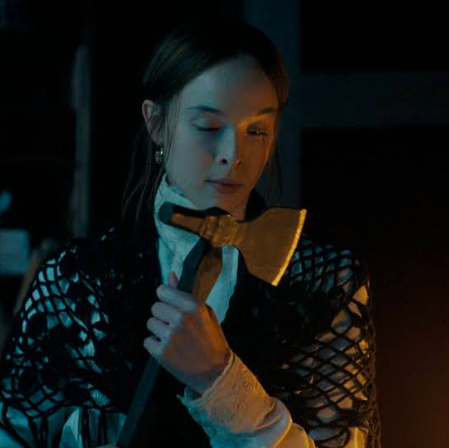
🚨 “I thought I knew the truth about this infamous murder case… I was completely wrong.” – Netflix is revisiting one of America’s darkest true-crime mysteries—and viewers may never see the story the same way again.
Monster: The Lizzie Borden Story: Netflix Reopens America’s Most Infamous Axe-Murder Mystery
More than 130 years after one of the most notorious murders in American history, the mystery of Lizzie Borden is returning to the screen — and Netflix is preparing to tell the story through the darkest lens yet.
Monster: The Lizzie Borden Story is the fourth installment of Ryan Murphy and Ian Brennan’s Monster anthology. After previous seasons explored notorious male figures including Jeffrey Dahmer, the Menendez brothers and Ed Gein, the franchise is making a significant change: for the first time, a woman stands at the center of its definition of a “monster.”
Ella Beatty stars as Lizzie Borden, the Massachusetts woman accused of murdering her father and stepmother with an axe in 1892. Netflix has confirmed that the new season will premiere globally on September 17, 2026.
📸 OFFICIAL IMAGE — First look at Ella Beatty as Lizzie Borden:
View the official Netflix photo here
The first images reveal a production soaked in Gothic atmosphere: candlelit rooms, elaborate Victorian costumes and, most strikingly, Beatty’s Lizzie staring directly ahead with blood covering her face.
It is a provocative introduction to a character whose guilt remains one of American true crime’s most enduring questions.
The Murder Case That Refused to Die
On August 4, 1892, Andrew Borden and his wife Abby were brutally murdered inside their home in Fall River, Massachusetts.
Andrew was a wealthy businessman and prominent local figure. His daughter Lizzie quickly emerged as a central suspect in the investigation.
The idea was sensational.
At a time when society held rigid expectations about how respectable women were supposed to behave, the possibility that an unmarried woman from an affluent New England household could be responsible for extraordinary violence fascinated and horrified the public.
Lizzie was arrested and eventually placed on trial.
Then came the outcome that ensured the mystery would survive for generations: she was acquitted.
There was no conviction capable of providing the public with a definitive ending.
Instead, Lizzie Borden became something far more powerful than an ordinary defendant. She became a legend.
📸 HISTORICAL REFERENCE — Lizzie Borden and the real case:
See historical context and images of Lizzie Borden
Even people who know almost nothing about the actual evidence may recognize her name. Books, plays, documentaries, films and television dramas have repeatedly reconstructed the crime.
The Borden murders eventually crossed the boundary separating history from folklore.
And that transformation makes the case particularly appropriate for Monster.
Netflix’s First Female “Monster”
The fourth season represents a major departure for the anthology.
Its previous central subjects have overwhelmingly been men associated with horrific crimes. Lizzie changes that formula.
Netflix describes the new installment as the story of its first female “Monster,” but the quotation marks around that idea are important. Lizzie Borden was never convicted of killing Andrew and Abby.
The historical reality is therefore considerably more complicated than simply presenting another famous murderer.
The season appears determined to explore that ambiguity.
According to Netflix’s official synopsis, the story follows the repressed daughter of a wealthy New England family and the family’s rebellious live-in maid as they find themselves trapped inside a household shaped by humiliation and cruelty. Their imagined escape becomes intertwined with sex, power and revenge before gruesome murders transform Lizzie into an icon.
📸 OFFICIAL NETFLIX GALLERY — Lizzie Borden Season 4 photos:
See Netflix’s first-look cast and character images
This framing suggests that Murphy and Brennan are less interested in producing a conventional “Who did it?” mystery than in asking a much more uncomfortable question:
How does society create a monster?
Ella Beatty Takes On Lizzie Borden
At the center of the series is Ella Beatty.
Beatty previously appeared in Murphy’s Feud: Capote vs. The Swans, but playing Lizzie Borden presents a completely different challenge.
She is portraying both a historical woman and a cultural myth.
The real Lizzie cannot simply be approached as a conventional fictional villain because the central allegation against her was never proven in court. At the same time, popular culture has spent more than a century transforming her into an almost supernatural symbol of female violence.
Beatty must somehow inhabit both versions.
Netflix’s early promotional material suggests that ambiguity will define the performance. One striking first-look photograph shows Beatty in period clothing with blood splattered across her face, staring toward the camera with an expression that refuses to provide an easy explanation.
📸 OFFICIAL IMAGE — Ella Beatty covered in blood as Lizzie:
View Ella Beatty’s first-look image on Netflix Tudum
Beatty has described the project as an exploration of a complicated psychology and an American crime that has achieved almost mythic status. She has also highlighted the season’s focus on female rage and repression.
Those themes could become crucial to understanding Netflix’s interpretation.
Female Rage in the Victorian Era
The Lizzie Borden story cannot easily be separated from gender.
Women living within affluent Victorian society faced expectations concerning obedience, sexuality, marriage, reputation and acceptable emotional behavior.
Anger could exist, but women were rarely permitted to express it openly without social consequences.
Desire could exist, but it had boundaries.
Independence could be imagined, but obtaining it could be extraordinarily difficult.
Monster appears prepared to use those restrictions as the psychological architecture surrounding its version of Lizzie.
The question is not necessarily whether oppression “caused” murder. Such a simplistic conclusion would flatten both the history and the victims.
Instead, the series has an opportunity to examine what happens when extreme resentment develops inside a world where appearances must constantly be maintained.
📸 PERIOD ATMOSPHERE — Official images from the new season:
Browse the Netflix Tudum feature and production stills
A respectable house can become a prison.
A family dinner can become psychological warfare.
Silence can conceal rage.
And domestic life can become the setting for unimaginable violence.
That contrast could give Season 4 a visual and psychological identity unlike anything the anthology has attempted before.
Vicky Krieps as Bridget Sullivan
One of the most intriguing elements of the new adaptation is the importance apparently given to Bridget Sullivan, the Bordens’ live-in maid.
Vicky Krieps plays Bridget.
Netflix’s official description places Lizzie and Bridget together at the center of the story, suggesting their relationship will play a substantial role in the season’s exploration of repression, sexuality, freedom and revenge.
That is significant.
Instead of restricting the drama entirely to the relationship between Lizzie and her parents, the series appears interested in examining two women occupying very different positions within the same restrictive household.
Lizzie belongs to the family but lacks complete freedom.
Bridget works inside the family home while occupying a dramatically different social class.
Their perspectives could allow the series to examine gender and class simultaneously.
📸 CAST IMAGE — Vicky Krieps as Bridget Sullivan:
See Vicky Krieps and the Season 4 cast photos
The creative choice could also become controversial.
Because substantial gaps remain in what can historically be known about private relationships inside the Borden household, any dramatization inevitably enters speculative territory.
That tension between historical evidence and dramatic invention will likely follow the series throughout its run.
Charlie Hunnam Becomes Andrew Borden
Charlie Hunnam takes on the role of Andrew Borden, Lizzie’s father.
His casting creates an interesting connection between seasons of the anthology. Hunnam previously played Ed Gein in Monster: The Ed Gein Story. Here, however, he moves away from the central accused figure and becomes one of the victims whose death launches the mystery.
Andrew Borden is essential to the psychological structure of the story.
Netflix’s synopsis specifically describes a home defined by humiliation and cruelty, suggesting that the season intends to explore the dynamics within the household before the murders rather than treating Andrew and Abby merely as names in a crime report.
📸 OFFICIAL CAST PHOTO — Charlie Hunnam as Andrew Borden:
View Charlie Hunnam in Netflix’s Season 4 preview
That approach could make the murders more disturbing.
The audience will not simply encounter a crime scene. Viewers will first spend time inside the family relationships that preceded it.
Rebecca Hall Plays Abby Borden
Rebecca Hall portrays Abby Borden, Lizzie’s stepmother and the second victim at the center of the historical case.
Hall is an especially compelling choice for a story driven by psychological tension.
The relationship between Lizzie and Abby has long been part of speculation surrounding the Borden case, and the series has the opportunity to transform domestic conflict into something increasingly claustrophobic.
The danger for any dramatization is allowing the victims to disappear behind the celebrity of the accused.
Monster will need to avoid that trap.
Andrew and Abby were not simply components of a legend. They were real people who died violently.
📸 OFFICIAL IMAGE — Rebecca Hall as Abby Borden:
See Rebecca Hall and other character images from Netflix
How much space the season gives them as characters rather than victims may ultimately determine how responsibly it handles its true-crime foundations.
An All-Star Supporting Cast
The ensemble extends far beyond Beatty, Hunnam, Hall and Krieps.
Billie Lourd plays Emma Borden, Lizzie’s older sister. Jessica Barden portrays actor Nance O’Neil, a friend of Lizzie’s, while Sarah Paulson is also part of the cast. Joey Pollari appears in the series as well. Netflix’s official listing confirms the ensemble.
📸 FULL CAST — Netflix’s official Season 4 feature:
View the cast guide and official photos
The strength of the supporting cast suggests the new season will expand beyond a simple recreation of the murders and trial.
Instead, the story can investigate the social ecosystem surrounding Lizzie.
Family.
Friendship.
Sexuality.
Class.
Reputation.
And the difference between the woman people knew and the monster the public eventually imagined.
A Gothic Nightmare Hidden Inside a Respectable Home
Visually, The Lizzie Borden Story has the potential to become the anthology’s most distinctive season.
The Netflix promotional material places enormous emphasis on period interiors, shadows, candles, formal clothing and dark domestic spaces.
It is not difficult to understand why.
The Borden case already contains the structure of Gothic horror.
A wealthy family lives together inside a respectable house.
Relationships deteriorate.
Resentments remain hidden.
Then, in daylight, two people are violently killed inside their own home.
The murderer apparently disappears.
📸 OFFICIAL SERIES PAGE — Artwork, teaser and imagery:
Explore the official Netflix series page
There is no need for a supernatural creature.
The house itself becomes frightening because someone inside it may be responsible.
That is a different type of horror.
It is intimate.
Sex, Power and Freedom
Netflix’s synopsis makes another thing clear: sexuality will form part of this interpretation.
The official description specifically connects the characters’ imagined escape with sex, power and revenge.
That could transform the season from a straightforward historical crime drama into something more provocative.
For Lizzie, freedom may represent several things simultaneously: financial independence, sexual autonomy, escape from family control and liberation from expectations about what a respectable woman should be.
But Monster is unlikely to portray freedom in uncomplicated terms.
Its title demands something darker.
What happens when the desire for liberation collides with violence?
What happens when audiences sympathize with a character and then become frightened by her?
And what if viewers can understand someone without being certain whether they should believe her?
Those contradictions are precisely where the Lizzie Borden story becomes fascinating.
The Problem With Calling Lizzie a Killer
There is one historical fact every viewer should remember while watching the series:
Lizzie Borden was acquitted.
That fact complicates virtually every dramatic decision.
A documentary can present evidence and competing theories.
A scripted drama has different demands. It needs scenes, motivations, private conversations and emotional perspectives that history cannot always verify.
Consequently, Monster will inevitably contain dramatization.
The responsible way to approach the series is therefore not as a definitive explanation of what happened in 1892 but as a modern interpretation of a famous unresolved case.
📸 HISTORICAL BACKGROUND — The real Lizzie Borden case:
Explore the historical overview and archival references
This distinction matters because popular entertainment possesses enormous power.
For millions of viewers, Netflix’s Lizzie may become more familiar than the historical woman herself.
Why America Never Forgot Lizzie Borden
Thousands of murders have disappeared from popular memory.
The Borden case did not.
Why?
Part of the answer lies in contradiction.
Lizzie did not resemble the stereotypical killer imagined by the public.
She came from a prosperous household.
She was a woman.
The crime occurred within the supposedly safe environment of a family home.
And after one of the most sensational murder trials of the era, she walked free.
There was no satisfying conclusion.
That uncertainty allowed the story to evolve.
Each generation could reinvent Lizzie.
Victim.
Killer.
Rebel.
Monster.
Misunderstood woman.
Feminist icon.
Gothic villain.
No single interpretation permanently defeated the others.
Why Season 4 Could Become the Most Controversial Monster Yet
Ryan Murphy and Ian Brennan are working with extraordinarily combustible material.
True crime is already controversial because entertainment is created from real violence.
Lizzie Borden adds another layer because the central woman was never convicted.
The creators therefore face a difficult balancing act.
Make Lizzie too sympathetic and the production could be accused of romanticizing violence.
Make her definitively murderous and the drama risks presenting speculation as historical certainty.
Make the story too restrained and it may lose the psychological intensity audiences expect from Monster.
The strongest version of the series would live somewhere between those extremes.
📸 NEW SEASON PREVIEW — More first-look images:
See Netflix Tudum’s complete preview
It does not need to tell viewers what to believe.
It needs to make them uncomfortable with how quickly they decide what they believe.
When Will Monster: The Lizzie Borden Story Be Released?
Netflix has officially announced that Monster: The Lizzie Borden Story arrives on September 17, 2026.
The official Netflix page currently lists Ella Beatty, Vicky Krieps, Charlie Hunnam, Rebecca Hall, Jessica Barden, Joey Pollari, Billie Lourd and Sarah Paulson among the cast. Netflix categorizes the series as a period piece, crime drama, horror title, psychological drama and social-issue story.
🎬 OFFICIAL TEASER & SERIES PAGE:
Watch the official teaser on Netflix
Everything revealed so far suggests that this will not simply be another dramatization of a famous murder.
It is a story about how violence becomes mythology.
It is about a woman who was declared not guilty by a jury but never fully acquitted by popular culture.
It is about repression, desire, family, class and the terrifying possibility that respectable appearances can hide something much darker.
More than 130 years after Andrew and Abby Borden were murdered, the questions remain.
Who killed them?
What really happened inside that house?
And why, after all this time, are we still unable to look away?
The courtroom delivered its verdict in 1893.
History never did.