
🚨 FORGET THE ODYSSEY—THIS IS THE MATT DAMON THRILLER EVERYONE SHOULD BE TALKING ABOUT.
Forget the Odyssey. This is the Matt Damon thriller everyone should be talking about.
Ben Affleck and Matt Damon have reunited for a relentless crime saga that plunges deep into a world of corrupt detectives, shattered loyalties, and betrayals that leave no one untouched. Inspired by true events, The Rip follows a deadly game where every alliance hides a secret and every decision pushes the characters closer to disaster. Explosive action, nerve-racking twists, and emotionally charged performances have viewers calling it one of the most gripping crime dramas in years. If you loved Heat, prepare for an even darker, more brutal ride that refuses to let up until the very last scene.

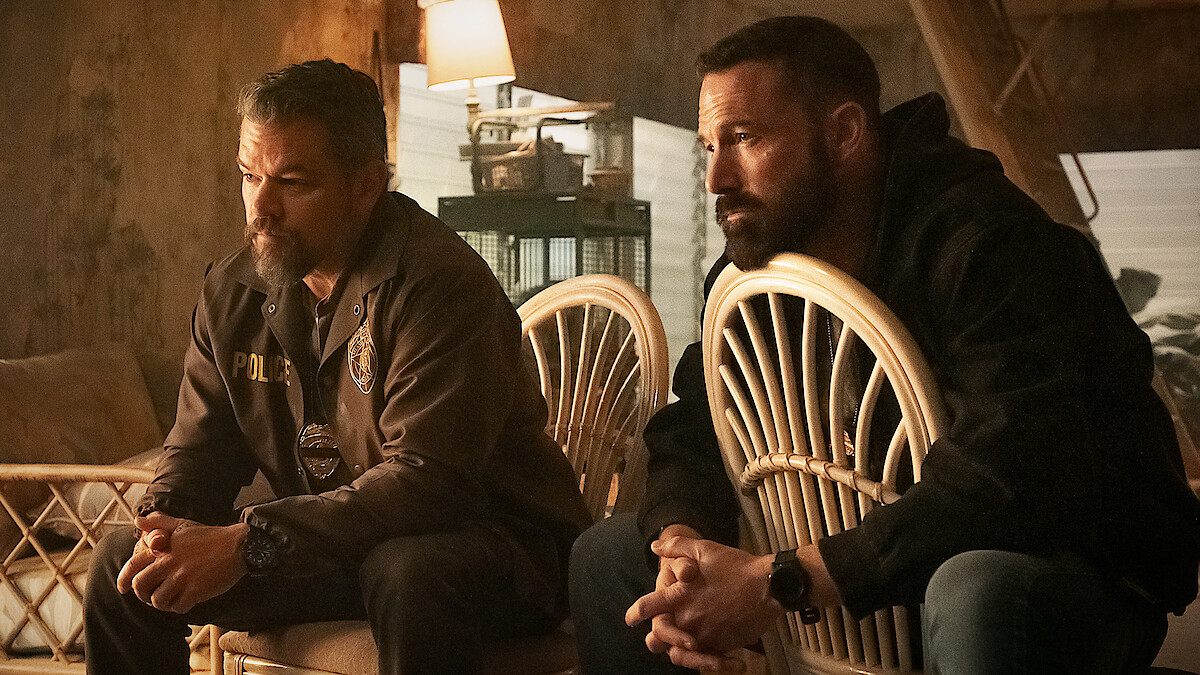
In January 2026, Netflix dropped The Rip, a hard-edged action thriller written and directed by Joe Carnahan. Matt Damon stars as Lieutenant Dane Dumars, a grieving Miami-Dade narcotics supervisor still reeling from the death of his young son. Ben Affleck plays Detective Sergeant J.D. Byrne, Dumars’s longtime partner and the closest thing he has to a brother in blue. Together they lead a tactical team that lives in the gray zone of the drug trade—seizing cash, guns, and product while trying to stay one step ahead of both the cartels and internal affairs.
What begins as a routine tip about a stash house holding a few hundred thousand dollars explodes into something far more dangerous. Behind the walls of an ordinary Miami Lakes home, the team discovers roughly $20 million in cash—stacked in buckets, hidden in attics, enough money to change every life in the room. Almost immediately, trust begins to fracture. Who can be trusted when that kind of cash is sitting on the table? Who is already planning to take a cut? And who is willing to kill to protect the secret?
Carnahan, working from a story developed with Michael McGrale, keeps the pressure cooker sealed tight. The film lives in close quarters: dimly lit rooms, fluorescent warehouses, the back of police vans, and the humid Miami night. There is little room for grand speeches or sweeping cityscapes. Instead, the camera stays locked on faces—Damon’s tight-jawed control, Affleck’s simmering calculation, the restless energy of a squad that suddenly understands the power of the money they have found.

The supporting cast deepens the sense of a unit under siege. Steven Yeun plays Detective Mike Ro with a quiet intensity that suggests he sees more than he says. Teyana Taylor brings steel and street smarts as a fellow officer who refuses to be sidelined. Kyle Chandler appears as a DEA agent whose arrival raises the stakes even higher. Sasha Calle, Catalina Sandino Moreno, and Scott Adkins round out a roster that feels lived-in rather than assembled for star power alone. The chemistry between Damon and Affleck remains the film’s gravitational center. Decades after Good Will Hunting, the two still share an effortless shorthand—glances that carry entire conversations, the easy rhythm of men who have survived too many close calls together. That history makes the eventual cracks in their partnership land with real force.
Carnahan has long specialized in stories about men under extreme pressure—The Grey, Narc, Smokin’ Aces. Here he strips the genre down to its essentials: greed, loyalty, and the thin line between the badge and the criminal. The action, when it comes, is sudden and brutal rather than choreographed spectacle. Gunfights are short, messy, and consequential. The real tension lives in the conversations that follow, the accusations that hang in the air, the way a single glance across a room full of money can change everything.
The True Story Behind the Fiction
The Rip is inspired by events that unfolded in Miami-Dade County in June 2016. A tactical narcotics team led by then-Captain Chris Casiano executed a search warrant on a home in Miami Lakes linked to a suspected marijuana trafficker. What they expected to find was product and perhaps a modest cash haul. What they actually uncovered was one of the largest cash seizures in department history—more than $20 million, much of it stuffed inside ordinary Home Depot buckets hidden in the attic and walls.
Casiano later described the moment the first buckets were opened as surreal. Counting the money took days under strict protocol. The seizure made national headlines and became the largest of its kind for the Miami-Dade Police Department at the time. Carnahan has said the idea for the film grew out of conversations with Casiano, a personal friend. The director was struck not only by the sheer scale of the money but by the psychological pressure it placed on the officers who found it. In the real world, the cash was inventoried, documented, and turned over. In the heightened reality of The Rip, that process becomes a crucible. The film invents the corruption, the paranoia, and the internal betrayal that the actual case did not contain. Casiano’s real-life grief over the later death of his young son from leukemia also finds an echo in Damon’s character, adding a layer of personal devastation beneath the professional crisis.
The movie makes no claim to documentary accuracy. On-screen text and promotional materials have been careful to describe the story as “inspired by” rather than “based on” the 2016 raid. Still, the connection has been enough to generate real-world friction. Some current and former Miami-Dade officers have publicly objected to the film’s portrayal of systemic corruption within the unit, arguing that it tarred an entire team by association. The lawsuit talk that briefly circulated earlier in 2026 underscored how raw the subject remains for people who lived the original investigation.

Why the Chemistry Still Works
There is a particular pleasure in watching Damon and Affleck share the screen again in this register. Their previous collaborations have ranged from the earnest (Good Will Hunting) to the corporate (Air). The Rip finds them in the moral twilight that suits both actors unusually well. Damon plays Dumars as a man holding himself together through sheer force of will, the grief over his son never far from the surface. Affleck’s Byrne is more fluid, more willing to consider the angles, and therefore more dangerous. Their scenes together crackle with the history the audience already brings to the pairing. When the partnership begins to fray, it feels personal in a way few studio thrillers manage.
Carnahan shoots much of the film in tight, restless compositions that keep the audience inside the characters’ rising anxiety. The Miami setting is present but never romanticized—strip malls, suburban houses with secrets in the walls, the constant humidity that makes every confrontation feel slightly overheated. The score stays low and percussive, more pulse than melody, reinforcing the sense that the story is always one bad decision away from spinning out of control.
Critics have been largely favorable, praising the lead performances and the film’s willingness to stay in the moral gray rather than offer easy heroes. Some have noted that the plot occasionally leans on familiar genre machinery—the big score, the compromised unit, the internal mole. Yet even those reviews tend to concede that Damon and Affleck elevate the material through sheer presence and the accumulated weight of their long collaboration. Audience response has been even stronger. On social platforms and in living rooms, viewers have described the film as the kind of propulsive, adult thriller that streaming platforms too often abandon in favor of safer fare.

A Darker Shade of Cop Movie
Comparisons to Michael Mann’s Heat are inevitable and not entirely misplaced. Both films are interested in the professional codes that bind men on opposite sides of the law, and both understand that the most interesting conflicts often happen inside the same organization. The Rip is leaner, more claustrophobic, and less romantic about its criminals. There are no grand monologues about the nature of the work. There is only the money, the men who found it, and the slow realization that the biggest threat may be sitting across the table.
The film also arrives at a moment when public trust in institutions feels especially fragile. Stories about police corruption have never been rare, but the combination of a real nine-figure cash seizure and a high-profile Hollywood treatment has given The Rip an extra charge. Whether the movie ultimately indicts the system or simply uses it as a pressure cooker is something viewers will debate. What is harder to argue with is the effectiveness of the ride. For two hours, Carnahan, Damon, and Affleck keep the audience locked in a room with a mountain of cash and a group of heavily armed men who no longer trust one another. That is a simple premise executed with confidence and a refusal to look away.
In an era of franchise fatigue and algorithm-driven content, The Rip feels like a throwback in the best sense—an original story driven by character, tension, and the enduring appeal of watching two of Hollywood’s most reliable stars dig into morally complicated material. It is not a perfect film. It does not reinvent the genre. What it does, with considerable skill, is remind audiences how satisfying a well-made crime thriller can still be when the performances are strong and the stakes feel personal.
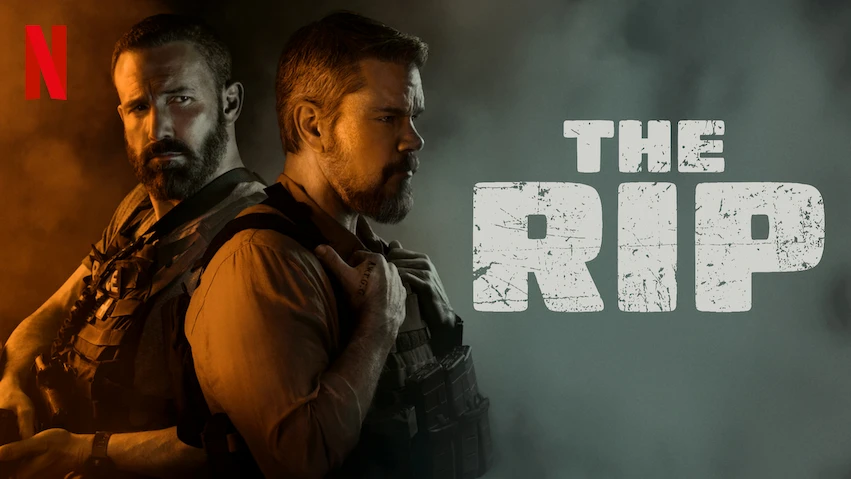
The final stretch of the movie refuses to offer easy exits. Loyalties are tested, blood is spilled, and the question of what any of them will walk away with—money, integrity, or simply their lives—hangs until the closing frames. Viewers who come for the Damon-Affleck reunion will find it delivers. Those who stay for the story will discover a lean, mean piece of genre filmmaking that understands the corrosive power of sudden wealth better than most.
The Rip is now streaming on Netflix. Watch it with the lights low, the volume up, and the understanding that once the first bucket is opened, there is no going back. Trust, as the film’s tagline warns, has a price. In this case, that price is paid in full.