🔥 Everyone’s Talking About David Tennant’s New BBC Drama — But His Unforgettable Crime Thriller With Olivia Colman Is Still the One That Will Keep You Awake Until 3AM
An 11-year-old boy found dead beneath the cliffs. A picturesque British seaside town hiding devastating secrets. And two extraordinary performances from David Tennant and Olivia Colman that helped turn an ordinary murder investigation into one of television’s most emotionally devastating mysteries.
David Tennant may be back in the spotlight thanks to his latest BBC drama, but there is another performance in his remarkable television career that deserves to be rediscovered — and it comes from a British crime thriller so gripping, so emotionally exhausting and so brilliantly constructed that watching just one episode can feel almost impossible.
The series is Broadchurch, the acclaimed ITV mystery drama that first captivated audiences in 2013 and transformed a seemingly peaceful Dorset seaside community into the setting for a devastating murder investigation.
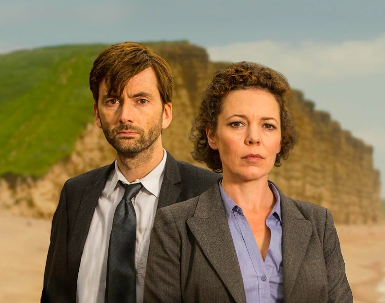
Alongside Oscar-winning actress Olivia Colman, Tennant delivered one of the defining performances of his career as Detective Inspector Alec Hardy, a troubled investigator whose arrival in a close-knit coastal town coincides with the discovery of an 11-year-old boy’s body on the beach.
What follows is far more than a conventional whodunnit.
It is a story about grief, suspicion, betrayal and the terrifying consequences of discovering that the people you trust most may be hiding secrets you never imagined.
And while modern crime dramas frequently rely on sensational violence, relentless action and increasingly elaborate twists, Broadchurch achieves something considerably more unsettling.
It makes an entire community feel like a crime scene.
From the opening episode, almost every conversation carries a hidden meaning. Every familiar face becomes a potential suspect. Every friendship begins to fracture under the pressure of unanswered questions.
And at the centre of it all are Tennant and Colman, portraying two detectives who could hardly be more different — yet whose partnership becomes the emotional foundation of the entire series.
For viewers discovering the show for the first time, one warning may be appropriate: clear your evening.
Because once the mystery begins, stopping before the next episode is considerably harder than it sounds.

A BEAUTIFUL SEASIDE TOWN — AND A DISCOVERY THAT CHANGES EVERYTHING
The opening premise of Broadchurch is deceptively simple.
In a small coastal community where everybody appears to know everybody else, 11-year-old Danny Latimer is found dead on the beach.
His death sends shockwaves through the town.
Danny’s parents, Beth and Mark Latimer, are plunged into unimaginable grief. Their friends and neighbours struggle to comprehend what has happened. And as investigators begin piecing together the boy’s final movements, it quickly becomes clear that the circumstances surrounding his death are far more disturbing than anyone initially imagined.
For a community accustomed to familiar routines, local gossip and the comforting illusion of safety, the investigation becomes a nightmare.
The streets remain the same. The shops continue opening. The sea still crashes against the towering cliffs.
But nothing feels ordinary anymore.
Suddenly, innocent conversations are remembered differently. Unexplained absences take on sinister significance. People who once trusted one another begin wondering whether the person living next door could be responsible for a child’s death.
The brilliance of creator Chris Chibnall’s storytelling lies in how patiently he allows that suspicion to spread.
Rather than presenting an obvious villain, the drama introduces a network of ordinary people with complicated relationships, private struggles and secrets they would prefer to keep buried.
Some are hiding personal mistakes.
Others are concealing painful histories.
And some simply become victims of suspicion because their behaviour appears unusual when viewed through the lens of a murder investigation.
The result is a mystery in which almost nobody feels entirely safe from scrutiny.
Even the audience becomes suspicious of characters it previously trusted.
And that is precisely what makes the series so addictive.
DAVID TENNANT AS YOU HAVE RARELY SEEN HIM
For millions of viewers, David Tennant will always be associated with his charismatic portrayal of the Tenth Doctor in Doctor Who.
His energetic personality, sharp humour and extraordinary emotional range made him one of the most recognisable faces on British television.
But Broadchurch revealed something very different.
As Alec Hardy, Tennant strips away much of the charm and theatrical energy associated with his most famous roles.
Hardy is abrasive, exhausted, secretive and frequently difficult to like.
He arrives in Broadchurch carrying the weight of a previous investigation that damaged his professional reputation and left him emotionally isolated.
He is not particularly interested in making friends.
He is even less interested in respecting the unwritten social rules of a town where personal relationships seem to complicate every stage of the investigation.
For Hardy, evidence matters more than popularity.
And if pursuing the truth means making himself unpopular, he is entirely prepared to do so.
Yet beneath his sharp exterior lies a deeply vulnerable man.
Tennant’s performance gradually reveals a detective haunted by professional failure, physical illness and the possibility that another investigation could end in catastrophe.
He is desperate to solve Danny’s murder, but his determination comes at a significant personal cost.
The character’s exhaustion feels genuine.
His frustration is frequently uncomfortable.
And when his carefully controlled emotions finally begin to surface, the effect is devastating.
It is a performance built not simply on dramatic speeches but on silence, restraint and the increasingly visible strain of a man struggling to hold himself together.
And then there is Olivia Colman.

OLIVIA COLMAN’S PERFORMANCE MAKES THE HEARTBREAK IMPOSSIBLE TO IGNORE
If Tennant provides Broadchurch with its tension and relentless investigative drive, Olivia Colman supplies much of its emotional heart.
Her character, Detective Sergeant Ellie Miller, is everything Hardy is not.
She is warm, approachable, deeply connected to her community and accustomed to viewing the people around her as friends rather than suspects.
Before Danny’s death, Ellie believes she understands the town she calls home.
She knows the families.
She recognises the familiar faces.
And she has every reason to believe that the people around her are fundamentally decent.
The murder investigation destroys that certainty.
Suddenly, Ellie is forced to question people she has known for years, including those with whom she shares personal relationships.
Her professional responsibilities begin colliding with her emotional loyalties.
And the longer the investigation continues, the more difficult it becomes for her to separate the detective from the friend, neighbour and mother.
Colman’s genius is in making that conflict painfully believable.
She can communicate disbelief, anger, compassion and overwhelming sadness with the smallest change in expression.
There is nothing exaggerated about her performance.
Instead, she allows the emotional consequences of the investigation to accumulate gradually, until the strain becomes almost unbearable.
Her chemistry with Tennant is equally remarkable.
Hardy approaches the investigation with suspicion and emotional distance.
Ellie initially struggles to accept that the people she knows could be capable of terrible acts.
Their disagreements provide moments of sharp humour, but they also reveal the central conflict at the heart of the story.
How can investigators uncover the truth when personal relationships make objectivity almost impossible?
For Colman, Broadchurch became another major milestone in an already impressive career.
At the 2014 BAFTA Television Awards, she won Leading Actress for her portrayal of Ellie Miller, while the programme itself won Best Drama Series. David Bradley also received the Supporting Actor award.
It was richly deserved recognition for a performance that remains among the most emotionally compelling of her television career.
THE MURDER MYSTERY THAT BECOMES SOMETHING MUCH DARKER
What separates Broadchurch from countless other crime dramas is its refusal to treat Danny Latimer’s death as merely a puzzle waiting to be solved.
Certainly, the mystery is compelling.
There are suspicious movements, inconsistent accounts, private relationships and revelations that repeatedly alter the direction of the investigation.
But the series is equally concerned with what happens to the people left behind.
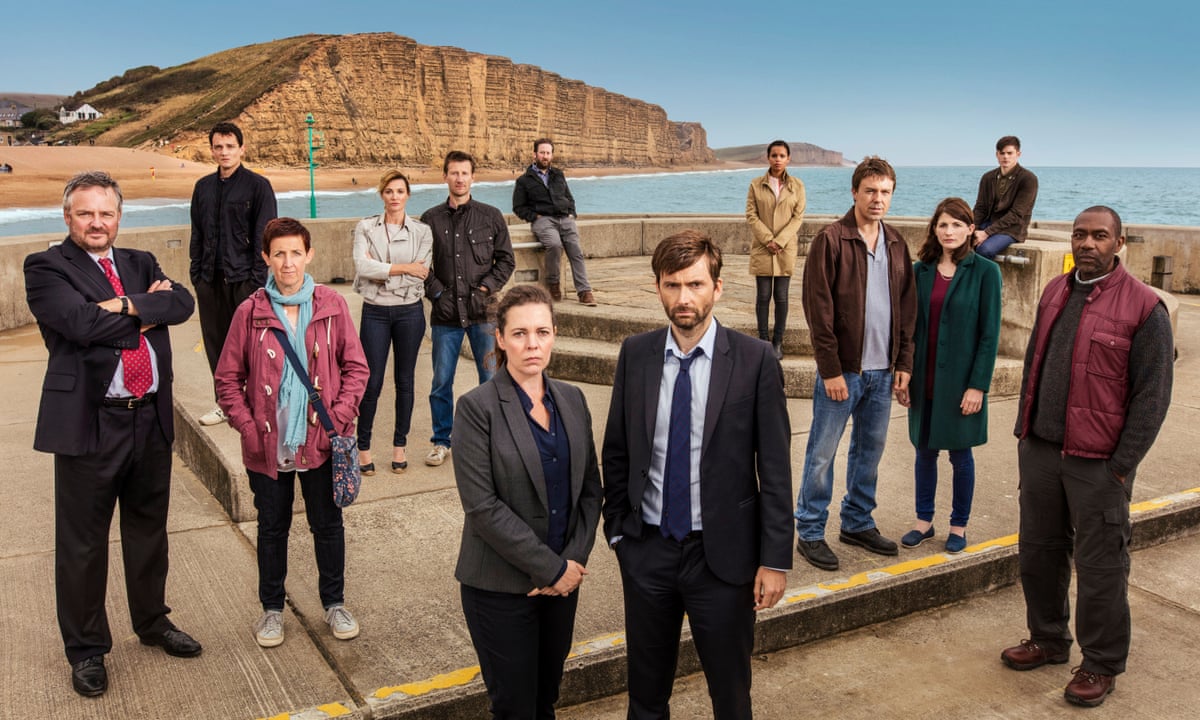
Danny’s parents, played by Jodie Whittaker and Andrew Buchan, become central to that emotional devastation.
Their grief is not presented as a single dramatic moment.
It is an ongoing struggle that changes the atmosphere inside their home, strains their marriage and alters their relationships with almost everyone around them.
Ordinary family routines become painful reminders of what they have lost.
Meanwhile, the investigation attracts increasing attention from journalists, exposing the community to a level of public scrutiny for which it is completely unprepared.
Rumours spread.
Private histories become public.
And people who have done nothing wrong can find their reputations damaged by suspicion alone.
This is where Broadchurch becomes particularly uncomfortable.
It forces viewers to confront how quickly a community can turn against itself when fear takes hold.
A suspicious expression becomes evidence in the court of public opinion.
An unexplained absence becomes a possible confession.
A private mistake becomes something much more sinister.
And with each new revelation, the audience is encouraged to reconsider everything it thought it understood.
The mystery does not simply ask who killed Danny.
It asks what happens when trust disappears.
THE CLIFFS, THE BEACH AND THE ATMOSPHERE YOU CAN ALMOST FEEL
Broadchurch would not have been nearly as effective without its extraordinary setting.
The towering cliffs, windswept beaches and narrow streets are not merely attractive scenery.
They are essential to the drama’s unsettling atmosphere.
Much of the series was filmed around West Bay in Dorset and Clevedon in North Somerset, with the dramatic Jurassic Coast landscape providing some of its most recognisable images.
The contrast is striking.
In daylight, the coastline looks almost impossibly beautiful.
The cliffs rise above the sea, the harbour appears peaceful, and the surrounding countryside suggests a place far removed from the dangers of urban life.
Yet beneath that picturesque surface lies a community being torn apart by violence and suspicion.
The landscape becomes a constant reminder of the difference between appearance and reality.
Even the sound of the sea takes on an ominous quality.
The camera frequently lingers on empty streets, lonely stretches of beach and the enormous cliffs overlooking the town.
These moments create a sense of isolation that is difficult to shake.
Composer Ólafur Arnalds’ haunting score adds another emotional dimension.
Its restrained piano melodies and atmospheric textures help give the series its distinctive sense of sadness and unease.
Rather than constantly announcing danger, the music often allows tension to build quietly.
The result is a drama that feels almost physically oppressive.
Even when nothing particularly dramatic is happening on screen, there is a persistent sense that something terrible is waiting to be uncovered.
EIGHT EPISODES THAT MAKE STOPPING ALMOST IMPOSSIBLE
The first series of Broadchurch consists of eight episodes, originally broadcast on ITV beginning March 4, 2013.
And its structure is one of the reasons it remains such a satisfying binge-watch.
Each instalment advances the investigation while introducing new complications that make previous assumptions increasingly unreliable.
A character who initially appears suspicious may suddenly seem innocent.
Someone previously considered trustworthy may reveal an unexpected secret.
And evidence that appears straightforward can acquire a completely different meaning once additional information emerges.
Crucially, the series rarely relies on action sequences to sustain suspense.
Instead, tension develops through conversations, interviews, personal confrontations and the gradual exposure of relationships that are far more complicated than they first appear.
This makes the viewing experience unusually involving.
Audiences are not simply watching detectives examine evidence.
They are constantly examining the characters themselves.
A pause before an answer.
A nervous glance.
An unexpected emotional reaction.
Almost anything can appear significant.
And because the series takes time to establish its characters as believable people, each new revelation carries emotional weight.
The investigation becomes more than a guessing game.
By the time the final episode approaches, viewers have invested so much in the characters that the prospect of discovering the truth becomes both irresistible and frightening.
Without revealing the identity of the killer, it is fair to say that the first series delivers a conclusion designed to have consequences far beyond the solving of the case.
The answer is important.
But the emotional destruction surrounding that answer is what makes Broadchurch linger in the memory.
THE SERIES THAT PROVED BRITISH CRIME DRAMA COULD BE DEVASTATINGLY PERSONAL
When Broadchurch premiered, British television was hardly short of detective stories.
Crime dramas had long been a cornerstone of the nation’s viewing habits.
Yet Chris Chibnall’s creation offered a particularly effective combination of familiar genre elements and intimate character storytelling.
The investigation provided the suspense.
The coastal setting supplied the atmosphere.
And the performances ensured that the emotional consequences remained impossible to ignore.
The drama’s success was subsequently recognised at the BAFTAs, where its three major television awards confirmed that this was much more than another routine murder mystery.
It also demonstrated the value of allowing a story to unfold patiently.
In an era when thrillers increasingly compete to deliver shocking developments every few minutes, Broadchurch trusts its audience to become invested in character, atmosphere and emotional complexity.
That confidence is one of its greatest strengths.
The programme eventually ran for three series, expanding its exploration of justice, trauma and the long-term consequences of violence.
But the original eight-part mystery remains the ideal introduction.
It is tightly constructed, emotionally coherent and powerful enough to stand on its own.
For anyone who enjoys crime dramas such as Happy Valley, Unforgotten or Mare of Easttown, Broadchurch offers a similarly compelling combination of suspense and human tragedy.
Its greatest achievement is making the viewer care about the people involved as much as the outcome of the investigation.
WHY DAVID TENNANT’S NEW BBC ROLE MAKES THIS THE PERFECT TIME TO REDISCOVER IT
More than a decade after Broadchurch first aired, David Tennant is once again attracting attention through a very different kind of British drama.
The actor stars in the third series of the BBC prison anthology Time, which premiered on October 11, 2026.
This latest instalment, written by Jimmy McGovern and Samuel Bailey, takes place inside a young offenders’ institution.
Tennant plays Bobby Bailey, a veteran custodial manager whose personal difficulties and professional responsibilities collide during a crisis inside the institution.
Alongside him, Siobhan Finneran returns as prison chaplain Marie-Louise O’Dell, a character confronting her own questions about faith, responsibility and compassion.
The three-part drama explores the experiences of young prisoners, the pressures facing staff and the complicated moral questions surrounding punishment and rehabilitation.
Although Time and Broadchurch tell very different stories, they share an important characteristic.
Neither is interested in presenting the justice system as a simple contest between good people and bad people.
Both explore the human consequences of wrongdoing.
Both examine individuals struggling under extraordinary emotional pressure.
And both give Tennant the opportunity to portray men whose outward toughness conceals considerable internal conflict.
In Broadchurch, Alec Hardy is determined to find the truth, even when the investigation threatens his health and emotional stability.
In Time, Bobby Bailey faces moral dilemmas inside an institution where the consequences of individual decisions can be devastating.
The performances are distinct, but they demonstrate Tennant’s remarkable ability to make troubled, difficult characters compelling.
For audiences drawn to his latest BBC appearance, revisiting Broadchurch offers a reminder of just how effectively he can anchor a demanding psychological drama.
And with Olivia Colman alongside him, the earlier series possesses an additional emotional force that is difficult to replicate.
A FINAL REVELATION THAT CHANGES EVERYTHING
There is a reason Broadchurch continues to deserve a place in conversations about the finest British crime dramas.
It understands that the most devastating mysteries are not necessarily those involving the most elaborate crimes.
Sometimes, the most disturbing story is one that unfolds in an ordinary place, among ordinary people, where the possibility of violence seems almost unthinkable.
A boy is found dead.
Two detectives begin asking questions.
A family desperately searches for answers.
And an entire town slowly discovers that familiarity does not always mean understanding.
The series builds its tension so carefully that, by the final episodes, even apparently harmless details can seem loaded with significance.
Tennant’s intensity becomes increasingly compelling.
Colman’s emotional vulnerability grows more heartbreaking.
And the supporting cast ensures that the investigation feels like a tragedy affecting an entire community rather than simply a case being processed by detectives.
What begins as a traditional murder mystery becomes a devastating examination of grief, loyalty, secrecy and the fragility of trust.
That is why the conclusion matters so much.
Not merely because it provides an answer, but because it forces the characters — and the audience — to reconsider the relationships on which the entire story has been built.
Broadchurch is not an undiscovered series, nor is it a forgotten commercial failure. It is an award-winning television success whose reputation has endured for years.
But for a new generation of viewers discovering David Tennant through his latest BBC work, it may still feel like finding a hidden treasure.
And for those who watched the original broadcast, revisiting the drama can be just as rewarding.
The clues take on new meaning.
The performances reveal additional layers.
And the emotional devastation remains remarkably powerful.
So while Tennant’s latest role in Time is deservedly attracting attention, there is an excellent reason to return to the windswept cliffs of Dorset and the extraordinary mystery that once captivated British television.
Because Broadchurch offers something that even the most spectacular modern thrillers sometimes struggle to achieve.
It makes the audience desperate to know the truth — and then makes that truth almost too painful to bear.
Eight episodes. One murdered child. A town full of secrets. And David Tennant and Olivia Colman at their unforgettable best.
For anyone who has yet to experience Broadchurch, this is one British crime drama worth staying up late for.
Broadchurch originally aired on ITV and ran for three series. Streaming availability varies by country and service.