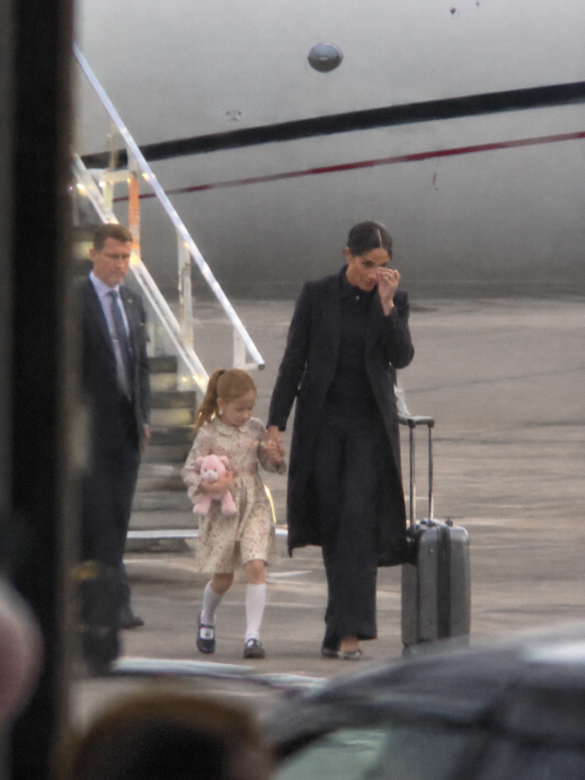
🔥 IT’S OVER: Meghan and her daughter were confirmed as… 👇
For years, the fractured relationship between the British Royal Family and the Duke and Duchess of Sussex has played out like a modern Shakespearean tragedy, punctuated by televised interviews, tell-all memoirs, and icy public reunions. Yet, beneath the surface of formal statements and carefully choreographed appearances, a quieter, more definitive separation has been taking place behind palace gates. According to multiple sources close to the royal household, the final bridge connecting Meghan Markle and her young daughter, Princess Lilibet, to the family’s most sacred private traditions has quietly collapsed.
While the headlines often focus on grand state occasions—coronations, jubilees, and national memorials—royal historians and insiders have long maintained that the true barometer of belonging within the House of Windsor is not found on the balcony of Buckingham Palace. Instead, it is measured by an invitation to the family’s secluded summer gatherings in the Scottish Highlands. For decades, Balmoral Castle and its surrounding estates have served as the ultimate sanctuary where the royals drop their public personas, share unguarded moments, and pass down unspoken traditions from one generation to the next.
Now, as preparations begin for the upcoming seasonal gatherings, palace insiders suggest that the door to this inner sanctum has been firmly shut. Meghan and Lilibet are reportedly no longer part of the informal guest lists, extended family itineraries, or private nursery arrangements that have historically united the Windsor cousins. For observers watching the slow-motion estrangement from afar, this development signals something far more permanent than a temporary cooling-off period: it marks the end of an era where reconciliation seemed merely a matter of time.
The Unspoken Currency of Royal Intimacy
To understand the weight of this exclusion, one must first understand how the British Royal Family operates when the cameras are turned off. In the public eye, royal protocol is rigid, dictated by centuries of precedence and constitutional duty. Behind closed doors, however, the family relies on an intricate network of informal trust. Loyalty is paramount, and discretion is the currency that buys access.
Since stepping back from senior royal duties in 2020 and relocating to Montecito, California, Prince Harry and Meghan have built an independent media and philanthropic empire. However, the very tools that fueled their commercial success—candid storytelling, behind-the-scenes revelations, and public critiques of institutional life—proved incompatible with the Windsor code of silence.
“The issue has never simply been about a single interview or a specific passage in a book,” explains one veteran courtier who served the household for over two decades. “It is about the erosion of psychological safety. When members of the family gather privately, they need to know that an offhand remark over breakfast or a minor disagreement during a walk on the moors will not reappear two years later in a documentary script or a syndicated column. Once that trust is broken, the mechanism to repair it simply doesn’t exist.”
Consequently, senior members of the family have reportedly adopted a policy of polite, formal distance. While channels of communication remain technically open for major life events or constitutional necessities, the warm, spontaneous inclusion that defines genuine family life has evaporated. For Meghan, who spent less than two years as a working royal before departing the United Kingdom, the ties to these private traditions were already tenuous. Without the daily reinforcement of shared family life, those threads have now frayed completely.
A Growing Generational Divide
Perhaps the most poignant aspect of this estrangement involves the youngest generation of royals. Princess Lilibet, born in Santa Barbara in June 2021, has spent almost her entire life across the Atlantic. Aside from a brief, low-key visit to the UK during the late Queen Elizabeth II’s Platinum Jubilee in 2022—where she famously met her great-grandmother for the first and only time—Lilibet has had virtually no physical proximity to her British relatives.
In contrast, the children of the Prince and Princess of Wales—Prince George, Princess Charlotte, and Prince Louis—are being raised at the very heart of the institution. Their summers are spent learning the rhythms of royal life alongside their cousins, the children of Zara Tindall and Peter Phillips, forming a tight-knit cohort that mirrors the bond once shared by Prince William and Prince Harry in their youth.
Royal commentators note that childhood bonds are rarely forged through occasional video calls or holiday cards; they are built through shared experiences, messy playdates, and summer holidays spent running through the same corridors. By not being present in the UK, and with no plans on the horizon for extended family stays, Lilibet is growing up in a completely different cultural and emotional universe from her cousins.
“It is a quiet tragedy of circumstance and choice,” says a London-based royal biographer. “You cannot pause childhood. Every summer that passes without Lilibet and her brother Archie spending time in Britain widens the gap. At this point, the Wales children and the Sussex children are essentially strangers who happen to share a surname and a grandfather. The family has effectively stopped trying to force a connection that geography and resentment have made impossible.”
The King’s Delicate Balancing Act
At the center of this complex family dynamic stands King Charles III. Since ascending the throne, the monarch has faced the unenviable task of balancing his role as Head of State with his instincts as a father and grandfather. Insiders frequently describe the King as deeply saddened by the distance between himself and his California-based grandchildren, whom he has barely had the opportunity to hold, let alone get to know.
Yet, as sovereign, Charles’s primary duty is to the stability and unity of the monarchy. Following health challenges within the royal household over the past two years, the King’s inner circle has become fiercely protective of his time, energy, and peace of mind. Senior aides, alongside Queen Camilla and Prince William, are said to be unified in their belief that the King cannot afford the emotional turmoil and media circus that inevitably accompany any interaction with the Sussexes.
“There is a profound sense of fatigue at the palace,” notes a source familiar with the King’s schedule. “Every time there is even a whisper of a reconciliation or a potential visit, it completely hijacks the news cycle, overshadowing the King’s charitable work and state duties. The consensus among the senior royals is that the drama must be contained. Protecting the King’s health and the tranquility of the family’s private retreats takes absolute precedence.”
This protective perimeter means that spontaneous visits are out of the question, and formal invitations to private family estates are no longer extended. While King Charles may still harbor personal hopes for a private rapprochement with his younger son someday, the institutional reality is clear: Meghan and Lilibet are no longer factored into the royal family’s domestic life.
Two Worlds, Two Narratives
Across the ocean in Montecito, the Sussexes have worked diligently to craft an alternative narrative—one centered on autonomy, modern philanthropy, and a sun-drenched California lifestyle far removed from the rigid hierarchies of the British aristocracy. Through various lifestyle ventures, production deals, and carefully curated public appearances, Meghan has projected an image of a woman who has moved on, unburdened by the expectations of an institution she felt failed to protect her.
Supporters of the Duchess argue that the exclusion from royal retreats is hardly a punishment, but rather the natural conclusion of a mutual parting of ways. From their perspective, Meghan and Harry chose freedom and mental well-being over a gilded cage, and raising their children away from the relentless scrutiny of the British tabloid press was an act of parental protection.
“Why would Meghan want to take her daughter into an environment where she feels unwelcome and unsupported?” asks a Los Angeles-based entertainment publicist who follows the couple’s brand strategy. “They have built their own court in California, complete with A-list friends, loyal staff, and complete control over their narrative. The royal family’s summer traditions belong to a chapter they closed years ago.”
However, critics point out a lingering contradiction. Despite claiming to have moved past royal life, the Sussexes continue to utilize their royal titles—including the prince and princess designations for their children—as key identifiers in their public and commercial endeavors. For many observers in Britain, retaining the prestige of the titles while remaining entirely detached from the family and the country they represent feels increasingly hollow.
The Finality of the Rift
In the history of the British monarchy, family feuds are nothing new. From the abdication crisis of 1936 to the turbulent divorces of the 1990s, the House of Windsor has weathered numerous internal storms. Usually, time, shared grief, or the unifying power of major royal milestones eventually softens the sharpest edges of conflict.
Yet, the current divide feels fundamentally different. It is not merely a dispute over money, property, or romantic choices; it is a clash of worldviews amplified by modern media economics. One side operates on the ancient principles of duty, hierarchy, and silence; the other thrives on personal expression, transparency, and commercial brand-building.
As the seasons turn and the royal family prepares to retreat behind the stone walls of their Scottish estates once again, the absence of Meghan and Lilibet will no longer spark frantic speculation or last-minute diplomatic maneuvering. Instead, it will simply be accepted as the new normal. The invitations aren’t lost in the mail, and the schedules aren’t merely clashing. The chapter has closed, the guest list has been finalized, and the House of Windsor has quietly moved on.