🚨 STEPHEN GRAHAM FANS ARE REDISCOVERING THIS VICIOUS FIVE-PART THRILLER — AND HIS PERFORMANCE IS NOTHING SHORT OF EXTRAORDINARY.
FORGET THE PRETTY PERIOD DRAMAS — STEPHEN GRAHAM COMMANDS A FLOATING HELL IN THE NORTH WATER, A BRUTAL ARCTIC NIGHTMARE THAT DESERVES TO BE REDISCOVERED
Stephen Graham has played gangsters, policemen, prisoners, chefs and broken fathers — but as the doomed Captain Brownlee in The North Water, he proves once again that few British actors can make silence feel quite so dangerous.
There are television dramas that invite you to settle comfortably into the sofa.
The North Water practically dares you to survive it.
From its grim Victorian streets to the frozen emptiness of the Arctic, Andrew Haigh’s five-part adaptation of Ian McGuire’s acclaimed novel is a merciless journey into greed, violence, addiction and the frightening things men become when civilisation disappears over the horizon.
There is blood.
There is ice.
There are secrets below deck.
And at the centre of the doomed whaling ship Volunteer stands one of Britain’s most reliably compelling actors: Stephen Graham.
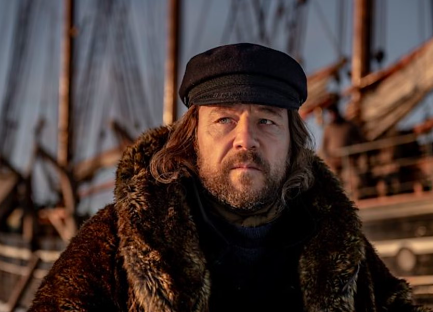
Graham plays Captain Arthur Brownlee, the weathered master of the vessel carrying a crew of increasingly dangerous men towards the Arctic.
And while Colin Farrell’s monstrous harpooner Henry Drax understandably attracts attention — Farrell transformed himself physically into an almost unrecognisable brute — it is Graham who gives the ship its battered, uneasy authority.
He doesn’t need theatrical speeches.
He doesn’t need to dominate every frame.
Sometimes all Graham needs is a pipe, a stare and a few seconds of silence.
You immediately understand that Captain Brownlee is a man carrying far more than the responsibility of navigating through ice.
And the further the Volunteer sails from Britain, the heavier that burden becomes.

STEPHEN GRAHAM WAS MADE FOR THIS WORLD
There is something about Graham’s face that period dramas often use brilliantly.
It looks lived in.
He can communicate exhaustion, suspicion, anger and regret before he has said a single word.
As Brownlee, wrapped in heavy clothing against the Arctic cold, Graham looks as though the sea has been punishing him for decades.
This is not the polished captain of an adventure novel.
There is no glamorous naval uniform, heroic posture or inspirational speech about courage.
Brownlee is a working captain on a commercial whaler.
His ship exists to make money.
His men exist to perform brutal labour.
And the voyage is already poisoned before they have truly begun.
The Volunteer is ostensibly sailing north to hunt whales and seals in 1859, when the industry is entering decline. But its owner, Baxter, played with sinister restraint by Tom Courtenay, has another financial calculation in mind.
The ship is worth something.
Its destruction could be worth more.
Brownlee knows far more about that arrangement than the ordinary sailors aboard his vessel.
That secret immediately changes the way we watch Graham.
Every order carries another meaning.
Every crisis creates another calculation.
Every mile north brings the captain closer to the consequences of decisions made safely back on land.
Graham never plays Brownlee like a cartoon villain.
That is crucial.
He plays him as something far more interesting: a compromised man.

A SHIP FULL OF MEN YOU WOULDN’T WANT TO MEET IN A DARK ALLEY
Of course, Brownlee’s questionable choices are only one of the Volunteer’s problems.
The ship also happens to contain Henry Drax.
Colin Farrell is almost startlingly transformed as the harpooner, abandoning the polished charisma audiences associate with him for something heavy, filthy and frightening.
Drax is violence given human form.
He does not spend much time agonising over morality.
He takes what he wants.
He hurts people when it suits him.
And he appears almost perfectly adapted to a world where physical strength can become its own form of authority.
Opposite him is Patrick Sumner, played by Jack O’Connell.
Sumner is a former army surgeon carrying the psychological wreckage of his experiences in India.
He also carries laudanum.
Quite a lot of it.
He joins the Volunteer hoping, perhaps, that geographical distance might provide escape from the memories following him.
Anyone familiar with dark television drama will immediately understand the problem with that plan.
People rarely escape themselves simply by getting on a ship.
And this particular ship is sailing directly into hell.
O’Connell gives Sumner a nervous intelligence that contrasts beautifully with Farrell’s animal brutality.
But above both men stands Brownlee.
At least officially.
Captain Brownlee is supposed to represent order.
Stephen Graham makes us wonder how long that order can possibly survive.

THE MOST DANGEROUS MAN DOESN’T HAVE TO BE THE LOUDEST
Farrell’s Drax is designed to terrify you immediately.
Graham’s Brownlee is more complicated.
Watch his face whenever events begin slipping beyond his control.
There is calculation there.
There is frustration.
Sometimes there is fear.
Most importantly, there is the exhaustion of a man who understands that being captain does not necessarily mean possessing real control.
That distinction gives Graham some of the series’ most interesting moments.
The Volunteer might technically belong to Brownlee while at sea, but authority aboard such a vessel is fragile.
A captain depends on men obeying him.
He depends on weather cooperating.
He depends on ice permitting passage.
He depends on equipment functioning.
And, above all, he depends on the violent men below deck deciding that his authority remains useful.
Once those assumptions begin collapsing, the title “Captain” starts sounding much less powerful.
Graham is superb at communicating that erosion.
His Brownlee begins as a man carrying authority almost physically.
But the Arctic doesn’t care about rank.
Neither does Drax.
THIS IS NOT THE ARCTIC OF CHRISTMAS CARDS
Visually, The North Water is extraordinary.
The production travelled into Arctic conditions rather than attempting to manufacture its entire frozen world inside a comfortable studio.
That decision matters.
The landscape doesn’t feel decorative.
It feels hostile.
The ice appears endless.
The water is black.
The men look tiny.
And suddenly the human dramas that seemed enormous inside the ship become almost laughably insignificant against the scale of the landscape surrounding them.
Graham himself described the experience of being there as something close to a spiritual journey, recalling the extraordinary sight of the cast playing football on pack ice. The production pushed cast and crew into genuinely demanding Arctic conditions, helping give the finished drama its unusually physical quality.
You can almost feel the cold through the screen.
That physical reality benefits Graham enormously.
Brownlee looks cold because Stephen Graham was working somewhere genuinely cold.
The wind does not behave like a special effect.
The sea doesn’t resemble a studio tank.
The ship looks vulnerable because, against that landscape, it is.
And Brownlee looks increasingly like a captain commanding a tiny wooden object at the edge of the world.
THEN EVERYTHING STARTS GOING WRONG
A doomed expedition is only interesting if the audience believes there was once some possibility of survival.
The North Water understands this.
The deterioration happens gradually.
There are tensions between the men.
There are hidden motives.
There is violence.
There are suspicions.
And then the voyage begins tightening around them.
The Volunteer stops feeling like transportation and starts feeling like confinement.
Men who might normally avoid one another cannot.
Secrets have nowhere to go.
Neither does fear.
This is where Andrew Haigh’s direction becomes particularly effective.
Haigh was previously associated with intimate character dramas including Weekend and 45 Years, making him an intriguing choice for a blood-soaked Victorian Arctic adventure.
But The North Water is more intimate than its epic landscapes initially suggest.
Strip away the whales, ice and nineteenth-century costumes and much of the drama is about men trapped together while their social restraints disappear.
Who are they when nobody is watching?
What happens when the law is thousands of miles away?
What does morality mean when survival becomes the only immediate objective?
Brownlee sits directly inside those questions.
Because he is supposed to be the law.
And he knows the entire voyage began with corruption.
GRAHAM MAKES BROWNLEE’S CORRUPTION FEEL HUMAN
A lesser performance might have turned Brownlee into an obvious schemer.
Graham doesn’t.
His captain feels like a man who has made decisions one compromise at a time.
That is much more unsettling.
Most people don’t wake up and decide to become villains.
They rationalise.
They accept one thing.
Then another.
Then they discover they are standing somewhere they never imagined reaching.
Brownlee belongs to that tradition.
His involvement with Baxter’s scheme means his authority is morally compromised from the beginning.
Yet Graham allows us to see something beyond greed.
There is weariness.
There is practicality.
There is perhaps even the knowledge that men like Brownlee operate inside an economic system controlled by wealthier men who will never experience the danger themselves.
The shipowner remains safely on land.
Brownlee sails into the Arctic.
The sailors bleed.
That class tension runs beneath the series.
These are not glamorous explorers searching for some heroic passage through the ice.
They are working men operating what is effectively a floating industrial machine.
They kill animals because somebody makes money from oil and blubber.
They risk death because somebody makes money from the voyage.
And when the economics stop working, someone finds another way to profit.
The insurance scheme is not separate from the brutality of the whaling industry.
It is an extension of it.
Human beings and animals become resources.
Graham’s Brownlee sits uncomfortably between the men being exploited and the businessman doing the exploiting.
COLIN FARRELL MAY BE THE MONSTER — BUT GRAHAM IS THE TRAGEDY
Farrell gives the series its most immediately shocking performance.
His Drax is enormous, dirty and almost proudly amoral.
There is something frighteningly uncomplicated about him.
Drax wants.
Drax takes.
Drax survives.
Graham’s Brownlee is more tragic because he understands consequences.
He knows what rules are.
He knows what responsibility means.
And he compromises both.
That creates a fascinating contrast between the two characters.
Drax behaves as if morality doesn’t exist.
Brownlee behaves as though morality exists but can occasionally be negotiated.
Which is more dangerous?
The North Water wisely refuses to give easy answers.
Jack O’Connell’s Sumner provides another point in the triangle.
He wants to believe civilisation means something, even while carrying evidence of its violence inside himself.
His memories of military service haunt him.
His addiction compromises him.
His attempts to maintain decency are repeatedly tested.
Put Sumner, Drax and Brownlee aboard the same vessel and the Volunteer becomes something more than a ship.
It becomes an experiment.
Remove comfort.
Remove law.
Remove witnesses.
Add hunger, cold, money and fear.
Then see what remains.
STEPHEN GRAHAM NEVER NEEDS TO SHOW OFF
This may be the greatest compliment one can pay Graham.
He never appears to be waiting for his “Stephen Graham moment.”
There is no sense of an actor counting down until the script gives him the giant emotional speech designed for awards clips.
He serves the character.
Brownlee watches.
Brownlee calculates.
Brownlee speaks when necessary.
And because Graham keeps so much contained, small changes become significant.
A shift in his eyes.
A tightening jaw.
A pause before answering.
These are tiny choices, but Graham has built a career out of making tiny choices feel enormous.
Anyone who has watched This Is England, Line of Duty, Time or Boiling Point already knows how devastating he can be when a character reaches emotional breaking point.
But The North Water demonstrates another side of his talent.
Restraint.
Captain Brownlee isn’t constantly exploding.
He is imploding.
And Graham makes that far more compelling.
THE SERIES IS BEAUTIFUL — AND ABSOLUTELY FILTHY
Period television sometimes cleans history until everybody looks suspiciously ready for a luxury fragrance advertisement.
Not here.
These men sweat.
They stink.
They bleed.
Their clothes look lived in.
The ship feels cramped and grimy.
The hunting sequences refuse to romanticise the work.
That physical ugliness is essential because the series is ultimately concerned with the thinness of civilisation.
Victorian Britain liked to imagine itself sophisticated.
But on the Volunteer, sophistication becomes difficult to maintain.
Men kill animals with astonishing brutality.
They exploit one another.
Violence lurks beneath ordinary conversations.
Money determines which risks are acceptable — particularly when wealthy people are not the ones taking those risks.
Graham fits this environment perfectly because nothing about his performance feels polished for modern audiences.
Brownlee belongs aboard that ship.
You believe he has stood on those decks before.
You believe he knows the sound of dangerous ice.
You believe sailors might obey him.
And you believe he has made choices he would rather not explain.
IT ISN’T EASY VIEWING — AND THAT’S THE POINT
Anyone approaching The North Water expecting a cosy historical adventure should reconsider.
This is bleak television.
There is graphic violence.
There is animal slaughter.
There are deeply disturbing crimes.
There is addiction.
There is death.
And there is very little sentimental reassurance that decency will automatically triumph simply because viewers would prefer it to.
But the brutality rarely feels included merely for shock.
The series is asking what happens when men enter an environment where survival and profit become more powerful than social morality.
The Arctic simply removes the excuses.
Back in Britain, exploitation can hide behind businesses, contracts and respectable clothing.
On the ice, everything becomes brutally visible.
Who has power?
Who doesn’t?
Who eats?
Who freezes?
Who survives?
Captain Brownlee begins the voyage believing he understands those calculations.
Then the North Water changes the equation.
WHY STEPHEN GRAHAM DESERVES ANOTHER LOOK
It would be easy for Graham to disappear inside a cast this strong.
Colin Farrell undergoes the most spectacular physical transformation.
Jack O’Connell carries much of the narrative as Sumner.
Tom Courtenay makes Baxter’s cold financial calculation memorable.
Yet Graham’s Brownlee remains one of the production’s essential ingredients.
He gives the Volunteer its authority before helping us understand how fragile authority really is.
He embodies the uneasy boundary between worker and boss, victim and accomplice, commander and doomed participant.
And he does it without demanding our attention.
He earns it.
That may be Graham’s greatest quality as an actor.
He makes ordinary-looking men impossible to ignore.
Brownlee isn’t a superhero.
He isn’t a genius detective.
He isn’t the biggest monster aboard the ship.
He’s simply a captain who made a bargain and then sailed far enough north to discover its true price.
In Graham’s hands, that is more than enough.
A FROZEN NIGHTMARE WORTH REDISCOVERING
The North Water originally arrived as a five-part drama in 2021, adapted and directed by Andrew Haigh from Ian McGuire’s Booker-longlisted novel. Contemporary reviews highlighted its blood-soaked adventure, imposing Arctic landscapes and formidable cast.
Years later, it still feels unusually physical.
You don’t simply watch the Volunteer move through the Arctic.
You feel trapped aboard it.
You can practically smell the wood, sweat and wet clothing.
You feel the cold tightening around the men.
And through it all stands Stephen Graham, pipe in hand, face weathered by fear and responsibility, desperately trying to remain captain of a ship whose fate may have been decided before it ever left Hull.
Colin Farrell may give The North Water its monster.
Jack O’Connell may give it its wounded conscience.
But Stephen Graham gives it something equally important:
A captain slowly discovering that command and control are not the same thing.
And once the ice closes in, that difference becomes terrifying.
For viewers who know Graham primarily from Boiling Point, Adolescence, Time or This Is England, The North Water is another reminder of the extraordinary range hiding behind one of British television’s most recognisable faces.
He doesn’t dominate the series by shouting louder than everyone else.
He dominates by making you watch him even when he says nothing.
And aboard a ship packed with killers, addicts, thieves, secrets and men heading towards disaster, Stephen Graham’s silence can somehow feel like the most ominous sound of all.