🚨 Streaming now: Robert De Niro at his most terrifyingly cold and calculated.
The Banality of Evil: Robert De Niro’s Masterclass in Menace and Moral Decay in Killers of the Flower Moon
Martin Scorsese’s Killers of the Flower Moon (2023) is a monumental achievement in American cinema, a film that peels back the mythos of westward expansion to expose the rot beneath. Adapted from David Grann’s non-fiction bestseller, the film investigates the systematic murders of wealthy Osage Nation members in 1920s Oklahoma. While Leonardo DiCaprio anchors the film’s moral vacuity through his portrayal of the weak-willed Ernest Burkhart, the narrative’s gravitational pull is dictated entirely by Robert De Niro. As William Hale—a self-appointed “King” of the county whose genial facade masks a sociopathic architect of mass murder—De Niro delivers one of the most chilling performances of his storied career. This review explores how Scorsese and De Niro weaponize cinematic history, rewriting the traditional gangster blueprint to examine the banality of white-supremacist greed.
The Architecture of Corruption: Establishing the “King”
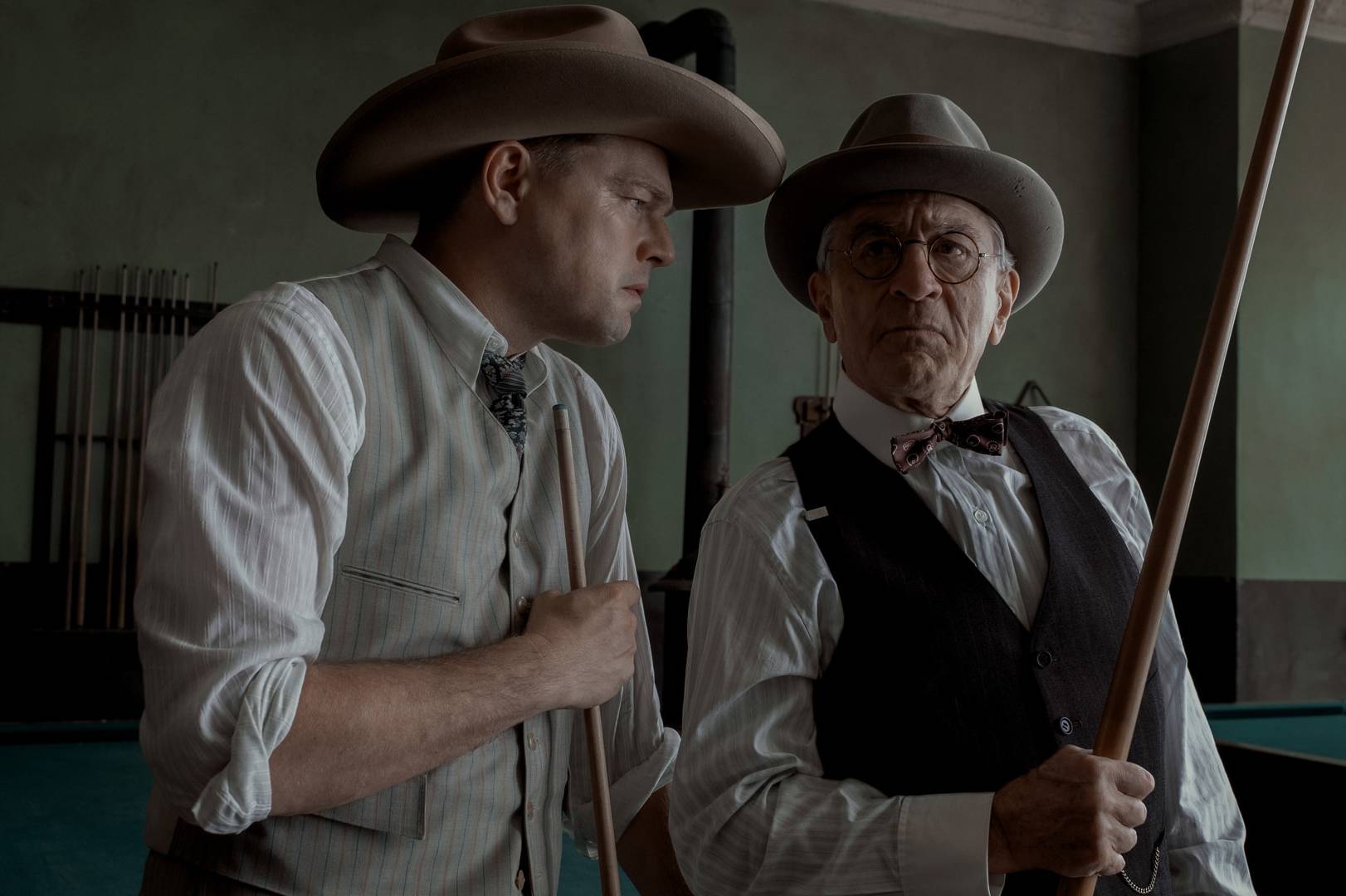
To understand De Niro’s performance, one must first recognize the chilling framework Scorsese builds around him. William Hale is not a cloistered villain hiding in the shadows; he is a pillar of the community. In the opening acts of the film, Hale presents himself as an enlightened patriarch, a man who speaks the Osage language, invests in their cultural ceremonies, and poses as their dearest friend and protector.
De Niro plays this duplicity with masterclass subtlety. There is no mustache-twirling villainy in his initial appearance. Instead, he exudes a grandfatherly warmth, a slow-spoken charm that disarms both the Osage people and the audience. When he welcomes Ernest back from World War I, his voice is a soft rumble of encouragement, laced with strategic suggestions about marrying into Osage wealth. De Niro understands that the most dangerous men are those who weaponize benevolence. Hale has calculated that the fastest way to inherit oil headrights is not through armed robbery, but through legal, calculated, and systematic assimilation—or, more accurately, absorption by execution.
The Banality of Evil in the Oklahoma Dust
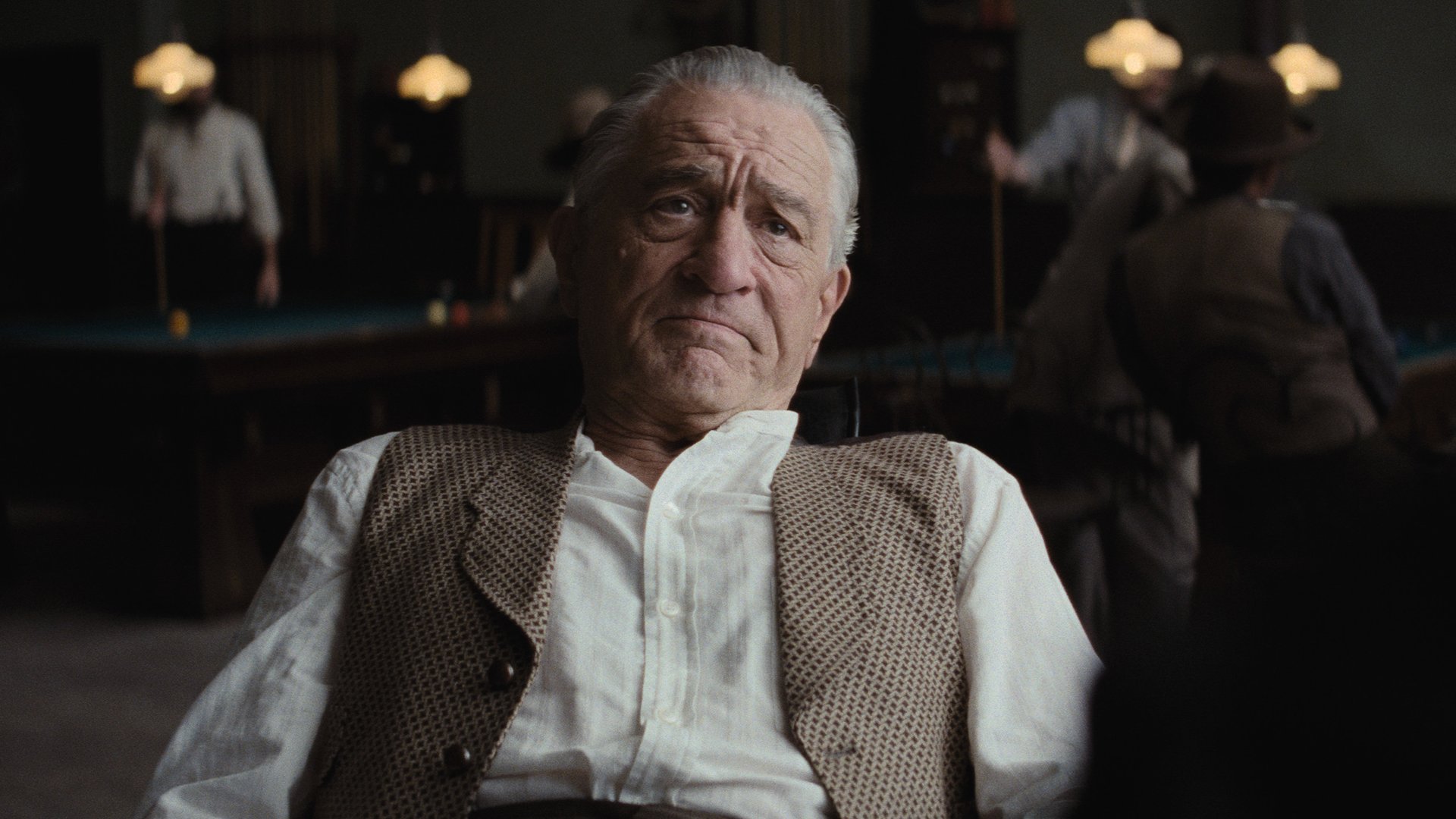
What makes De Niro’s portrayal of Hale so profoundly disturbing is his chilling normalization of evil. Hannah Arendt coined the term “the banality of evil” to describe Adolf Eichmann, a man who committed horrific atrocities not out of demonic zeal, but out of bureaucratic routine and career ambition. De Niro applies this exact psychological framework to William Hale.
Hale orders the execution of entire families—shooting, bombing, and poisoning men, women, and children—with the exact same detached composure one might use to manage a cattle ranch. In one of the film’s most unsettling scenes, Hale discusses the murder of a grieving mother while casually eating a piece of pie, his tone conversational and devoid of malice. There is no emotional outburst, no sadistic cackling, and no internal conflict. De Niro strips away the cinematic romance typically afforded to movie gangsters. Hale views the Osage people not as human beings with rich cultural lives, but as temporary obstacles standing between him and subsurface mineral rights.
This emotional flatness is terrifying. De Niro’s eyes remain cool and calculating behind his wire-rimmed glasses. He does not need to raise his voice to command absolute terror; a quiet directive, a measured pause, or a slight narrowing of the eyes is enough to send local hitmen scrambling to execute his bloody commands.
The Deconstruction of the De Niro Gangster Persona
For film audiences, watching De Niro play William Hale carries a profound meta-textual weight. For decades, De Niro defined the American gangster archetype. From young Vito Corleone in The Godfather Part II to Jimmy Conway in Goodfellas and Frank Sheeran in The Irishman, De Niro has specialized in men of honor among thieves, individuals bound by codes of loyalty, respect, and street justice.
In Killers of the Flower Moon, Scorsese and De Niro systematically dismantle that legacy. William Hale claims to operate under a code of chivalry and southern gentility, but it is an entirely hollow construct. Unlike the mobsters of Scorsese’s past who shared a twisted sense of camaraderie, Hale treats everyone—including his own nephew, Ernest—as disposable pawns. He manipulates Ernest’s genuine, albeit deeply flawed, affection for his Osage wife, Mollie (played with devastating grace by Lily Gladstone), weaponizing family ties to facilitate poisoning and betrayal.
De Niro exposes the pathetic, bureaucratic nature of American greed. Hale is not a grand criminal mastermind driven by dark passion; he is a petty, small-minded opportunist who happened to find a loophole in a racist legal system that allowed him to murder with impunity. By subverting the audience’s historical affection for De Niro’s screen persona, Scorsese forces us to confront the reality that historical atrocities are rarely committed by cartoon monsters—they are committed by well-dressed neighbors who smile in your face while picking your pocket and plotting your funeral.
The Dynamic with Leonardo DiCaprio: Power and Subservience
The psychological core of the film rests on the toxic dynamic between Hale and Ernest Burkhart. DiCaprio’s Ernest is a man defined by competing impulses: he genuinely loves his wife Mollie, yet he is utterly weak-willed, intellectually hollow, and desperately covetous of wealth.
De Niro’s Hale acts as an absolute psychological puppeteer over Ernest. Their interactions form a masterclass in manipulation. Hale doesn’t command Ernest to commit crimes; he nudges him, plants seeds of racial superiority, strokes his ego, and frames murder as a civic duty to keep white wealth within the family. When Ernest shows flashes of human conscience or anxiety, De Niro’s Hale deploys a chilling mix of paternal disappointment and veiled threats.
The psychological subjugation is complete. De Niro plays Hale not just as an uncle, but as a cult leader whose congregation consists of greedy, morally bankrupt white men willing to terrorize a sovereign nation for a slice of oil money. The tragedy of Ernest is that he is too cowardly to be a true monster, yet too weak to escape the gravitational pull of Hale’s absolute malice.
Cinematic Craft: Framing the Monster
Director Martin Scorsese, working alongside legendary cinematographer Rodrigo Prieto, frames De Niro’s performance with striking visual discipline. The Oklahoma landscape, vast and sun-baked, serves as a silent witness to the carnage. Yet, within this open frontier, Hale operates in tight, claustrophobic interiors—courtrooms, Masonic lodges, and ranch houses where conspiracies are whispered over dry whiskey.
De Niro’s physical posture reflects his character’s calculated control. He stands tall, moves with measured deliberation, and dresses in pristine, light-colored suits that contrast sharply with the dark, dusty misery of the crimes he orchestrates. When the federal investigators (led by Jesse Plemons as Tom White) finally close in, Hale’s veneer of absolute confidence does not shatter in a dramatic explosion of panic. Instead, he pivots seamlessly into legal defense, showcasing the horrifying resilience of institutional white supremacy.
Historical Resonance and the Epilogue
Killers of the Flower Moon is more than a historical period piece; it is an urgent reckoning with systemic erasure. For decades, the Reign of Terror against the Osage Nation was treated as a footnote in American history textbooks, often framed merely as the backdrop for the birth of the FBI. Scorsese and his screenwriters pivot the perspective, placing the Osage people at the absolute center of the narrative, ensuring their grief, resilience, and cultural survival are honored.
De Niro’s performance serves as the anchor for this historical indictment. By portraying William Hale with such chilling, unrepentant banality, De Niro ensures that the film refuses to offer comfortable catharsis. The horror of the Reign of Terror wasn’t just that people died; it was that the entire white power structure—from local law enforcement and doctors to undertakers and judges—was complicit in the enterprise.
In the film’s powerful framing device—a 1930s radio broadcast reenactment that transitions into the present day—Scorsese reminds us of how history is packaged for entertainment, often sanitizing the brutal realities of racial violence. De Niro’s performance cuts right through that sanitization. He presents a man who believed he was above the law, above morality, and above human empathy.
Conclusion
Robert De Niro’s performance in Killers of the Flower Moon is a towering achievement in a career already defined by greatness. By stripping away the cinematic romanticism of the gangster genre, De Niro exposes the cold, calculated, and horrifyingly ordinary face of historical malice. William Hale stands as one of cinema’s most terrifying villains precisely because he feels so achingly real—a reminder that the most devastating atrocities are often committed not by fire-breathing monsters, but by smiling men in crisp suits who value oil and power above human life. Supported by Scorsese’s visionary direction, DiCaprio’s tragic weakness, and Gladstone’s monumental emotional core, De Niro anchors a cinematic masterpiece that will continue to haunt audiences, provoke discussion, and redefine American historical cinema for generations to come.