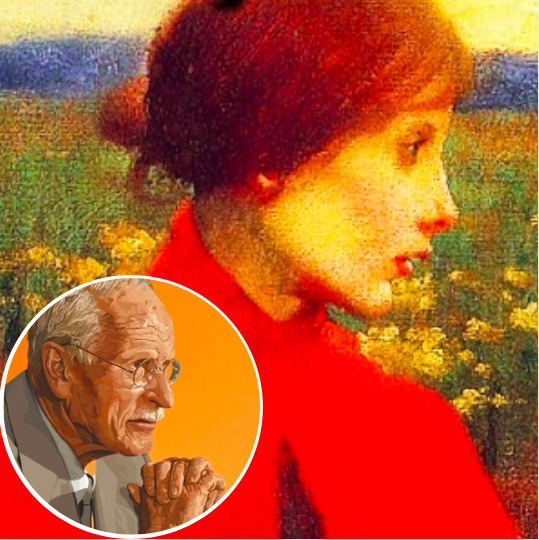
🔥 The Thing We Run From: Carl Jung and the Modern Fear of Facing Ourselves
In an age of constant motion, endless noise, and infinite stimulation, one quiet question continues to haunt modern humanity: Why do so many people feel lost, anxious, and empty despite unprecedented comfort and convenience? We scroll endlessly, consume relentlessly, chase achievement and validation, yet still experience a deep sense of disconnection — from others, from meaning, and most disturbingly, from ourselves.
Swiss psychiatrist Carl Gustav Jung believed he had uncovered the unsettling answer nearly a century ago. His conclusion was not comforting, nor was it easy to accept. Jung argued that modern suffering is not primarily caused by external circumstances, trauma, or lack of opportunity — but by a profound and systematic avoidance of self-reflection. We are not lost because life has no meaning. We are lost because we refuse to look where meaning actually resides.
And where it resides is precisely where we least want to go.
Carl Jung and the Fear of the Inner World
Carl Jung, the founder of analytical psychology, spent his life exploring the hidden structures of the human psyche. Unlike many of his contemporaries, Jung did not see the mind merely as a machine shaped by instincts or conditioning. He believed the psyche was alive, symbolic, and purposeful, containing within it a guiding intelligence he called the Self.
Through decades of clinical work, Jung noticed a disturbing pattern. When patients were confronted with silence, introspection, or the need to examine their inner lives, many reacted with intense resistance. Instead of turning inward, they distracted themselves. They created chaos. They sabotaged relationships. They immersed themselves in work, pleasure, ideology, or fantasy. Some even generated crises rather than sit alone with their thoughts.
Jung famously observed that people will do almost anything, no matter how absurd or destructive, to avoid facing their own souls.
This avoidance was not laziness or ignorance. It was fear.
Why Self-Reflection Feels So Dangerous
To understand why people run from introspection, Jung introduced one of his most influential concepts: the Shadow.
The Shadow represents the parts of ourselves we deny, repress, or refuse to acknowledge. These aspects may include anger, envy, fear, shame, selfishness, weakness, or unfulfilled desires — but also unrealized strengths, creativity, and power. The Shadow forms because society rewards certain traits and punishes others. To survive and belong, we learn to hide what is unacceptable.
Over time, this hiding becomes habitual. Eventually, we forget that the Shadow is ours at all.
But repression comes at a cost. Jung warned that what we refuse to face within ourselves does not disappear. Instead, it is projected outward — onto other people, groups, or circumstances. We see evil, stupidity, corruption, or threat everywhere except where it truly originates.
This explains why individuals and societies so often repeat destructive patterns. We blame others for the very traits we refuse to recognize in ourselves. We fight external enemies while remaining blind to our internal conflicts.
Facing the Shadow feels dangerous because it threatens our carefully constructed self-image. It forces us to confront uncomfortable truths about who we are — not who we pretend to be.
The Illusion of Escape
Modern life, perhaps more than any era before it, offers unlimited opportunities for escape.
We can scroll for hours without thinking. We can binge-watch entire lives instead of living our own. We can drown discomfort in productivity, pleasure, outrage, or constant connection. Algorithms are designed not to enlighten us, but to keep us distracted — endlessly stimulated yet inwardly empty.
Jung could not have predicted smartphones or social media, but he predicted the psychological consequences perfectly. He warned that when external stimulation replaces inner reflection, the individual becomes fragmented, anxious, and disconnected from meaning.
We tell ourselves we are busy, not avoiding. But the result is the same.
The irony, Jung argued, is devastating: the more we run from ourselves, the more trapped we become.
The Loss of Meaning in Modern Life
One of Jung’s most profound insights was that psychological suffering often stems not from pathology, but from a crisis of meaning.
In Modern Man in Search of a Soul, Jung wrote that modern individuals suffer because they no longer feel their lives are part of a larger story. Religion, myth, and ritual once provided symbolic frameworks that helped people understand suffering, purpose, and transformation. As these structures weakened, nothing meaningful replaced them.
Material success, status, and consumption filled the void — but they could not satisfy the soul.
Jung believed that meaning cannot be manufactured externally. It emerges organically when a person aligns with their inner truth. Without this alignment, even success feels hollow. Pleasure becomes addictive. Achievement feels insufficient. Life becomes a performance rather than an experience.
This is why so many people today feel exhausted without knowing why. They are not tired from doing too much — they are tired from living against themselves.
Individuation: The Path We Avoid
Jung called the process of becoming whole individuation.
Individuation is not self-improvement in the superficial sense. It is not about becoming better, more productive, or more impressive. It is about becoming more real.
This process requires confronting the Shadow, integrating rejected parts of the psyche, and accepting the paradoxes within oneself. It is painful because it dismantles illusions. It demands responsibility, honesty, and courage. But Jung believed it was the only path to genuine psychological health.
Importantly, individuation is not selfish. A person who has not faced themselves, Jung argued, unconsciously burdens others with their unresolved conflicts. They seek validation, control, or rescue from the outside. By contrast, an individuated person contributes to society not through conformity, but through authenticity.
Yet individuation is rare — not because it is inaccessible, but because it is uncomfortable.
Anxiety, Depression, and the Avoided Soul
Jung did not view anxiety and depression merely as disorders to be suppressed. He often interpreted them as signals — messages from the psyche that something essential was being ignored.
When we silence these signals with distraction or medication alone, we may reduce symptoms, but the underlying conflict remains unresolved. The psyche, Jung believed, will always seek balance. If ignored, it speaks louder.
This does not mean suffering should be glorified. But Jung insisted that suffering has meaning when it is listened to rather than avoided.
Modern culture encourages us to eliminate discomfort at all costs. Jung encouraged us to understand it.
The Shadow on a Collective Scale
Jung extended his insights beyond individuals to entire societies. He warned that when a culture refuses self-reflection, it projects its Shadow collectively — creating enemies, scapegoats, and moral panics.
History offers chilling confirmation of this idea. Jung observed how mass movements, ideologies, and authoritarian regimes often arise when individuals surrender inner responsibility in favor of external certainty. The less people know themselves, the more easily they are controlled.
A society that avoids introspection becomes dangerous — not only to others, but to itself.
Why We Resist the Truth
If facing ourselves leads to freedom, why do we resist it so fiercely?
Because freedom is frightening.
To truly know oneself is to abandon comforting narratives. It means accepting that we are not purely good or bad, strong or weak, rational or emotional — but complex, contradictory, and unfinished. It means accepting responsibility for our lives rather than blaming circumstances.
Jung believed most people prefer familiar misery to unfamiliar truth.
The Paradox of Liberation
The greatest paradox Jung revealed is this: the very thing we run from is the thing that can set us free.
The soul we avoid is not our enemy. It is our guide. But it speaks a language of symbols, dreams, emotions, and discomfort — not convenience or certainty.
When we finally turn inward, we do not find immediate peace. We find confusion. Resistance. Pain. But beneath that lies coherence, direction, and meaning.
Jung wrote that no tree can grow to heaven unless its roots reach down to hell.
Conclusion: The Courage to Look Inward
Modern humanity stands at a crossroads. Never before have we been so connected — and so internally divided. Never before have we had so many tools to escape ourselves — and so few reasons to face ourselves.
Carl Jung did not offer easy answers. He offered a challenge.
He asked us to stop running.
To sit in silence.
To listen to what we have been avoiding.
Not because it is pleasant — but because it is necessary.
Perhaps the anxiety, emptiness, and confusion so many feel today are not signs of failure, but invitations. Invitations to reclaim the lost conversation with the soul.
And perhaps, as Jung warned and hoped, the meaning we seek everywhere else has been waiting inside us all along.