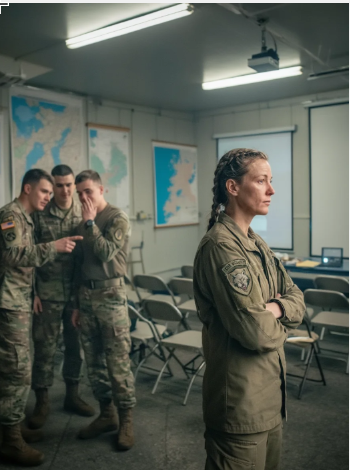
They laughed at her for wearing a patch, assuming it meant nothing and dismissing her entirely. But when she turned around and revealed the tattoo beneath it, the truth shocked everyone and instantly silenced the room.
They laughed at her for wearing a patch, assuming it meant nothing and dismissing her entirely. But when she turned around and revealed the tattoo beneath it, the truth shocked everyone and instantly silenced the room.
They laughed at her for wearing a patch, assuming it meant nothing and dismissing her entirely. But when she turned around and revealed the tattoo beneath it, the truth shocked everyone and instantly silenced the room.
It started, like most misunderstandings do, with something small. Not dramatic, not loud, not even particularly important—at least not to the people who noticed it first. Just a patch. Faded, stitched, and worn thin at the edges, like it had been carried through more years than it should have survived. But sometimes the smallest things carry the heaviest stories, and sometimes people only realize that when it’s far too late to take back what they’ve said.
Mara Ellison arrived at Blackridge Training Facility on a wind-swept morning that smelled faintly of dust and engine oil, the kind of place where routines mattered more than names and people were measured before they were known. She stepped off the transport bus quietly, carrying a single duffel bag slung over her shoulder, her posture straight but unassuming, the kind of posture you don’t notice unless you’ve seen it before in someone who’s been trained to hold themselves together even when everything inside is falling apart. She was thirty-two, though something in her stillness suggested more years lived than that number allowed, and her face—sun-marked, calm, almost withdrawn—gave away very little except for the fact that she preferred not to be the center of anyone’s attention.
Unfortunately, attention found her anyway.
It didn’t take long. In a place like Blackridge, details were currency. People noticed boots, posture, haircuts, accents, and anything that didn’t quite fit the pattern. And what didn’t fit, more often than not, became a target. For Mara, that detail was stitched onto her left sleeve: a weathered patch bearing the unmistakable insignia of the Iron Wolves, a unit so selective and so rarely spoken about that even mentioning its name tended to lower voices in a room. It wasn’t the kind of emblem someone wore casually, and certainly not the kind that belonged on the arm of someone listed, according to official records, as a supply coordinator.
The first comments came in the mess hall, as they often do, where people feel emboldened by numbers and the illusion of anonymity. Three younger soldiers—fresh out of advanced training, still carrying that restless mix of confidence and insecurity—noticed it immediately. One of them nudged the other, then laughed a little too loudly.
“Hey,” he said, pointing with his fork like he’d just spotted something amusing, “you know what that is, right? Or is that just for decoration?”
Mara didn’t look up right away. She took another bite of her food, chewing slowly, as though the question had been directed at someone else entirely. When she finally lifted her gaze, it wasn’t defensive or annoyed. It was calm. Almost detached.
“I know what it is,” she said.
That only made it worse.
“Oh, she knows,” another one chimed in, grinning. “That’s rich. You buy that at a surplus store, or did someone give it to you for Halloween?”
A few people nearby laughed. Not cruelly, not intentionally—but enough. Enough for the moment to settle into something uncomfortable.
“The Iron Wolves don’t recruit people like you,” the first one added, his tone sharpening slightly, like he was trying to prove something not just to her, but to himself. “No offense.”
Mara nodded once, as if acknowledging a fact rather than an insult. “None taken.”
She went back to eating.
That, more than anything, unsettled them. There was no argument, no defensiveness, no attempt to justify or explain. Just silence. And silence, in a place built on hierarchy and validation, has a way of making people uneasy.
The whispers spread faster than anyone intended. They always do. By the end of the day, half the base had formed an opinion without ever speaking to her. Words like fraud, poser, and wannabe floated through conversations, passed along with casual certainty. No one questioned the assumption because it fit too neatly into what they expected to see: a quiet logistics officer wearing something she hadn’t earned.
Eventually, the situation reached someone who couldn’t ignore it.
Sergeant Cole Redding had been in logistics long enough to know that small problems, if left alone, had a way of becoming large ones. He called Mara into his office the following morning, closing the door behind her with a soft but deliberate click. His desk was neat, his expression neutral, but there was an edge to his posture that suggested he had already made up his mind.
“Ellison,” he said, folding his hands together, “I’m going to need you to remove that patch.”
Mara’s eyes flickered briefly—not in surprise, but in acknowledgment. “Understood, Sergeant.”
“You’re not authorized to wear it,” he continued. “I checked your file. Logistics. No special operations record. No attached units. Nothing that justifies it.”
“I understand.”
There was a pause. He studied her for a moment, perhaps expecting resistance, or at least an explanation. But she didn’t offer one. Instead, she reached up slowly, carefully, and unpinned the patch. The way she held it—gently, almost reverently—made something in the room feel heavier than before.
“Where did you get it?” he asked, softer now, curiosity slipping through the cracks of authority.
Mara looked at the patch for a moment before answering. “From someone who asked me to keep it safe.”
“That someone…?”
She met his eyes, and for the first time, there was something there—not anger, not defiance, but something deeper. Something final.
“He’s not here to answer questions.”
Redding didn’t push further. He simply nodded, dismissing her.
But the story didn’t end there. It never does.

That afternoon, in the same mess hall where it had started, the three soldiers were waiting again. Not deliberately, perhaps—but with the kind of expectation that comes from wanting to see the outcome of something you’ve set in motion. When Mara walked in without the patch, they noticed immediately.
“Well, look at that,” one of them said, leaning back in his chair with a satisfied grin. “Guess someone finally told you to take it off.”
Another laughed. “Good call. You were making people look bad.”
This time, Mara didn’t sit down right away. She placed her tray on the table, her movements steady, unhurried, and then—without raising her voice—she spoke.
“You want to know what it means?” she asked.
Something in her tone cut through the room. Conversations slowed. Heads turned.
She turned her back to them.
At first, no one understood what she was doing. Then, slowly, she reached up and pulled down the collar of her shirt.
What they saw silenced the room completely.
The Iron Wolves emblem was there—but not as a patch. It was inked into her skin, deep and permanent, the lines sharp despite the years. Beneath it were coordinates, etched with precision. And cutting through the center of it all was a scar—jagged, uneven, unmistakable. The kind of scar that doesn’t come from accidents.
It comes from survival.
An older man at the edge of the room—one who hadn’t said a word all day—stood up slowly, his chair scraping against the floor. His face had gone pale.
“Those coordinates…” he said quietly. “That’s Black Ridge Sector. Operation Nightfall. Evac point three.”
Mara pulled her collar back into place.
“I was there,” she said.
The silence that followed wasn’t awkward. It was heavy. Respectful. Unavoidable.
“There were six of us,” she continued, her voice steady, though softer now. “We were supposed to extract two civilians. It didn’t go as planned. We walked into something we weren’t briefed on.”
No one interrupted.
“The explosion took out the building before we could get clear. I was closest to the exit. I got out. The others…” She paused, just briefly. “I went back in. Twice.”
The room held its breath.
“I carried out who I could. Called for support that never came. By the time backup arrived, it was already over.”
One of the soldiers who had mocked her earlier swallowed hard. “The patch…”
“Belonged to Staff Sergeant Adrian Velez,” she said. “He gave it to me before we went in. Told me if anything happened, I was to make sure it didn’t get forgotten.”
No one laughed this time.
That evening, Lieutenant Colonel Harris Monroe sat in his office, staring at a file that had been marked restricted. It hadn’t been easy to access, and it certainly hadn’t been intended for routine review. But now that it was open, there was no ignoring it.
FILE: ELLISON, MARA
Former Unit: Iron Wolves
Role: Combat Medic / Recon Specialist
Status: Sole surviving operator — Operation Nightfall
Commendations: Multiple (declined)
Requested Reassignment: Logistics
He leaned back in his chair, exhaling slowly.
When Mara stood in front of him later that night, she looked the same as she had that morning—quiet, composed, almost invisible if you didn’t know what to look for.
“You could have chosen anything,” Monroe said. “Why logistics?”
She didn’t hesitate.
“Because people think it’s small,” she replied. “Because they don’t see it. And because if it’s done right, fewer names end up on lists like that.”
Monroe nodded.
The next morning, something had shifted. Not dramatically. Not loudly. But enough. Conversations changed tone. Eyes lingered differently—not with suspicion, but with recognition. Respect, even.
On Mara’s desk, there was a small box.
Inside it was a new patch. Clean. Carefully stitched. Untouched by time.
And beneath it, a note:
You don’t have to wear this. But we wanted you to know—we understand now.
There were signatures. Twelve of them.
She read it once, then folded it back just as carefully as she had the old one.
That night, she sat alone in her quarters, writing three letters. Her handwriting was steady, deliberate. In each one, she told a story—not of loss, but of impact. Of bravery. Of moments that mattered.
When she finished, she sealed them, stood, and walked out into the cool night air.
Above her, the sky stretched wide and quiet.
She looked up for a long moment before speaking, her voice barely more than a whisper.
“I didn’t forget.”
And somehow, that was enough.
Lesson of the Story
We are often too quick to judge what we don’t understand, especially when appearances seem to contradict expectations. True experience, sacrifice, and courage rarely announce themselves loudly—they live quietly in the people who have carried them the longest. This story reminds us that respect should never be based on assumptions, and that sometimes the people who say the least are the ones who have endured the most. Listening before judging is not just kindness—it is responsibility.