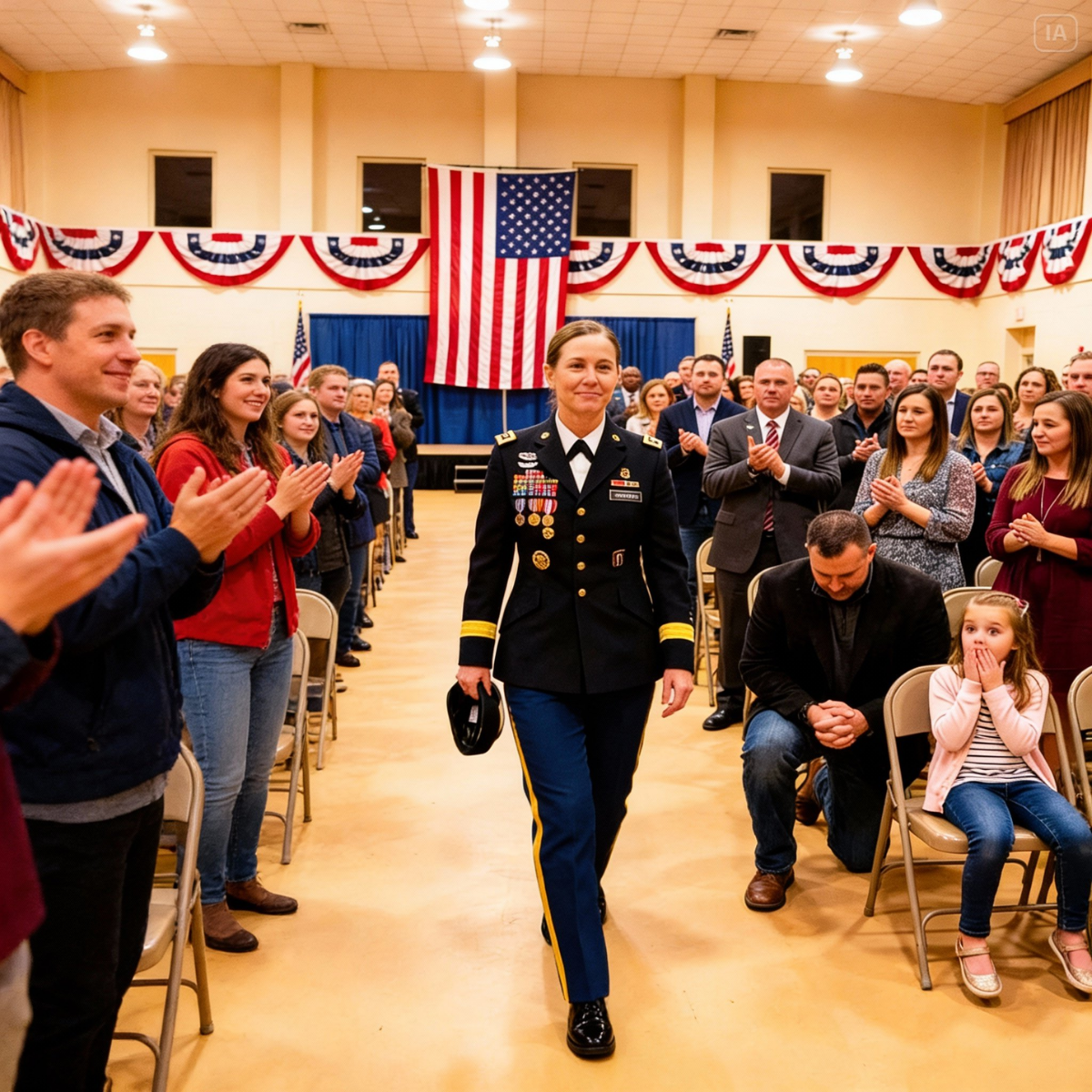
A Silent Shadow in the Heart of Chicago Shattered Every Law of Physics and Military Logic to Save a Life No One Knew Was Lost!
My family belittled my military service and said I wasn’t “real family” while Grandpa was fighting for his life—then one phone call revealed the truth about me and flipped their world upside down.
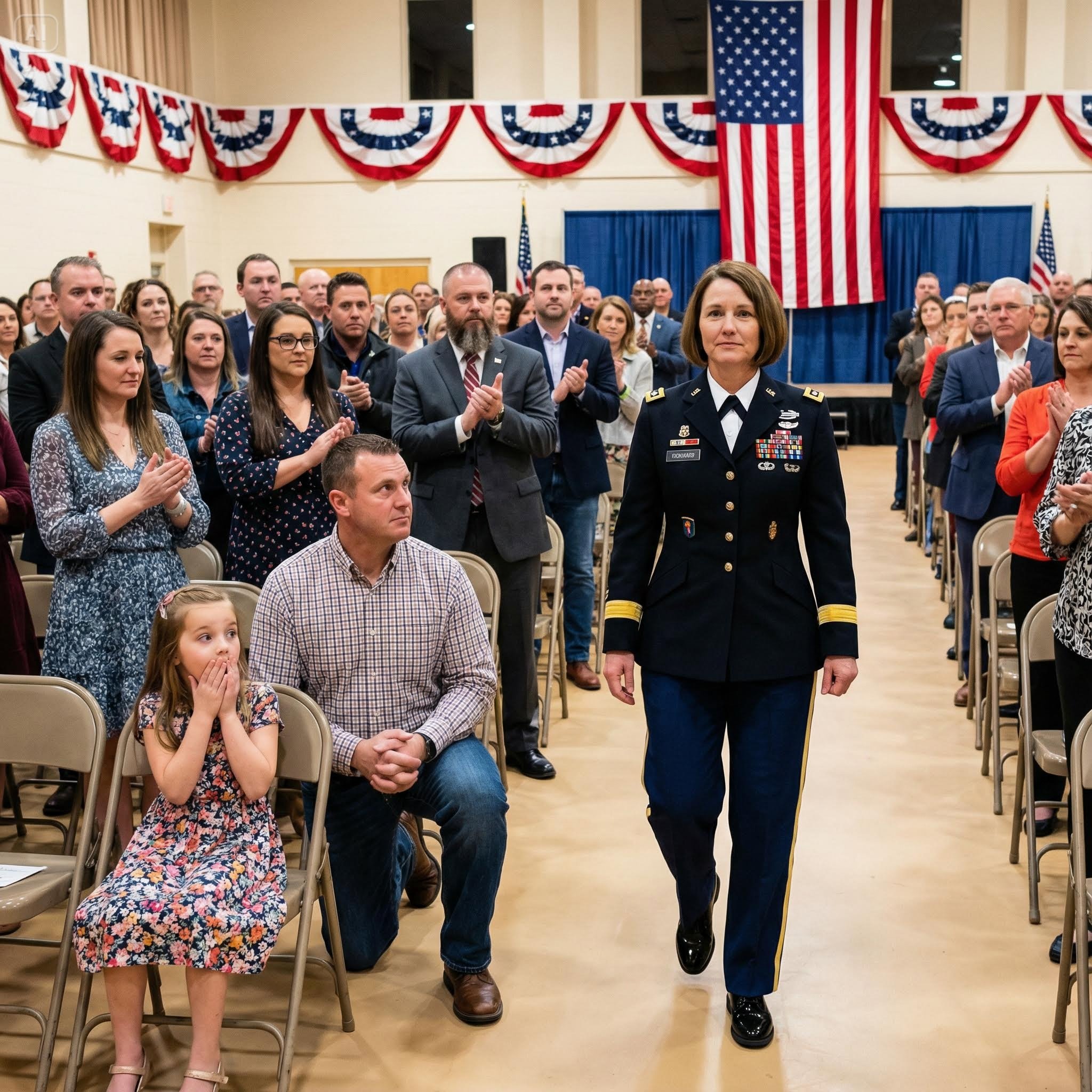
PART 1: THE ACCIDENTAL CONFRONTATION
The air in the Chicago Federal Armory didn’t smell like the city outside. It didn’t smell like deep-dish pizza, lake water, or exhaust. It smelled like cold steel, Hoppe’s No. 9 solvent, and the heavy, suffocating silence of men and women who had seen too much. I sat in the far corner, tucked away from the transit of high-ranking officers and the clatter of logistics. To them, I was just Staff Sergeant Maya Reyes—a ghost in a digital camouflage uniform, a woman with grease on her knuckles and a heavy rifle across her lap.
The Barrett M82A1 is not just a weapon; it is a sixty-inch beast of recoil-operated destruction. It weighs thirty pounds of uncompromising engineering. As I stripped it down on my rubber mat, I felt the familiar weight of the world settling into its grooves. I moved with the surgical precision of a woman who knows that a single grain of sand in the wrong place is the difference between a life saved and a tragedy written in a classified report.
Most people in the building walked past me without a glance. In the military, snipers are loud at a distance but invisible up close. We are the “Wraiths.” We exist in the margins. But today, the rhythm of the room changed. The rhythmic click-clack of polished Oxford shoes stopped right in front of my mat.
“Carry on, soldier,” a voice boomed. It was General Thomas Kearns. The kind of man whose chest is a colorful map of every conflict the United States has fought in the last forty years. He was on his weekly inspection, his aide, Lieutenant Colonel Blake, hovering behind him like a nervous shadow.
I didn’t stop. I eased the bolt forward, feeling the spring settle. “Roger, sir,” I replied, my voice as flat as the horizon.
He would have kept walking. He should have kept walking. But then, a stray beam of fluorescent light caught a sliver of enamel on my blouse. It was a small, unassuming rectangle. A badge. Most people didn’t know what it meant. But Kearns was a man who lived for the details. He leaned in, his eyes narrowing as he read the inscription.
3,200-METER CONFIRMED.
The General blinked. Then he blinked again, as if the numbers might rearrange themselves into something more “reasonable.” Two miles.
“Soldier,” he said, his voice dropping an octave into a tone of pure skepticism. “That is not possible. Physics doesn’t allow for a shot at that distance. The curvature of the Earth alone makes that a fairy tale. Who authorized this badge? This is an insult to every ballistic scientist in the Pentagon.”
I set the bolt on a blue cloth. I didn’t get defensive. When you do what I do, you lose the need to prove yourself to anyone but the wind. “Sir, the engagement was recorded by mission command and verified by multiple observers. Documentation exists at a classification level above this facility.”
Blake was already tapping furiously at a tablet. His face went from professional curiosity to a pale, ghostly white. “Sir… her record. It’s… it’s not just Sniper School. She has reconnaissance certifications from tiers I didn’t know we used. Attachments to the 75th Ranger Regiment, and—” He stopped, his throat dry. “And entries redacted under Special Access Programs. Code name: Wraith.”
Kearns looked at me, then at the Barrett, then back at me. “Reyes, explain to me how anyone makes 3,200. I want the truth, not the manual.”
“Understanding, patience, and the environment, sir,” I said. “You aren’t just firing a bullet. You are launching a small aircraft and predicting where it will land four seconds after it leaves the barrel.”
“I don’t believe in ghosts, and I don’t believe in luck,” Kearns snapped, his face reddening. “I want to see it. I want to see if you’re a soldier or a liar.”
PART 2: THE KILLING FLIGHT
The tension didn’t stay in the armory. It followed us to a restricted range in the high deserts of the Southwest, a place where the heat shimmers off the ground like a fever dream. The targets were set at 1,200 meters—the maximum length of the bay. To Kearns, it looked like an impossible distance.
“You’ve been talking a big game, Sergeant,” Kearns said, standing over me as I lay in the dust. “If you miss this, I’ll personally strip that badge off your uniform for fraud. We don’t play dress-up in this man’s Army.”
I didn’t look at him. I was busy looking at the world. “Wind at muzzle is three knots, gusting to five,” I whispered. “Temperature is 94 degrees. Density altitude is high. The bullet will be ‘light.’ I’m adjusting for spin drift right, three-tenths mil. Holding a whisper of left for the quartering breeze.”
“Stop the chatter and pull the trigger!” Kearns barked.
“Sir, with all due respect,” I said, my voice cold enough to drop the desert temperature. “I don’t pull the trigger. I wait for the planet to align. If you can’t be silent, leave the range.”
The silence that followed was lethal. Blake looked like he was about to faint. No one talked to a two-star General like that. But Kearns, surprisingly, shut his mouth. He realized that for the next few seconds, I wasn’t his subordinate. I was the master of a domain he couldn’t even visualize.
I waited for the gap between my heartbeats. I felt the rotation of the Earth in the marrow of my bones.
Crack.
The rifle spoke, a thunderclap that shook the very air in our lungs. A heartbeat passed. Then another. Then a third.
“Impact. Center mass,” the spotter called out, his voice trembling.
Kearns didn’t say a word. He was looking through his glass. The hole was exactly where a silver dollar would have been. “At 1,200,” he said, his voice trembling slightly. “But you’re telling me you’ve done nearly triple that? In the field? Under fire?”
“I did it because I had to, sir,” I said, sitting up. “In the Hindu Kush. A group of American aid workers were being held. A conventional assault would have alerted the guards. They were going to execute them at dawn. I had one window. One shot. One chance to beat the wind.”
“You shot a man from two miles away?” Kearns asked, the skepticism finally replaced by a raw, haunting awe.
“I didn’t shoot a man, sir,” I said, looking at the distant mountains. “I intercepted destiny. I laid in my own sweat for six hours. I watched the target through a lens, calculating the rotation of the planet itself. When the leader raised his hand to give the order for the execution, the bullet was already halfway there. It traveled for 3.8 seconds. In those seconds, I prayed to a God I don’t know that my math was right.”
The General sat down on a crate, his bravado gone. He looked at my hands—small, steady, and covered in desert grit. He realized that the world wasn’t run by the people who made the most noise, but by the people who could stay still the longest.
PART 3: THE WEIGHT OF THE GHOST
Back in Chicago, weeks later, the armory was back to its usual chaos. But something had changed. The General didn’t do “inspections” anymore. He just visited.
He walked by my mat one last time. He didn’t stop to check the grease or the bolts. He just looked at the badge. “People think precision is about the finger on the trigger,” he said softly.
“It’s about everything that happens before it, sir,” I replied. “It’s about the hours of silence that no one sees.”
He nodded—a slow, respectful tilt of the head. “Carry on, Wraith. The world sleeps better knowing you’re awake.”
If you ever see someone sitting in the corner, doing the quiet work, the repetitive work—the work that seems boring—look closer. Exceptional capability often hides where attention doesn’t reach. The difference between the routine and the remarkable is the preparation you never saw. I didn’t chase the impossible. I just prepared for it until the impossible had no choice but to happen.