STREAMING NOW ON NETFLIX: ELIZABETH OLSEN AND JEREMY RENNER IN AN UNFORGETTABLE THRILLER
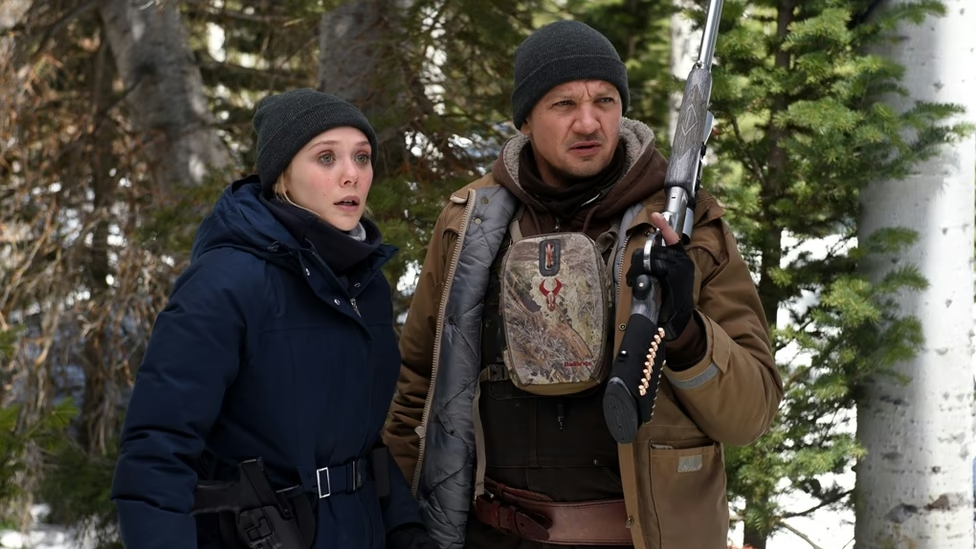
In a place where the weather kills faster than bullets. On streaming, Elizabeth Olsen and Jeremy Renner deliver masterclass performances as Jane and Cory, hunting down a ruthless killer in a frozen reservation. As they follow fresh tracks into the silent forest, the chilling discovery waiting in the snow is…
The cold does not negotiate. It does not care about jurisdiction, grief, or the thin line between hunter and hunted. In the vast, white emptiness of Wyoming’s Wind River Indian Reservation, winter is not merely a season—it is an active participant in every tragedy. That brutal truth sits at the heart of Wind River, the 2017 neo-Western thriller now streaming on Netflix and once again gripping audiences years after its theatrical release.
Jeremy Renner plays Cory Lambert, a U.S. Fish and Wildlife Service tracker whose intimate knowledge of the land borders on the supernatural. He can read the snow the way others read a newspaper. When he discovers the body of a young Native American woman miles from the nearest road, barefoot and frozen in a landscape that should have killed her long before she stopped running, the discovery is only the beginning. Elizabeth Olsen arrives as Jane Banner, a young FBI agent dispatched to a place that operates by rules she has never encountered. She is competent, determined, and completely out of her depth in an environment where the nearest backup is hours away and the cold itself can close an investigation faster than any suspect.
What follows is not a conventional procedural. Taylor Sheridan, who wrote and directed the film as his feature directorial debut, strips away the comforts of city-set crime stories. There are no conference rooms filled with whiteboards, no endless forensic labs, no procedural safety nets. There is only the reservation, the snow, the limited resources of tribal police, and two people forced to trust each other while navigating a case that keeps revealing how little the outside world understands—or cares—about what happens on this land.
The performances are the film’s quiet power. Renner, often associated with more explosive roles, delivers one of his most restrained and haunted turns. Cory carries a private grief that never needs to be announced; it lives in the way he moves through the landscape, the careful way he speaks to the people who live there, and the particular intensity he brings to tracking. Olsen matches him with a performance that balances professional resolve against growing vulnerability. Jane is not the seasoned veteran who has seen it all. She is sharp enough to know when she needs help and stubborn enough to keep pushing even when the environment, the bureaucracy, and the case itself seem determined to break her. Their chemistry is not romantic; it is something rarer in thrillers—a partnership forged in mutual respect under extreme pressure.
Sheridan’s direction and writing treat the setting as a character with its own agency. The cinematography turns the endless white expanses into something both beautiful and hostile. Snow muffles sound. Wind erases tracks. The cold invades lungs, equipment, and judgment. Viewers feel the isolation in their bones. This is not the picturesque winter of holiday films. This is the kind of cold that kills, the kind that turns a desperate flight into a death sentence, the kind that makes every decision about when to stop and when to keep moving a matter of survival.
The film also refuses to treat the reservation as mere backdrop. It engages, with a clear-eyed seriousness, the realities of jurisdictional gaps, limited resources, and the particular vulnerabilities of Native communities. The story of missing and murdered Indigenous women is not reduced to a plot device; it is the air the characters breathe. Sheridan has spoken about writing the film after learning how little data even exists on the subject—how the absence of statistics itself becomes a form of erasure. That awareness informs the tone. There is anger here, but it is controlled, channeled through character and consequence rather than speechifying.
Supporting performances deepen the world. Gil Birmingham, as a tribal police officer and Cory’s friend, brings a weary authority that feels lived-in. The late Graham Greene appears with the quiet gravity that defined so much of his work. The ensemble never feels like decoration; each person carries the weight of a place where justice is often delayed, incomplete, or delivered outside official channels.
What makes Wind River linger is its refusal of easy catharsis. The investigation moves forward through tracking, interrogation, and the slow accumulation of small, devastating details. Clues appear in footprints, in the condition of a body, in the stories people choose to tell or withhold. The tension is atmospheric as much as plot-driven. Viewers are placed alongside Cory and Jane as they move deeper into the silent forest and the equally silent gaps in the official record. The film trusts its audience to sit with discomfort, with the knowledge that some wounds do not close cleanly, and with the understanding that the cold is never just weather.
Critical response at the time of release was strong, and the film has only grown in stature. It holds a high score on Rotten Tomatoes, with particular praise for its writing, performances, and the way it uses landscape as emotional and narrative force. Many viewers who first encountered Sheridan through Yellowstone or Sicario have returned to Wind River and found it one of his purest statements—lean, precise, and unsentimental. Its recent surge on Netflix demonstrates that the story still lands with force. New audiences are discovering the film not as a period piece but as something urgent, still capable of unsettling them long after the credits roll.
The caption that draws people in is accurate in its essentials. The weather does kill faster than bullets in this world. Renner and Olsen do deliver performances that feel like masterclasses in restraint and intensity. And yes, as the two of them follow tracks into the forest, something waits in the snow that changes the shape of the investigation and the people pursuing it.
To say more would be to rob the film of its carefully measured revelations. Wind River works best when experienced with as little prior knowledge as possible beyond the premise. It is a thriller that earns its tension through character and environment rather than cheap shocks. It is a story about people trying to do the right thing in a place where the right thing is often unclear, incomplete, or dangerously personal. And it is a reminder that some landscapes refuse to be conquered—they simply wait for the next person who underestimates them.
For those who have not yet seen it, the film is currently available on Netflix. It runs just under two hours and asks for full attention. The cold on screen is the kind that stays with you. The performances are the kind that make you lean forward. And the final movement of the story—when the tracks lead to their inevitable destination—lands with a force that is both inevitable and deeply human.
In a streaming landscape crowded with louder, flashier crime stories, Wind River stands apart by doing less and meaning more. It trusts silence. It respects the land. And it understands that the most chilling discoveries are not always the ones that shock, but the ones that confirm what the characters, and the audience, already feared was true.
The snow is waiting. The tracks are fresh. Jane and Cory are already moving. The only question left is whether you will follow them into the silent forest.