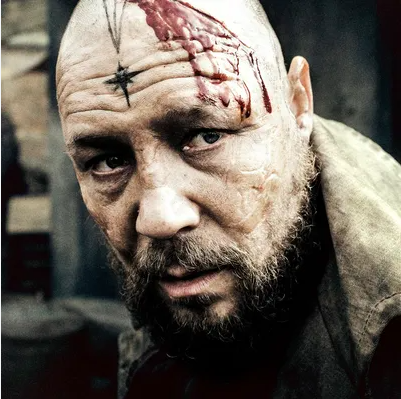
🔥 Stephen Graham is back — but this isn’t the world you’ve seen him in before!
Taboo Review: Stephen Graham Brings Dangerous Energy to Tom Hardy’s Brutal, Beautiful and Unforgettable Period Thriller
Few television dramas create a world as immediately oppressive as Taboo. From its opening moments, the series seems soaked in mud, smoke, blood and corruption. London is not presented as the polished capital familiar from traditional period dramas. It is a place of narrow streets, filthy docks, candlelit rooms and powerful men conducting ruthless business behind closed doors.
At the center of this darkness stands Tom Hardy as James Keziah Delaney, a man who returns to England after years in Africa carrying secrets that almost everyone would prefer to remain buried.
Yet among the extraordinary collection of characters surrounding Hardy, one performer brings a particularly memorable kind of electricity to the series: Stephen Graham.
Graham plays Atticus, a dangerous underworld figure who becomes one of Delaney’s most valuable allies. He may not dominate every episode, but when he appears, the atmosphere immediately changes.
It is precisely the sort of role Graham handles brilliantly.
Atticus can be threatening without shouting, amusing without becoming comic relief and strangely loyal while remaining somebody no sensible person would underestimate.
In a series already overflowing with menace, Stephen Graham somehow finds his own distinctive corner of the darkness.

Stephen Graham Enters a World Built for Him
Set in 1814, Taboo begins with James Delaney returning unexpectedly to London following the death of his father.
Most people believed Delaney was dead.
His arrival immediately creates problems.
He inherits a strategically valuable piece of territory called Nootka Sound, placing him between some extraordinarily powerful interests. The East India Company wants control. The British Crown has its own concerns. The ongoing conflict between Britain and the United States makes the land even more important.
Delaney refuses to cooperate.
That decision begins a dangerous battle involving espionage, murder, blackmail, political maneuvering and the criminal underworld.
This is where characters such as Atticus become essential.
Delaney cannot survive merely by confronting businessmen across polished desks. He needs people who understand another London — the London beneath official society.
Atticus belongs there.
Stephen Graham plays him like a man who has survived because he understands exactly how dangerous the world is.
He doesn’t need an introduction explaining why people should fear him.
His presence does the work.

Atticus Is More Than Delaney’s Muscle
It would have been easy to write Atticus as a straightforward criminal lieutenant.
Taboo gives Graham more interesting material.
Atticus possesses violence, certainly, but he also possesses intelligence. He understands loyalty, negotiation and the complicated rules operating among people who exist beyond respectable society.
Most importantly, his relationship with Delaney develops into something more compelling than a simple employer-and-employee arrangement.
Delaney needs Atticus because Atticus can accomplish things that respectable institutions cannot.
Atticus, meanwhile, recognizes that Delaney is playing a game considerably larger than an ordinary criminal scheme.
There is mutual usefulness between them.
Eventually, there is something resembling trust.
In the universe of Taboo, trust may be the rarest currency of all.
Graham communicates this evolution beautifully because he never turns Atticus sentimental. The character remains rough, unpredictable and dangerous.
His loyalty means something precisely because viewers understand what kind of man he is.

Graham Knows How to Make Supporting Characters Feel Essential
Stephen Graham has built a remarkable career partly because of his ability to transform characters who could have existed merely on the edges of stories into people audiences remember.
Atticus demonstrates that talent perfectly.
Tom Hardy understandably dominates Taboo. Delaney is the gravitational center around which almost every storyline moves.
But Graham does not attempt to compete with Hardy’s intensity.
Instead, he provides a different kind of energy.
Hardy’s Delaney is frequently silent, mysterious and almost mythological. He moves through London as though he has returned from somewhere beyond ordinary civilization.
Graham’s Atticus feels firmly rooted in the streets.
He understands people.
He understands crime.
He understands survival.
Put them together and the contrast becomes fascinating.
Delaney feels like a force arriving in London.
Atticus feels like somebody who already knows every dirty corner of it.
Tom Hardy Creates One of Television’s Strangest Antiheroes
Any discussion of Graham’s performance inevitably leads back to Hardy because their characters work so effectively together.
Hardy helped create Taboo alongside his father, Chips Hardy, and Steven Knight, and the project feels almost engineered around his particular screen presence.
James Delaney speaks slowly.
He watches people carefully.
He rarely explains himself.
His reputation often enters rooms before he does.
There is something almost supernatural surrounding him, although the series deliberately keeps many aspects of his experiences mysterious.
Hardy doesn’t play Delaney as a conventional heroic protagonist.
He is manipulative.
He can be brutal.
He carries trauma and secrets from his years abroad.
Yet the forces opposing him are frequently so corrupt that viewers find themselves drawn into his rebellion.
This moral ambiguity gives Taboo much of its power.
Nobody seems completely clean.
Everyone wants something.
Almost every relationship contains a transaction.
Atticus fits naturally into this landscape because he never pretends otherwise.
London Has Rarely Looked This Unpleasant — or This Beautiful
One of Taboo‘s greatest achievements is atmosphere.
The London of 1814 practically becomes another character.
Mud covers streets.
Smoke hangs over buildings.
The Thames feels threatening rather than picturesque.
Interiors are illuminated by candles and fireplaces, leaving enormous portions of rooms swallowed by shadow.
Even wealthy environments feel sinister.
The visual design rejects romantic nostalgia.
This is not a period drama where viewers are invited to admire beautiful costumes and dream about living in the past.
You can almost smell Taboo.
And that is not necessarily a compliment to nineteenth-century London.
The dirtiness is important because it reinforces the show’s central idea: beneath the respectable institutions of empire lies something ugly.
The East India Company conducts itself with polished authority, but its actions can be more ruthless than anything committed in the criminal streets.
That hypocrisy runs throughout the series.
The East India Company Becomes a Terrifying Opponent
Jonathan Pryce delivers another standout performance as Sir Stuart Strange, chairman of the East India Company.
Strange represents institutional power.
Unlike Atticus, he does not need to personally roam dangerous streets.
He has offices.
Employees.
Money.
Political influence.
Networks of information.
The Company can destroy people while maintaining the appearance of respectable commerce.
This creates an intriguing contrast.
Atticus is openly part of the criminal world, yet the supposedly civilized men opposing Delaney often prove equally capable of cruelty.
Taboo repeatedly asks viewers to reconsider where criminality truly begins.
Is the street gangster automatically more immoral than the powerful businessman who can order lives destroyed from behind a desk?
The show rarely provides simple answers.
It doesn’t need to.
The comparison speaks for itself.
Jessie Buckley Adds Another Unpredictable Force
The supporting cast is unusually strong.
Jessie Buckley appears as Lorna Bow, whose connection to Delaney’s father brings her directly into the inheritance conflict.
Like Atticus, she initially appears to occupy a relatively clear position in the story.
Then things become more complicated.
That is practically a rule in Taboo.
Nobody remains exactly what they first appear to be.
Lorna has her own intelligence, survival instincts and motivations. Her interactions with Delaney gradually become part of the increasingly strange collection of people orbiting his plan.
Oona Chaplin’s Zilpha Geary adds a much darker emotional element through her complicated relationship with Delaney, while Michael Kelly brings political intrigue from the American side of the conflict.
David Hayman, Edward Hogg, Jason Watkins and Franka Potente contribute to a supporting ensemble that makes the world feel densely populated rather than merely decorated around Hardy.
Still, Graham stands out because Atticus feels as though he could have existed before Delaney returned and would continue existing if Delaney disappeared.
That sense of independent life is invaluable.
Stephen Graham’s Greatest Weapon Is Unpredictability
Graham has a particular ability to make viewers uncertain about what his characters might do next.
Atticus benefits enormously from that quality.
One moment he can seem relaxed.
The next, there is danger behind his eyes.
The shift doesn’t require theatrical music or exaggerated dialogue.
Graham can create it through posture, rhythm and expression.
This makes Atticus perfect for Taboo, where almost every alliance is potentially temporary.
When Delaney begins assembling people around himself, audiences naturally question whether they can be trusted.
Atticus exists within that uncertainty.
But his growing loyalty eventually becomes one of the more satisfying relationships in the series.
Not because Atticus suddenly becomes a good man.
He doesn’t.
Rather, Taboo allows loyalty to exist among morally compromised people.
That is much more interesting.
The Violence Has Consequences
Taboo can be brutally violent.
But its strongest moments are rarely violent simply for spectacle.
Violence is another form of communication in this world.
People use it to establish power, enforce silence, punish betrayal or remove obstacles.
Atticus understands this language.
So does Delaney.
Yet the series also demonstrates that violence creates consequences.
Plans become more complicated.
Enemies retaliate.
Bodies attract attention.
Trust deteriorates.
The escalating conflict eventually makes London itself feel like a trap closing around Delaney and everyone associated with him.
By the later episodes, survival has become uncertain even for characters who initially seemed untouchable.
A Slow Burn That Demands Attention
Taboo is not effortless television.
That may be either its greatest strength or its biggest obstacle, depending on the viewer.
The narrative is dense.
Political interests overlap.
Characters sometimes speak indirectly.
Delaney intentionally withholds information.
The series expects audiences to remember names, relationships and motivations.
Anyone watching while scrolling continuously through a phone may find themselves confused.
But attention is rewarded.
Small details matter.
Apparently minor conversations can become significant later.
Characters introduced on the margins may suddenly become essential.
The mystery surrounding Delaney’s history unfolds gradually rather than through convenient exposition.
The result feels closer to an eight-hour Gothic novel than a conventional action thriller.
The Sound and Silence Matter
Another strength is the series’ use of sound.
Taboo understands the value of silence.
Rooms can become uncomfortable simply because nobody speaks.
Footsteps, breathing, water and distant noises contribute to tension.
Hardy’s distinctive delivery becomes part of this sonic landscape.
Delaney often speaks as though every word has been selected long before it leaves his mouth.
Graham operates differently.
Atticus feels faster and more connected to the rhythms of ordinary people.
Again, the contrast helps both actors.
They aren’t offering competing versions of masculinity or menace.
They represent different worlds that have temporarily found a common purpose.
Atticus Gives Delaney Something He Desperately Needs
For all Delaney’s intelligence and intimidating confidence, he cannot execute his plans alone.
This becomes increasingly apparent.
He needs information.
He needs transportation.
He needs people capable of operating outside the law.
He needs allies who understand that working with him may result in death.
Atticus becomes crucial because he understands those realities without needing them explained.
There is an almost professional respect between the two men.
Neither requires the other to be morally pure.
They simply need each other to remain useful — and, eventually, loyal.
That relationship provides Taboo with some of its most satisfying character dynamics.
The Finale Rewards the Slow Build
Without revealing the series’ major developments, the final stretch brings many of Delaney’s apparently disconnected preparations together.
Plans that once seemed incomprehensible acquire purpose.
Alliances are tested.
The various political and commercial forces pursuing Delaney begin closing in.
And the criminal network surrounding him becomes increasingly important.
This is where Stephen Graham’s presence pays off particularly well.
Atticus is no longer merely an interesting figure encountered along the way.
He has become part of Delaney’s machinery of survival.
The series’ gradual construction makes that transformation believable.
Nobody simply announces loyalty.
It has been earned through danger.
Why Stephen Graham Fits Taboo So Perfectly
Graham’s performance succeeds because Taboo requires actors who can suggest histories the script never fully explains.
Atticus looks lived-in.
You believe he knows these streets.
You believe he has enemies.
You believe he has survived situations that would have killed other people.
And you believe that beneath his roughness exists a personal code.
That final element matters enormously.
A conventional criminal character becomes memorable when audiences discover boundaries.
What won’t this person do?
Whom will he protect?
What does loyalty mean to him?
Graham makes those questions interesting without demanding the spotlight.
That is the mark of a superb supporting performance.
A Drama Unlike Almost Anything Else on British Television
Calling Taboo simply a crime drama undersells it.
It is simultaneously a revenge story, political thriller, Gothic mystery, historical drama and exploration of imperial corruption.
There are elements of family tragedy.
There are supernatural suggestions.
There are espionage plots.
There are criminal conspiracies.
And somehow, most of it belongs to the same grim universe.
The series occasionally risks becoming overwhelmed by its own ambition. Some mysteries remain deliberately opaque, and the relentless darkness can become exhausting.
But blandness is never the problem.
Taboo possesses an identity.
Within minutes, you know you are watching something different.
Final Verdict
Stephen Graham may not be the central star of Taboo, but Atticus is exactly the kind of supporting character that demonstrates why Graham has become one of Britain’s most compelling actors.
He enters Tom Hardy’s already intimidating world and immediately belongs there.
Atticus is violent but intelligent, dangerous but dependable, humorous without becoming ridiculous and loyal without becoming soft.
Graham never overplays him.
Instead, he creates the impression of an entire criminal history existing beyond what viewers see onscreen.
Tom Hardy remains the commanding center of the drama, delivering an intensely physical and deliberately mysterious performance as James Delaney. Jonathan Pryce is superbly unpleasant as the face of institutional power, while Jessie Buckley, Oona Chaplin, David Hayman and the rest of the ensemble deepen an already fascinating world.
But whenever Graham appears, Taboo gains something extra.
Energy.
Uncertainty.
Humanity.
Danger.
Nearly a decade after its original 2017 broadcast, the drama still feels unusually distinctive. Its combination of Gothic imagery, historical intrigue and psychological menace has aged far better than many conventional thrillers from the same period.
And Stephen Graham’s Atticus remains one of the reasons.
In a story where almost everybody is hiding something, Graham creates a man who never needs to pretend he is respectable.
Strangely, that may make him one of the easier people to trust.